 VIPSolutions
Please solve this problem step by stepIn the following figure, a Zener diode is used as a simple voltage regulator (Maintains a constant Vou). The Zener diode is designed to have a Zener voltage, Vz or Vzener, at 5.0V if you provide Iz >20mA. If Vin can vary from 10-15V and Risso varies from 125 to 2500, find the following a. The maximum value of R that will always maintain I; > 20mA. Use this value of R for the remaining questions. b. The min/max power dissipation in R c. The min/max power dissipation in the Zener diode. d. Someone accidently hooks up Vin backwards and provides -10V to -15V, what's the maximum power dissipation in R. I Lous —»> — R Va I J Veur™ Ve Ris
Question:
Please solve this problem step by step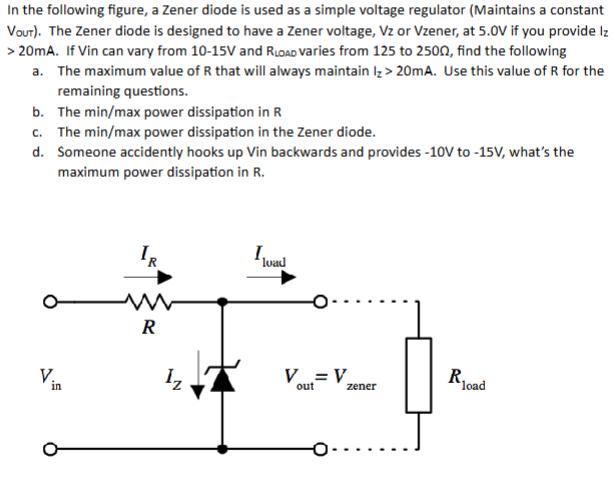 In the following figure, a Zener diode is used as a simple voltage regulator (Maintains a constant
Vou). The Zener diode is designed to have a Zener voltage, Vz or Vzener, at 5.0V if you provide Iz
>20mA. If Vin can vary from 10-15V and Risso varies from 125 to 2500, find the following
a. The maximum value of R that will always maintain I; > 20mA. Use this value of R for the
remaining questions.
b. The min/max power dissipation in R
c. The min/max power dissipation in the Zener diode.
d. Someone accidently hooks up Vin backwards and provides -10V to -15V, what's the
maximum power dissipation in R.
I Lous
—»> —
R
Va I J Veur™ Ve Ris
In the following figure, a Zener diode is used as a simple voltage regulator (Maintains a constant
Vou). The Zener diode is designed to have a Zener voltage, Vz or Vzener, at 5.0V if you provide Iz
>20mA. If Vin can vary from 10-15V and Risso varies from 125 to 2500, find the following
a. The maximum value of R that will always maintain I; > 20mA. Use this value of R for the
remaining questions.
b. The min/max power dissipation in R
c. The min/max power dissipation in the Zener diode.
d. Someone accidently hooks up Vin backwards and provides -10V to -15V, what's the
maximum power dissipation in R.
I Lous
—»> —
R
Va I J Veur™ Ve Ris
This is AI generated Response.
Asked by: Mohin
Created at: 2025-10-24 13:44:28
Asked by: Mohin
Created at: 2025-10-24 13:44:28
Final Answer:
Rendered
Raw Text
Did you like this answer?
Let's analyze and solve the problem step by step.
---
## **Given Data and Assumptions**
- The Zener diode maintains a constant Zener voltage \( V_Z \).
- \( V_{in} \) varies from 10V to 15V.
- \( R_{load} \) varies from 125Ω to 250Ω.
- The Zener voltage \( V_Z \) is 5.V.
- \( I_{Z} \) (Zener current) must be greater than 20mA for regulation.
- The maximum power dissipation in R: \( P_{R} = I_{R}^2 R \).
- The supply voltage \( V_{in} \) can go down to 10V and up to 15V.
- \( R_{load} \) can be from 125Ω to 250Ω.
---
## **a) Find the maximum value of R such that \( I_{Z} > 20\text{mA} \)**
### Step 1: Determine the Zener current \( I_Z \)
The total current \( I_R \) splits into the Zener diode current \( I_Z \) and load current \( I_{load} \):
\[
I_R = I_Z + I_{load}
\]
Where:
\[
I_{load} = \frac{V_{out}}{R_{load}} = \frac{V_Z}{R_{load}}
\]
### Step 2: Find \( R_{max} \) for the minimum \( I_Z \)
To maximize \( R \), minimize the Zener current \( I_Z \). The minimum \( I_Z \) should be 20mA.
At the **worst-case scenario** for maximum \( R \), the supply voltage is at its **minimum** (i.e., 10V), and the load resistance is at its maximum (250Ω), because:
- Lower \( V_{in} \) reduces \( I_R \).
- Larger \( R_{load} \) reduces \( I_{load} \).
### Step 3: Calculate \( I_{load} \)
\[
I_{load} = \frac{V_Z}{R_{load}} = \frac{5V}{250\Omega} = .02A = 20mA
\]
### Step 4: Find \( I_R \)
The supply voltage \( V_{in} = 10V \), and the Zener diode voltage \( V_Z = 5V \), so:
\[
V_{R} = V_{in} - V_Z = 10V - 5V = 5V
\]
Total resistor current:
\[
I_R = \frac{V_{R}}{R} = \frac{5V}{R}
\]
Since:
\[
I_R = I_Z + I_{load}
\]
and we want \( I_Z \geq 20mA \), with \( I_{load} = 20mA \):
\[
I_R = I_Z + I_{load} = 20mA + 20mA = 40mA
\]
### Step 5: Calculate \( R_{max} \)
\[
R_{max} = \frac{V_{R}}{I_R} = \frac{5V}{40mA} = \frac{5V}{.04A} = 125 \Omega
\]
---
## **Answer for part (a):**
\[
\boxed{
R_{max} = 125\, \Omega
}
\]
---
## **b) Find the minimum power dissipation in R**
Power dissipation:
\[
P_{R} = I_R^2 R
\]
Using the **maximum \( R \)** from part (a) (125Ω), and the **minimum \( V_{in} \)** (10V):
\[
I_R = \frac{V_{in} - V_Z}{R} = \frac{10V - 5V}{125\Omega} = \frac{5V}{125\Omega} = .04A = 40mA
\]
Power dissipated:
\[
P_{R} = (.04A)^2 \times 125\Omega = .0016A^2 \times 125\Omega = .2\, \text{W}
\]
---
## **Answer for part (b):**
\[
\boxed{
P_{R} = .2\, \text{W}
}
\]
---
## **c) Find the minimum and maximum power dissipation in the Zener diode**
### Step 1: Calculate \( I_Z \)
- For **minimum \( I_Z \)**: \( I_Z = 20\, \text{mA} \) (given).
- For **maximum \( I_Z \)**: when \( V_{in} \) is at maximum (15V) and load at minimum (125Ω):
\[
V_{R} = V_{in} - V_Z = 15V - 5V = 10V
\]
Current through resistor:
\[
I_R = \frac{10V}{R}
\]
At \( R = 125\, \Omega \):
\[
I_R = \frac{10V}{125\Omega} = .08A = 80mA
\]
The load current:
\[
I_{load} = \frac{V_Z}{R_{load}} = \frac{5V}{125\Omega} = 40mA
\]
Thus, the Zener current:
\[
I_Z = I_R - I_{load} = 80mA - 40mA = 40mA
\]
### Step 2: Power dissipation in Zener diode
\[
P_Z = V_Z \times I_Z
\]
- **Minimum \( P_Z \)** (at \( I_Z = 20\, \text{mA} \)):
\[
P_{Z, min} = 5V \times 20mA = 5V \times .02A = .1\, \text{W}
\]
- **Maximum \( P_Z \)** (at \( I_Z = 40\, \text{mA} \)):
\[
P_{Z, max} = 5V \times 40mA = .2\, \text{W}
\]
---
## **Final answers:**
| **Part** | **Result** |
|------------|--------------|
| **a)** | \( R_{max} = 125\, \Omega \) |
| **b)** | \( P_{R} = .2\, \text{W} \) |
| **c)** | \( P_{Z, min} = .1\, \text{W} \), \( P_{Z, max} = .2\, \text{W} \) |
Let me know if you'd like further clarification!
Question:
Please solve once again correctly and properly
This is AI generated Response.
Asked by: Mohin
Created at: 2025-10-24 13:45:26
Asked by: Mohin
Created at: 2025-10-24 13:45:26
Final Answer:
Rendered
Raw Text
Did you like this answer?
## Solution to the Voltage Regulator Problem
### **Given Data**
- Zener voltage, \( V_Z = 5.0\, V \)
- Input voltage range, \( V_{in} = 10\, V \) to \( 15\, V \)
- Load resistance range, \( R_{load} = 125\, \Omega \) to \( 2500\, \Omega \)
- Minimum Zener current, \( I_Z > 20\, mA \)
---
## **a) Maximum Value of R to Maintain \( I_Z > 20\, mA \)**
### Step 1: Calculate Load Current \( I_{load} \)
\[
I_{load} = \frac{V_Z}{R_{load}}
\]
#### For Maximum Load Resistance \( R_{load} = 2500\, \Omega \):
\[
I_{load} = \frac{5\, V}{2500\, \Omega} = 0.002\, A = 2\, mA
\]
### Step 2: Total Current \( I_R \)
\[
I_R = I_Z + I_{load}
\]
To ensure \( I_Z \geq 20\, mA \):
\[
I_R = 20\, mA + 2\, mA = 22\, mA = 0.022\, A
\]
### Step 3: Calculate Maximum Resistance \( R_{max} \)
Using the minimum input voltage \( V_{in} = 10\, V \):
\[
V_R = V_{in} - V_Z = 10\, V - 5\, V = 5\, V
\]
Thus,
\[
R_{max} = \frac{V_R}{I_R} = \frac{5\, V}{0.022\, A} \approx 227.27\, \Omega
\]
### **Final Answer for Part (a)**
\[
\boxed{R_{max} \approx 227.27\, \Omega}
\]
---
## **b) Minimum and Maximum Power Dissipation in R**
### Power Dissipation Formula
\[
P_R = I_R^2 R
\]
### For Minimum Power Dissipation
Using \( R = 125\, \Omega \) and \( I_R = 0.022\, A \):
\[
P_{R, min} = (0.022\, A)^2 \times 125\, \Omega = 0.000484 \times 125 \approx 0.0605\, W
\]
### For Maximum Power Dissipation
Using \( R = 227.27\, \Omega \) and \( I_R = 0.022\, A \):
\[
P_{R, max} = (0.022\, A)^2 \times 227.27\, \Omega = 0.000484 \times 227.27 \approx 0.1105\, W
\]
### **Final Answers for Part (b)**
\[
\boxed{P_{R, min} \approx 0.0605\, W}, \quad \boxed{P_{R, max} \approx 0.1105\, W}
\]
---
## **c) Minimum and Maximum Power Dissipation in the Zener Diode**
### Step 1: Calculate Zener Current \( I_Z \)
- For **minimum \( I_Z = 20\, mA \)**:
\[
P_{Z, min} = V_Z \times I_Z = 5\, V \times 0.020\, A = 0.1\, W
\]
- For **maximum \( I_Z \)** when \( V_{in} = 15\, V \) and \( R_{load} = 125\, \Omega \):
#### Step 1a: Calculate \( I_{load} \)
\[
I_{load} = \frac{5\, V}{125\, \Omega} = 0.04\, A = 40\, mA
\]
#### Step 1b: Calculate Total Current \( I_R \)
\[
I_R = \frac{10\, V}{R} \text{ (use \( R = 125\, \Omega \))}
\]
\[
I_R = 0.08\, A = 80\, mA
\]
#### Step 1c: Calculate Zener Current \( I_Z \)
\[
I_Z = I_R - I_{load} = 80\, mA - 40\, mA = 40\, mA
\]
#### Step 1d: Calculate Power Dissipation in Zener Diode
\[
P_{Z, max} = V_Z \times I_Z = 5\, V \times 0.040\, A = 0.2\, W
\]
### **Final Answers for Part (c)**
\[
\boxed{P_{Z, min} = 0.1\, W}, \quad \boxed{P_{Z, max} = 0.2\, W}
\]
---
## **d) Maximum Power Dissipation in R with Reverse Voltage**
### Step 1: Calculate Total Current with Negative Input
If \( V_{in} = -10\, V \):
\[
V_R = V_{in} - V_Z = -10\, V - 5\, V = -15\, V
\]
### Step 2: Calculate Current \( I_R \)
Using \( R = 125\, \Omega \):
\[
I_R = \frac{-15\, V}{125\, \Omega} = -0.12\, A = 120\, mA
\]
### Step 3: Calculate Power Dissipation in R
\[
P_R = I_R^2 R = (0.12\, A)^2 \times 125\, \Omega = 0.0144 \times 125 = 1.8\, W
\]
### **Final Answer for Part (d)**
\[
\boxed{P_R \approx 1.8\, W}
\]
---
This concludes the step-by-step solution for all parts of the voltage regulator problem.
📢 Instructions:
- Ask anything relatd to above question only.
- For new Question goto :