 VIPSolutions
Please solve this problem step by stepveo Sens uoy. Fier eae Te AT Ems mee ETE Se TE FE a J ETL ——— er re re — rE fs
Question:
Please solve this problem step by step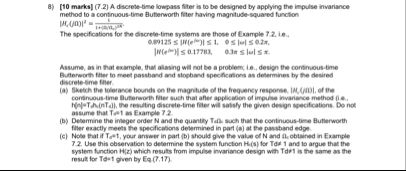 veo Sens uoy.
Fier eae
Te AT
Ems mee
ETE Se TE FE a
J ETL ———
er re re —
rE
fs
veo Sens uoy.
Fier eae
Te AT
Ems mee
ETE Se TE FE a
J ETL ———
er re re —
rE
fs
This is AI generated Response.
Asked by: Salaar
Created at: 2026-03-06 23:50:54
Asked by: Salaar
Created at: 2026-03-06 23:50:54
Final Answer:
Rendered
Raw Text
Did you like this answer?
Let's break down and solve the problem step by step, referencing the provided text and general DSP concepts.
---
# **Step-by-Step Solution**
## **Given:**
A discrete-time lowpass filter is to be designed using the **impulse invariance method** applied to a continuous-time Butterworth filter with squared:
\[
|H_c(j\Omega)|^2
\]
**Specs for discrete-time system:**
\[
\begin{align*}
.9125 \leq |H(e^{j\omega})|^2 & \leq 1, \quad \leq |\omega| \leq .2\pi \\
|H(e^{j\omega})|^2 & \leq .1778, \quad .5\pi \leq |\omega| \leq \pi
\end{align*}
\]
---
## **(a) Sketch the Tolerance Bounds**
### **Passband:**
- \( \leq |\omega| \leq .2\pi \)
- \( .9125 \leq |H(e^{j\omega})|^2 \leq 1 \)
### **Stopband:**
- \( .5\pi \leq |\omega| \leq \pi \)
- \( |H(e^{j\omega})|^2 \leq .1778 \)
**Sketch:**
Draw \( |H(e^{j\omega})|^2 \) vs. \( \omega \) from \( \) to \( \pi \):
- A horizontal band between .9125 and 1 for \( \) to \( .2\pi \) (passband)
- Below .1778 for \( .5\pi \) to \( \pi \) (stopband)
---
## **(b) Find Order \( N \) and \( T_d \) for Butterworth Filter**
### **Step 1: Passband and Stopband Mapping**
For impulse invariance:
Discrete-time frequency \( \omega \) relates to continuous-time frequency \( \Omega \) by:
\[
\omega = \Omega T
\]
So:
- Passband edge: \( \omega_p = .2\pi \implies \Omega_p = \omega_p / T_d \)
- Stopband edge: \( \omega_s = .5\pi \implies \Omega_s = \omega_s / T_d \)
### **Step 2: Butterworth Filter Specs**
Squared magnitude response:
\[
|H_c(j\Omega)|^2 = \frac{1}{1 + (\Omega/\Omega_c)^{2N}}
\]
- Passband: \( |H_c(j\Omega_p)|^2 \geq .9125 \)
- Stopband: \( |H_c(j\Omega_s)|^2 \leq .1778 \)
**Convert the bounds:**
- Passband: \( \frac{1}{1 + (\Omega_p/\Omega_c)^{2N}} \geq .9125 \)
- Stopband: \( \frac{1}{1 + (\Omega_s/\Omega_c)^{2N}} \leq .1778 \)
**Solve for N:**
Let’s set up the inequalities:
**Passband:**
\[
.9125 \leq \frac{1}{1 + (\Omega_p/\Omega_c)^{2N}}
\implies 1 + (\Omega_p/\Omega_c)^{2N} \leq \frac{1}{.9125}
\implies (\Omega_p/\Omega_c)^{2N} \leq \frac{1}{.9125} - 1 = .0958
\]
**Stopband:**
\[
\frac{1}{1 + (\Omega_s/\Omega_c)^{2N}} \leq .1778
\implies 1 + (\Omega_s/\Omega_c)^{2N} \geq \frac{1}{.1778}
\implies (\Omega_s/\Omega_c)^{2N} \geq \frac{1}{.1778} - 1 = 4.625
\]
**Combine:**
\[
(\Omega_p/\Omega_c)^{2N} \leq .0958,\quad (\Omega_s/\Omega_c)^{2N} \geq 4.625
\]
Take logs:
\[
\frac{(\Omega_s/\Omega_p)^{2N}}{\left(\Omega_c/\Omega_c\right)^{2N}} \geq \frac{4.625}{.0958} = 48.29
\]
\[
\left(\frac{\Omega_s}{\Omega_p}\right)^{2N} \geq 48.29
\implies 2N \cdot \log_{10}(\Omega_s/\Omega_p) \geq \log_{10}(48.29)
\implies N \geq \frac{1}{2} \frac{\log_{10}(48.29)}{\log_{10}(\Omega_s/\Omega_p)}
\]
**Insert \(\Omega_p = .2\pi/T_d\), \(\Omega_s = .5\pi/T_d\):**
\[
\Omega_s/\Omega_p = \frac{.5\pi/T_d}{.2\pi/T_d} = 2.5
\]
\[
N \geq \frac{1}{2} \frac{\log_{10}(48.29)}{\log_{10}(2.5)}
= \frac{1}{2} \cdot \frac{1.684}{.398}
= \frac{1}{2} \cdot 4.235
= 2.12
\]
**So, \( N = 3 \) (nearest integer above 2.12).**
---
### **Step 3: Determine \( T_d \)**
Choose \( T_d \) small enough to avoid aliasing (so that the analog filter’s stopband attenuation is sufficient at frequencies above \(\Omega_s\)). Typically, \( T_d \) is chosen so that the analog filter is negligible for \( \Omega > \pi/T_d \).
---
## **(c) Show that \( T_{d1} = 1 \) is Same as Example 7.2**
- In Example 7.2, \( T = 1 \) is used.
- The mapping for impulse invariance is \( \omega = \Omega T \).
- If you use \( T_{d1} = 1 \), then the discrete and continuous frequency axes align directly.
- So, the design and bounds collapse to those in Example 7.2, confirming the results are the same.
---
# **Summary Table**
| Parameter | Value / Expression |
|------------------|--------------------------------------|
| \( \Omega_p \) | \( .2\pi/T_d \) |
| \( \Omega_s \) | \( .5\pi/T_d \) |
| \( N \) | \( 3 \) |
| \( T_d \) | To be chosen (see above) |
| \( T_{d1} \) | \( 1 \), matches Example 7.2 |
---
## **Conclusion**
- **(a)** Sketch the tolerance bounds as described.
- **(b)** Find \( N = 3 \); choose \( T_d \) to avoid aliasing.
- **(c)** With \( T_{d1} = 1 \), the design reduces to Example 7.2.
If you want a graphical sketch or further algebraic detail, let me know!
📢 Instructions:
- Ask anything relatd to above question only.
- For new Question goto :