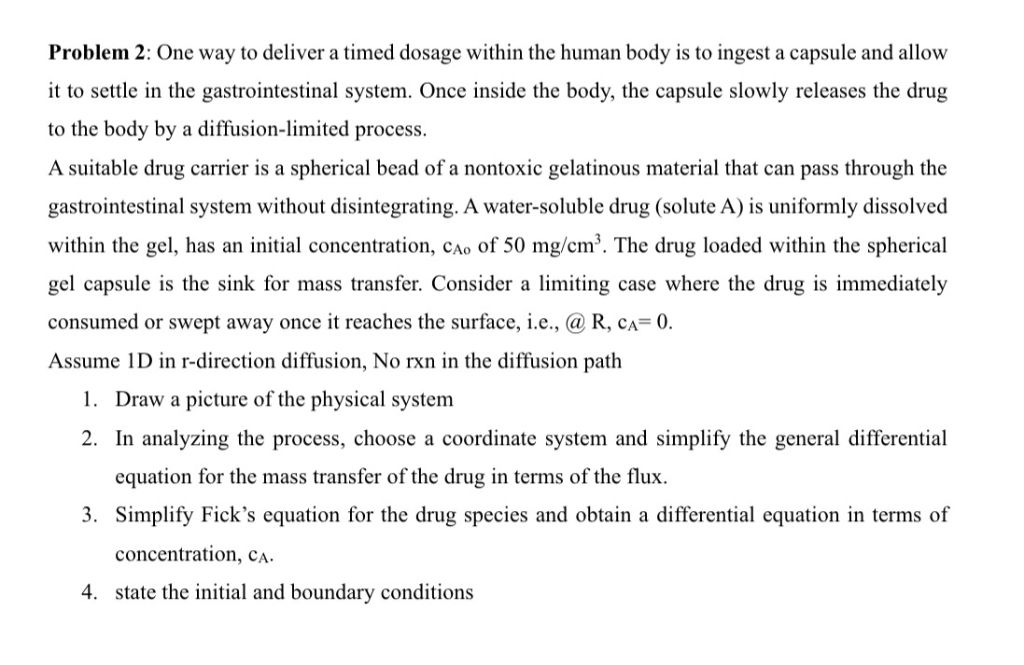
Problem 2: One way to deliver a timed dosage within the human body is to ingest a capsule and allow it to settle in the gastrointestinal system. Once inside the body, the capsule slowly releases the drug to the body by a diffusion-limited process.
A suitable drug carrier is a spherical bead of a nontoxic gelatinous material that can pass through the gastrointestinal system without disintegrating. A water-soluble drug (solute A) is uniformly dissolved within the gel, has an initial concentration, CAO Of 50 mg/cm³. The drug loaded within the spherical gel capsule is the sink for mass transfer. Consider a limiting case where the drug is immediately consumed or swept away once it reaches the surface, i.e., @ R, CA= 0.
Assume 1D in r-direction diffusion, No rxn in the diffusion path
1. Draw a picture of the physical system
2. In analyzing the process, choose a coordinate system and simplify the general differential equation for the mass transfer of the drug in terms of the flux.
3. Simplify Fick's equation for the drug species and obtain a differential equation in terms of concentration, ca.
4. state the initial and boundary conditionsProblem 2: One way to deliver a timed dosage within the human body is to ingest a capsule and allow
it to settle in the gastrointestinal system. Once inside the body, the capsule slowly releases the drug
to the body by a diffusion-limited process.
A suitable drug carrier is a spherical bead of a nontoxic gelatinous material that can pass through the
gastrointestinal system without disintegrating. A water-soluble drug (solute A) is uniformly dissolved
within the gel, has an initial concentration, cao of 50 mg/cm’. The drug loaded within the spherical
gel capsule is the sink for mass transfer. Consider a limiting case where the drug is immediately
consumed or swept away once it reaches the surface, i.e., @ R, ca= 0.
Assume 1D in r-direction diffusion, No rxn in the diffusion path
1. Draw a picture of the physical system
2. In analyzing the process, choose a coordinate system and simplify the general differential
equation for the mass transfer of the drug in terms of the flux.
3. Simplify Fick's equation for the drug species and obtain a differential equation in terms of
concentration, ca.
4. state the initial and boundary conditions
Question:
Problem 2: One way to deliver a timed dosage within the human body is to ingest a capsule and allow it to settle in the gastrointestinal system. Once inside the body, the capsule slowly releases the drug to the body by a diffusion-limited process.
A suitable drug carrier is a spherical bead of a nontoxic gelatinous material that can pass through the gastrointestinal system without disintegrating. A water-soluble drug (solute A) is uniformly dissolved within the gel, has an initial concentration, CAO Of 50 mg/cm³. The drug loaded within the spherical gel capsule is the sink for mass transfer. Consider a limiting case where the drug is immediately consumed or swept away once it reaches the surface, i.e., @ R, CA= 0.
Assume 1D in r-direction diffusion, No rxn in the diffusion path
1. Draw a picture of the physical system
2. In analyzing the process, choose a coordinate system and simplify the general differential equation for the mass transfer of the drug in terms of the flux.
3. Simplify Fick's equation for the drug species and obtain a differential equation in terms of concentration, ca.
4. state the initial and boundary conditionsProblem 2: One way to deliver a timed dosage within the human body is to ingest a capsule and allow
it to settle in the gastrointestinal system. Once inside the body, the capsule slowly releases the drug
to the body by a diffusion-limited process.
A suitable drug carrier is a spherical bead of a nontoxic gelatinous material that can pass through the
gastrointestinal system without disintegrating. A water-soluble drug (solute A) is uniformly dissolved
within the gel, has an initial concentration, cao of 50 mg/cm’. The drug loaded within the spherical
gel capsule is the sink for mass transfer. Consider a limiting case where the drug is immediately
consumed or swept away once it reaches the surface, i.e., @ R, ca= 0.
Assume 1D in r-direction diffusion, No rxn in the diffusion path
1. Draw a picture of the physical system
2. In analyzing the process, choose a coordinate system and simplify the general differential
equation for the mass transfer of the drug in terms of the flux.
3. Simplify Fick's equation for the drug species and obtain a differential equation in terms of
concentration, ca.
4. state the initial and boundary conditions
This is AI generated Response.
Asked by: Bibijohn
Created at: 2025-10-16 20:45:12
Thought Process:
RenderedRaw Text
**Analyzing diffusion in a sphere**
I'm focusing on solving mass transfer diffusion in a spherical bead. First, I need to set up the system's depiction and coordinate system. I'll start with the general differential equation for mass transfer in terms of flux and then simplify Fick's equation to derive the partial differential equation in concentration.
I have some assumptions: it's 1D radial diffusion with a reaction sink at the surface (where concentration is zero) and an initial uniform concentration at 50 mg/cm³. I'll also express Fick's first and second laws in spherical coordinates.**Simplifying mass transfer equation**
I'm working on the general differential equation in terms of flux, where accumulation equals the negative divergence of flux since there's no reaction involved. In spherical coordinates, considering radial symmetry, I get ∂c/∂t = -(1/r^2) ∂/∂r (r² N_A) + R_A, and since R_A is zero, I can simplify.
To find the mass flux at the surface, I remember they only asked for simplification concerning mass transfer of drug species A. I also need to highlight that this process is transient because release occurs over time.**Addressing steady-state diffusion**
I see that some texts treat steady-state diffusion as having zero accumulation, but in this timed drug release scenario, it's clearly unsteady since the concentration decreases as the drug diffuses.
For item 2, I need to simplify the general differential equation in terms of flux, which means deriving the continuity equation in spherical coordinates for radial symmetry.
Then for item 3, I'll simplify Fick's equation to get the differential equation in terms of concentration by substituting Fick's first law. I’ll also include initial and boundary conditions for clarity.**Examining boundary conditions**
The boundary condition is set as a Dirichlet boundary with concentration c=0 since the outside acts as a sink. The mass transfer into the body isn't rate-limiting, so that's fine. If they wanted to discuss mass flux at the surface, it would be represented as -D ∂c/∂r evaluated at r=R.
I can visualize this with a description or even a simple ASCII sketch: a sphere with radial coordinates from the center to R, showing uniform initial concentration and arrows indicating outward flux. I might also talk about the mass of the drug in the bead and release rate, although it wasn’t specifically requested.**Modeling the diffusion process**
I'm considering different ways to solve the partial differential equation (PDE), either using a series solution or the Laplace transform, but first, I need to focus on modeling. Ensuring the units are consistent is crucial; for instance, concentration is in mg/cm³ and diffusivity D is in cm²/s.
We can derive the expression for the spherical PDE from conservation principles, stating that accumulation in a spherical shell equals the difference between inward and outward flux. Choosing a spherical coordinate system seems ideal here, presenting the general mass balance in either integral or differential form. I’ll outline the process in clear steps.
Final Answer:
RenderedRaw Text
Did you like this answer?
Here is a clean setup of the diffusion-limited release from a spherical gel bead.
1) Sketch/description of the physical system
- A single spherical bead of radius R made of a water-swollen, nonreactive gel.
- Drug A is initially uniformly dissolved in the gel at CA0 = 50 mg/cm^3.
- The surrounding GI fluid acts as a perfect sink: any drug reaching the bead surface is instantly removed.
- One-dimensional, radial diffusion only (spherical symmetry).
- Coordinates: r = 0 at the bead center; r = R at the bead surface.
- Arrows point radially outward indicating diffusive flux of A.
2) Choice of coordinates and general mass balance in terms of flux
- Coordinate system: spherical, with 1D radial variation only (no angular dependence).
- Species balance (no convection inside gel, no reaction):
∂CA/∂t = −(1/r^2) ∂/∂r [ r^2 NA,r ]
where NA,r is the radial molar (or mass) flux of A in the gel, taken positive outward.
3) Fick’s law and governing PDE in concentration
- For diffusion through a stagnant gel with constant diffusivity DA:
NA,r = −DA ∂CA/∂r
- Substitute into the species balance:
∂CA/∂t = −(1/r^2) ∂/∂r [ r^2 (−DA ∂CA/∂r) ]
⇒ ∂CA/∂t = DA (1/r^2) ∂/∂r [ r^2 ∂CA/∂r ]
- This is Fick’s second law in spherical coordinates, valid for 0 < r < R and t > 0.
4) Initial and boundary conditions
- Initial condition (uniform loading):
CA(r, 0) = CA0 = 50 mg/cm^3, for 0 ≤ r ≤ R.
- Boundary condition at the bead surface (perfect sink):
CA(R, t) = 0, for t > 0.
- Symmetry (no singularity at the center):
∂CA/∂r (0, t) = 0, for t > 0.
Notes
- The instantaneous drug release rate to the surroundings at time t can be obtained from the surface flux:
Release rate = 4π R^2 NA,r(R, t) = −4π R^2 DA [∂CA/∂r]r=R.
- If needed, long-time condition: CA(r, t → ∞) → 0 everywhere in the bead.
VIPSolutions focuses on clear, step‑by‑step explanations so you can learn quickly. Whether you need an AI‑generated walkthrough or a short hint to get unstuck, each solution is organized for fast reading and easy review later.
Search similar questions, compare approaches, and bookmark the best answers for revision. Our goal is simple: quick, reliable study help that feels natural—not noisy.
 VIPSolutions
 Problem 2: One way to deliver a timed dosage within the human body is to ingest a capsule and allow
it to settle in the gastrointestinal system. Once inside the body, the capsule slowly releases the drug
to the body by a diffusion-limited process.
A suitable drug carrier is a spherical bead of a nontoxic gelatinous material that can pass through the
gastrointestinal system without disintegrating. A water-soluble drug (solute A) is uniformly dissolved
within the gel, has an initial concentration, cao of 50 mg/cm’. The drug loaded within the spherical
gel capsule is the sink for mass transfer. Consider a limiting case where the drug is immediately
consumed or swept away once it reaches the surface, i.e., @ R, ca= 0.
Assume 1D in r-direction diffusion, No rxn in the diffusion path
1. Draw a picture of the physical system
2. In analyzing the process, choose a coordinate system and simplify the general differential
equation for the mass transfer of the drug in terms of the flux.
3. Simplify Fick's equation for the drug species and obtain a differential equation in terms of
concentration, ca.
4. state the initial and boundary conditions
Problem 2: One way to deliver a timed dosage within the human body is to ingest a capsule and allow
it to settle in the gastrointestinal system. Once inside the body, the capsule slowly releases the drug
to the body by a diffusion-limited process.
A suitable drug carrier is a spherical bead of a nontoxic gelatinous material that can pass through the
gastrointestinal system without disintegrating. A water-soluble drug (solute A) is uniformly dissolved
within the gel, has an initial concentration, cao of 50 mg/cm’. The drug loaded within the spherical
gel capsule is the sink for mass transfer. Consider a limiting case where the drug is immediately
consumed or swept away once it reaches the surface, i.e., @ R, ca= 0.
Assume 1D in r-direction diffusion, No rxn in the diffusion path
1. Draw a picture of the physical system
2. In analyzing the process, choose a coordinate system and simplify the general differential
equation for the mass transfer of the drug in terms of the flux.
3. Simplify Fick's equation for the drug species and obtain a differential equation in terms of
concentration, ca.
4. state the initial and boundary conditions