This is AI generated Response.
Asked by: Nadeem
Created at: 2026-01-19 15:58:19
Final Answer:
RenderedRaw Text
Did you like this answer?
# Solution: Stats and Probability – Interpreting Posterior Probability for a Rare Disease
## **Step 1: Understanding the Problem**
The question relates to interpreting the **posterior probability** that an individual actually has a rare disease, given a positive result from a diagnostic test. The test has known **sensitivity** (true positive rate) and **specificity** (true negative rate), but the disease is rare (very low base rate or prevalence in the population).
---
## **Step 2: Key Concepts**
- **Sensitivity:** Probability that the test is positive given the person has the disease, i.e., \( P(\text{Test} + | \text{Disease}) \).
- **Specificity:** Probability that the test is negative given the person does not have the disease, i.e., \( P(\text{Test} - | \text{No Disease}) \).
- **Base Rate (Prevalence):** Probability that a randomly selected person from the population has the disease, i.e., \( P(\text{Disease}) \).
- **Posterior Probability (Positive Predictive Value):** Probability that a person has the disease given a positive test result, i.e., \( P(\text{Disease} | \text{Test} +) \).
---
## **Step 3: Applying Bayes' Theorem**
Bayes' theorem gives:
\[
P(\text{Disease} | \text{Test} +) = \frac{P(\text{Test} + | \text{Disease}) \cdot P(\text{Disease})}{P(\text{Test} +)}
\]
Where
\[
P(\text{Test} +) = P(\text{Test} + | \text{Disease}) \cdot P(\text{Disease}) + P(\text{Test} + | \text{No Disease}) \cdot P(\text{No Disease})
\]
- \( P(\text{Test} + | \text{No Disease}) = 1 - \text{Specificity} \) (false positive rate)
---
## **Step 4: Reasoning with a Very Low Base Rate**
When the base rate \( P(\text{Disease}) \) is very low:
- The numerator \( P(\text{Test} + | \text{Disease}) \cdot P(\text{Disease}) \) is very small.
- The denominator is dominated by \( P(\text{Test} + | \text{No Disease}) \cdot P(\text{No Disease}) \), since \( P(\text{No Disease}) \) is close to 1 and even a small false positive rate can create a large number of false positives.
**Interpretation:**
Even with a highly sensitive and specific test, a positive result in a population with very low prevalence will often be a false positive.
Thus, the posterior probability \( P(\text{Disease} | \text{Test} +) \) is much lower than intuition might suggest.
---
## **Step 5: Evaluating the Answer Choices**
- **a) It will be close to 100%.**
This is incorrect. A low base rate means most positives are false positives.
- **b) It will be close to 50%.**
This is not generally true for very rare diseases; the probability is usually much lower.
- **c) It will be less than 50%.**
This is correct for very low disease prevalence, even with a good test.
- **d) It depends on the specificity but not the sensitivity.**
Both sensitivity and specificity influence the result, so this is not accurate.
---
## **Step 6: Explanation and Final Answer**
**Explanation:**
For rare diseases, even a good diagnostic test will yield a low probability of actually having the disease after a positive test due to the overwhelming number of false positives from the much larger non-diseased population. Both specificity and sensitivity matter, but the rarity of the disease dominates the calculation.
---
## **Final Answer**
**The most accurate statement is:**
> **c) It will be less than 50%.**
**Summary:**
The posterior probability of disease given a positive test result is typically less than 50% when the disease is very rare, even with a highly accurate test, because false positives outnumber true positives in such scenarios.
Question:
give answwer
This is AI generated Response.
Asked by: Nadeem
Created at: 2026-01-19 15:58:59
Final Answer:
RenderedRaw Text
Did you like this answer?
# Solution: Stats and Probability – Interpreting Posterior Probability for a Rare Disease
## **Step 1: Understanding the Problem**
The problem involves determining the posterior probability that an individual has a rare disease based on a positive result from a diagnostic test. This test is characterized by known **sensitivity** and **specificity**, while the disease itself has a very low prevalence in the population.
---
## **Step 2: Key Concepts**
- **Sensitivity**: The probability that the test correctly identifies a diseased individual, denoted as \( P(\text{Test} + | \text{Disease}) \).
- **Specificity**: The probability that the test correctly identifies a non-diseased individual, denoted as \( P(\text{Test} - | \text{No Disease}) \).
- **Base Rate (Prevalence)**: The probability that a randomly selected individual has the disease, denoted as \( P(\text{Disease}) \).
- **Posterior Probability (Positive Predictive Value)**: The probability that an individual has the disease given a positive test result, denoted as \( P(\text{Disease} | \text{Test} +) \).
---
## **Step 3: Applying Bayes' Theorem**
Bayes' theorem aids in calculating the posterior probability:
\[
P(\text{Disease} | \text{Test} +) = \frac{P(\text{Test} + | \text{Disease}) \cdot P(\text{Disease})}{P(\text{Test} +)}
\]
Where the total probability of a positive test result is calculated as:
\[
P(\text{Test} +) = P(\text{Test} + | \text{Disease}) \cdot P(\text{Disease}) + P(\text{Test} + | \text{No Disease}) \cdot P(\text{No Disease})
\]
In this formula:
- \( P(\text{Test} + | \text{No Disease}) = 1 - \text{Specificity} \) represents the false positive rate.
---
## **Step 4: Reasoning with a Very Low Base Rate**
In situations where the base rate \( P(\text{Disease}) \) is very low:
- The numerator \( P(\text{Test} + | \text{Disease}) \cdot P(\text{Disease}) \) becomes very small.
- Conversely, the denominator is largely influenced by \( P(\text{Test} + | \text{No Disease}) \cdot P(\text{No Disease}) \), which is significant since \( P(\text{No Disease}) \) is close to 1, leading to a considerable number of false positives.
**Interpretation:**
Despite a test's high sensitivity and specificity, the number of false positives in a population with very low disease prevalence can dominate results, leading to a much lower posterior probability than expected.
---
## **Step 5: Evaluating the Answer Choices**
- **a) It will be close to 100%.**
Incorrect. The low base rate leads to a high rate of false positives.
- **b) It will be close to 50%.**
Not generally true for rare diseases; the probability is generally much lower.
- **c) It will be less than 50%.**
Correct. For very low disease prevalence, this is typically true.
- **d) It depends on the specificity but not the sensitivity.**
Both sensitivity and specificity impact the result, rendering this statement inaccurate.
---
## **Step 6: Explanation and Final Answer**
**Explanation:**
The rarity of the disease means that even a positive test result often indicates a false positive, leading to a posterior probability that is significantly lower than might be intuitively expected. Both sensitivity and specificity play roles, but the low prevalence is the key factor.
---
## **Final Answer**
**The most accurate statement is:**
> **c) It will be less than 50%.**
**Summary:**
In the context of rare diseases, the posterior probability of having the disease following a positive test result is typically less than 50%, primarily due to the prevalence of false positives compared to true positives.
VIPSolutions focuses on clear, step‑by‑step explanations so you can learn quickly. Whether you need an AI‑generated walkthrough or a short hint to get unstuck, each solution is organized for fast reading and easy review later.
Search similar questions, compare approaches, and bookmark the best answers for revision. Our goal is simple: quick, reliable study help that feels natural—not noisy.
 VIPSolutions
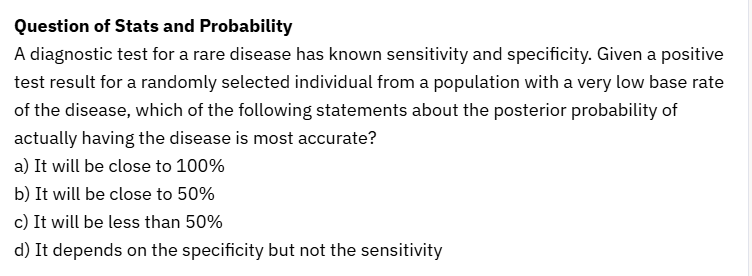 Question of Stats and Probability
A diagnostic test for a rare disease has known sensitivity and specificity. Given a positive
test result for a randomly selected individual from a population with a very low base rate
of the disease, which of the following statements about the posterior probability of
actually having the disease is most accurate?
2) Tt will be close to 100%
b) Tt will be close to 50%
©) Tt will be less than 50%
d) It depends on the specificity but not the sensitivity
Question of Stats and Probability
A diagnostic test for a rare disease has known sensitivity and specificity. Given a positive
test result for a randomly selected individual from a population with a very low base rate
of the disease, which of the following statements about the posterior probability of
actually having the disease is most accurate?
2) Tt will be close to 100%
b) Tt will be close to 50%
©) Tt will be less than 50%
d) It depends on the specificity but not the sensitivity