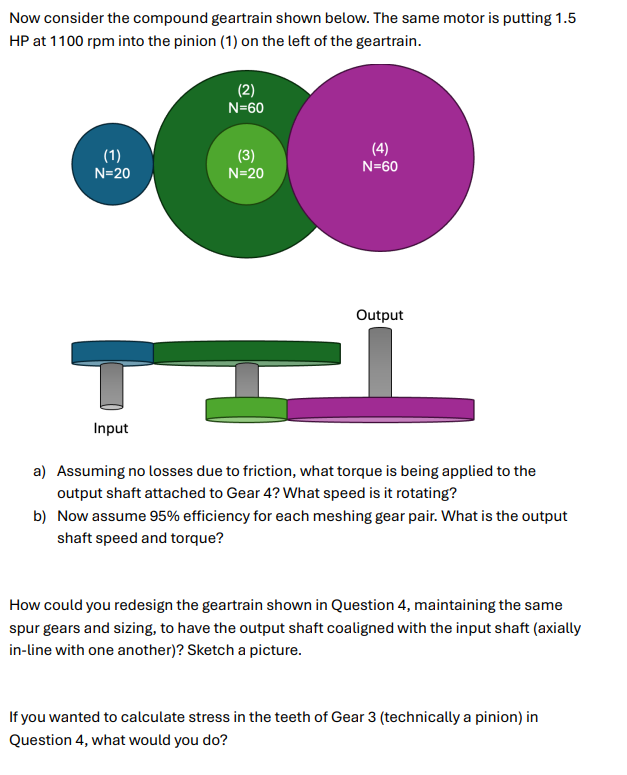
Provide answers of all partsNow consider the compound geartrain shown below. The same motor is putting 1.5
HP at 1100 rpm into the pinion (1) on the left of the geartrain.
@
N=60
; (4)
0) @ &
N=20 N=20 (=z
Output
Input mn ml I
a) Assuming no losses due to friction, what torque is being applied to the
output shaft attached to Gear 4? What speed is it rotating?
b) Now assume 95% efficiency for each meshing gear pair. What is the output
shaft speed and torque?
How could you redesign the geartrain shown in Question 4, maintaining the same
‘spur gears and sizing, to have the output shaft coaligned with the input shat (axially
in-line with one another)? Sketch a picture.
If you wanted to calculate stress in the teeth of Gear 3 (technically a pinion) in
Question 4, what would you do?
Question:
Provide answers of all partsNow consider the compound geartrain shown below. The same motor is putting 1.5
HP at 1100 rpm into the pinion (1) on the left of the geartrain.
@
N=60
; (4)
0) @ &
N=20 N=20 (=z
Output
Input mn ml I
a) Assuming no losses due to friction, what torque is being applied to the
output shaft attached to Gear 4? What speed is it rotating?
b) Now assume 95% efficiency for each meshing gear pair. What is the output
shaft speed and torque?
How could you redesign the geartrain shown in Question 4, maintaining the same
‘spur gears and sizing, to have the output shaft coaligned with the input shat (axially
in-line with one another)? Sketch a picture.
If you wanted to calculate stress in the teeth of Gear 3 (technically a pinion) in
Question 4, what would you do?
This is AI generated Response.
Asked by: Gurubindra Singh
Created at: 2025-07-12 09:03:05
Final Answer:
RenderedRaw Text
Did you like this answer?
Let's solve each part step by step:
---
### a) **Assuming no losses due to friction, what torque is being applied to the output shaft attached to Gear 4? What speed is it rotating?**
#### **Step 1: Gear Ratios and Speed Calculation**
- **Gear 1 (N1):** 20 teeth, input at 1100 rpm
- **Gear 2 (N2):** 60 teeth
- **Gear 3 (N3):** 20 teeth (mounted on same shaft as Gear 2, thus same speed as Gear 2)
- **Gear 4 (N4):** 60 teeth
**Gear train:**
- Gear 1 drives Gear 2
- Gear 3 (on same shaft as 2) drives Gear 4
**First stage (1 drives 2):**
\[
\text{Speed of Gear 2} = \text{Speed of Gear 1} \times \frac{N_1}{N_2}
\]
\[
= 1100 \times \frac{20}{60} = 1100 \times 0.333 = 366.7 \text{ rpm}
\]
**Second stage (3 drives 4):**
\[
\text{Speed of Gear 4} = \text{Speed of Gear 3} \times \frac{N_3}{N_4}
\]
But Gear 3 and 2 are on same shaft, so speed of Gear 3 = speed of Gear 2 = 366.7 rpm
\[
\text{Speed of Gear 4} = 366.7 \times \frac{20}{60} = 366.7 \times 0.333 = 122.2 \text{ rpm}
\]
---
#### **Step 2: Torque Calculation**
**Input Power:** 1.5 HP = 1.5 × 746 = **1119 W**
\[
\text{Power} = \text{Torque} \times \text{Angular Velocity}
\]
\[
T = \frac{P}{\omega}
\]
where \(\omega\) in rad/s: \(\omega = 2\pi \times n / 60\)
**At Output Shaft (Gear 4):**
\[
n_{4} = 122.2 \text{ rpm}
\]
\[
\omega_{4} = 2\pi \times 122.2 / 60 = 12.8 \text{ rad/s}
\]
\[
T_{4} = \frac{P}{\omega_{4}} = \frac{1119}{12.8} = 87.4 \text{ Nm}
\]
---
**Summary for (a):**
- **Output Shaft Speed (Gear 4):** **122.2 rpm**
- **Output Torque:** **87.4 Nm**
---
### b) **Assume 95% efficiency for each meshing gear pair. What is the output shaft speed and torque?**
There are **2 gear meshes**, each at 95% efficiency.
**Overall efficiency:**
\[
\eta_{total} = 0.95 \times 0.95 = 0.9025
\]
**Output Power:**
\[
P_{out} = P_{in} \times \eta_{total} = 1119 \times 0.9025 = 1010 \text{ W}
\]
**Speed of output shaft remains the same:** **122.2 rpm**
**Output Torque:**
\[
T_{4, \,eff} = \frac{P_{out}}{\omega_{4}} = \frac{1010}{12.8} = 78.9 \text{ Nm}
\]
---
**Summary for (b):**
- **Output Shaft Speed:** **122.2 rpm**
- **Output Shaft Torque:** **78.9 Nm**
---
### c) **Redesign for Coaxial Shafts (Input and Output in Line)**
To have input and output shafts **coaxial**, you can use an **idler gear** or a **planetary gear system**.
Since you’re to use the same gears, you can use an **idler gear train** (see sketch below):
**Sketch:**
```
Input Shaft (Gear 1) --- Gear 2 (on intermediate shaft) --- Idler Gear(s) --- Output Shaft (Gear 4)
```
- Place Gear 4 in line with Gear 1 (input and output on the same axis).
- Use an idler gear between Gears 3 and 4 to transmit motion while aligning the shafts.
**[You can draw a straight line with gears 1 and 4 on the ends, and 2, 3, and any idlers in the middle.]**
---
### d) **Calculating Stress in the Teeth of Gear 3**
To calculate the **tooth stress** (bending stress) in Gear 3 (the pinion):
1. **Calculate the tangential force on Gear 3:**
\[
F_t = \frac{2T}{d}
\]
where \(T\) is the torque on Gear 3 and \(d\) is the pitch diameter.
2. **Use the Lewis Bending Equation:**
\[
\sigma = \frac{F_t}{b m Y}
\]
where:
- \(F_t\): Tangential load
- \(b\): Face width
- \(m\): Module (pitch diameter/number of teeth)
- \(Y\): Lewis form factor (depends on number of teeth and gear shape)
3. **Plug in values for Gear 3's torque, module, and geometry.**
---
## **Summary Table**
| Part | Output Speed (rpm) | Output Torque (Nm) |
|------|--------------------|--------------------|
| (a) | 122.2 | 87.4 |
| (b) | 122.2 | 78.9 |
---
Let me know if you need a sketch or further explanation on any step!
VIPSolutions focuses on clear, step‑by‑step explanations so you can learn quickly. Whether you need an AI‑generated walkthrough or a short hint to get unstuck, each solution is organized for fast reading and easy review later.
Search similar questions, compare approaches, and bookmark the best answers for revision. Our goal is simple: quick, reliable study help that feels natural—not noisy.
 VIPSolutions
 Now consider the compound geartrain shown below. The same motor is putting 1.5
HP at 1100 rpm into the pinion (1) on the left of the geartrain.
@
N=60
; (4)
0) @ &
N=20 N=20 (=z
Output
Input mn ml I
a) Assuming no losses due to friction, what torque is being applied to the
output shaft attached to Gear 4? What speed is it rotating?
b) Now assume 95% efficiency for each meshing gear pair. What is the output
shaft speed and torque?
How could you redesign the geartrain shown in Question 4, maintaining the same
‘spur gears and sizing, to have the output shaft coaligned with the input shat (axially
in-line with one another)? Sketch a picture.
If you wanted to calculate stress in the teeth of Gear 3 (technically a pinion) in
Question 4, what would you do?
Now consider the compound geartrain shown below. The same motor is putting 1.5
HP at 1100 rpm into the pinion (1) on the left of the geartrain.
@
N=60
; (4)
0) @ &
N=20 N=20 (=z
Output
Input mn ml I
a) Assuming no losses due to friction, what torque is being applied to the
output shaft attached to Gear 4? What speed is it rotating?
b) Now assume 95% efficiency for each meshing gear pair. What is the output
shaft speed and torque?
How could you redesign the geartrain shown in Question 4, maintaining the same
‘spur gears and sizing, to have the output shaft coaligned with the input shat (axially
in-line with one another)? Sketch a picture.
If you wanted to calculate stress in the teeth of Gear 3 (technically a pinion) in
Question 4, what would you do?