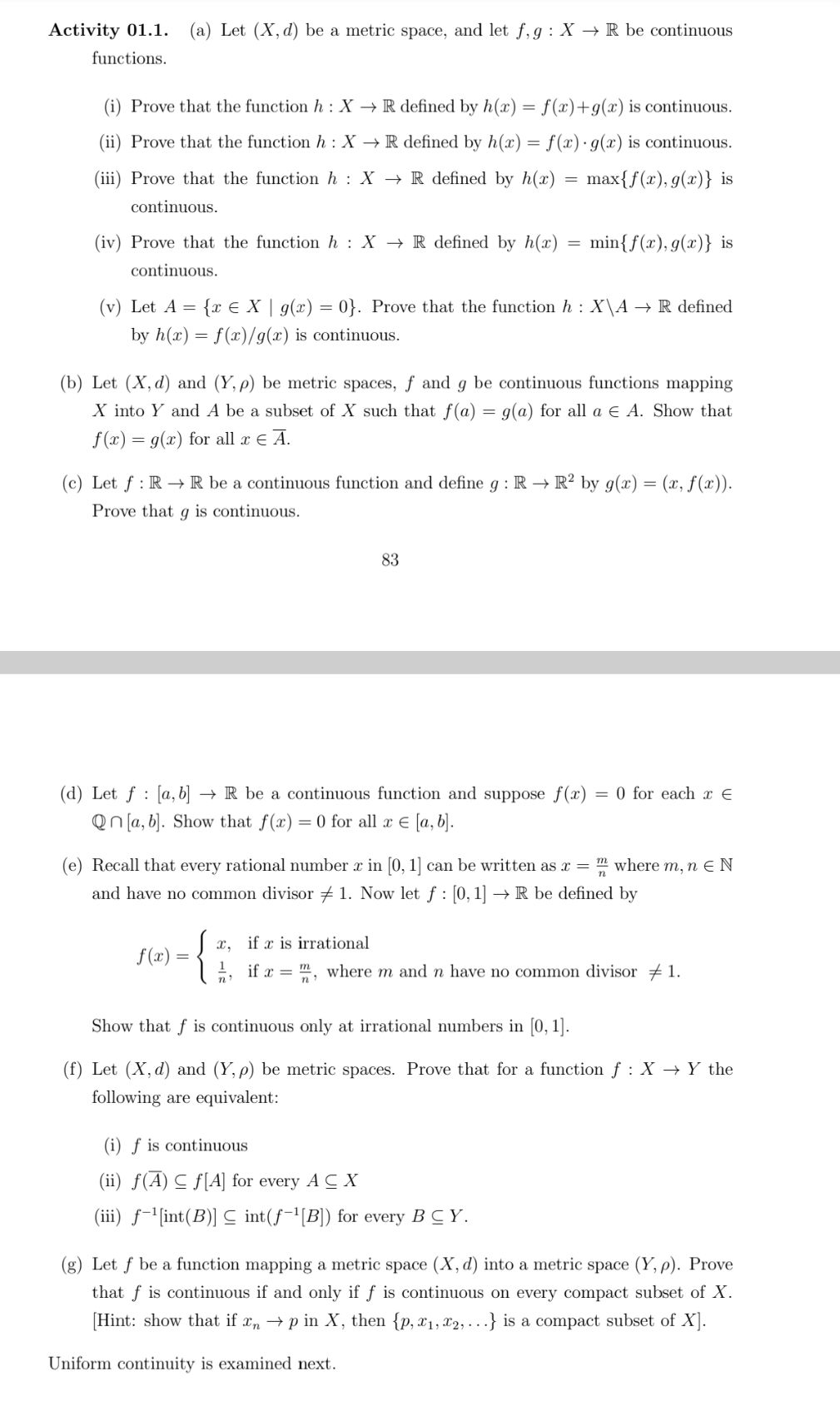
Provide complete calculated solution in proper structural way from start to end and write the solution in the format of, 1st- complete solution, 2nd - explanation of each and every part, 3rd - final conclusion statementActivity 01.1. (a) Let (X,d) be a metric space, and let f,g : X — R be continuous
functions.
(i) Prove that the function i: X — R defined by h(z) = f(z)+g(x) is continuous.
(ii) Prove that the function h : X — R defined by h(x) = f(z) g(x) is continuous.
(iii) Prove that the function h : X — R defined by h(x) = max{f(z),g(z)} is
continuous.
(iv) Prove that the function h : X — R defined by h(x) = min{f(z),g(z)} is
continuous.
(v) Let A= {xz € X | g(x) = 0}. Prove that the function h : X\A — R defined
by h(z) = f(x)/g(z) is continuous.
(b) Let (X,d) and (Y,p) be metric spaces, f and g be continuous functions mapping
X into Y and A be a subset of X such that f(a) = g(a) for all a € A. Show that
f(z) =g(z) for all z € A.
(c) Let f:R — R be a continuous function and define g : R — R? by g(r) = (x, f(z)).
Prove that g is continuous.
83
(d) Let f : [a,b] — R be a continuous function and suppose f(z) = 0 for each = €
Qn [a,b]. Show that f(x) = 0 for all z € [a,b].
(e) Recall that every rational number z in [0, 1] can be written as x = 2 where m,n € N
and have no common divisor # 1. Now let f : [0,1] — R be defined by
x, if x is irrational
J@=01 4pm ivi
wo if = where m and n have no common divisor # 1.
Show that f is continuous only at irrational numbers in [0, 1].
(f) Let (X.d) and (Y,p) be metric spaces. Prove that for a function f : X — Y the
following are equivalent:
(i) f is continuous
(ii) f(A) C f[A] for every AC X
(iii) f~'[int(B)] C int(f~*[B]) for every BC Y.
(g) Let f be a function mapping a metric space (X, d) into a metric space (Y, p). Prove
that f is continuous if and only if f is continuous on every compact subset of X.
[Hint: show that if z,, — p in X, then {p,z,25,...} is a compact subset of X].
Uniform continuity is examined next.
Question:
Provide complete calculated solution in proper structural way from start to end and write the solution in the format of, 1st- complete solution, 2nd - explanation of each and every part, 3rd - final conclusion statementActivity 01.1. (a) Let (X,d) be a metric space, and let f,g : X — R be continuous
functions.
(i) Prove that the function i: X — R defined by h(z) = f(z)+g(x) is continuous.
(ii) Prove that the function h : X — R defined by h(x) = f(z) g(x) is continuous.
(iii) Prove that the function h : X — R defined by h(x) = max{f(z),g(z)} is
continuous.
(iv) Prove that the function h : X — R defined by h(x) = min{f(z),g(z)} is
continuous.
(v) Let A= {xz € X | g(x) = 0}. Prove that the function h : X\A — R defined
by h(z) = f(x)/g(z) is continuous.
(b) Let (X,d) and (Y,p) be metric spaces, f and g be continuous functions mapping
X into Y and A be a subset of X such that f(a) = g(a) for all a € A. Show that
f(z) =g(z) for all z € A.
(c) Let f:R — R be a continuous function and define g : R — R? by g(r) = (x, f(z)).
Prove that g is continuous.
83
(d) Let f : [a,b] — R be a continuous function and suppose f(z) = 0 for each = €
Qn [a,b]. Show that f(x) = 0 for all z € [a,b].
(e) Recall that every rational number z in [0, 1] can be written as x = 2 where m,n € N
and have no common divisor # 1. Now let f : [0,1] — R be defined by
x, if x is irrational
J@=01 4pm ivi
wo if = where m and n have no common divisor # 1.
Show that f is continuous only at irrational numbers in [0, 1].
(f) Let (X.d) and (Y,p) be metric spaces. Prove that for a function f : X — Y the
following are equivalent:
(i) f is continuous
(ii) f(A) C f[A] for every AC X
(iii) f~'[int(B)] C int(f~*[B]) for every BC Y.
(g) Let f be a function mapping a metric space (X, d) into a metric space (Y, p). Prove
that f is continuous if and only if f is continuous on every compact subset of X.
[Hint: show that if z,, — p in X, then {p,z,25,...} is a compact subset of X].
Uniform continuity is examined next.
This is AI generated Response.
Asked by: Dynamic
Created at: 2025-09-12 15:52:06
Final Answer:
RenderedRaw Text
Did you like this answer?
Let's solve **Activity 01.1(a)** as requested.
---
## 1. Complete Solution
Let \((X, d)\) be a metric space, and let \(f,g : X \to \mathbb{R}\) be continuous functions.
### (i) **Sum of Continuous Functions**
**Claim:** The function \(h(x) = f(x) + g(x)\) is continuous.
**Proof:**
Let \(x_0 \in X\) and \(\epsilon > 0\). Since \(f\) and \(g\) are continuous at \(x_0\), \(\exists \delta_1, \delta_2 > 0\) such that for all \(x\), if \(d(x, x_0) < \delta_1\), then \(|f(x) - f(x_0)| < \epsilon/2\), and if \(d(x, x_0) < \delta_2\), then \(|g(x) - g(x_0)| < \epsilon/2\).
Let \(\delta = \min\{\delta_1, \delta_2\}\). Then if \(d(x, x_0) < \delta\):
\[
|h(x) - h(x_0)| = |f(x) + g(x) - f(x_0) - g(x_0)| \leq |f(x) - f(x_0)| + |g(x) - g(x_0)| < \epsilon/2 + \epsilon/2 = \epsilon.
\]
Thus, \(h\) is continuous.
---
### (ii) **Product of Continuous Functions**
**Claim:** The function \(h(x) = f(x) \cdot g(x)\) is continuous.
**Proof:**
Let \(x_0 \in X\). Since \(f\) and \(g\) are continuous at \(x_0\), choose \(\epsilon > 0\). We have:
\[
|h(x) - h(x_0)| = |f(x)g(x) - f(x_0)g(x_0)| = |f(x)g(x) - f(x)g(x_0) + f(x)g(x_0) - f(x_0)g(x_0)|
\]
\[
= |f(x)(g(x)-g(x_0)) + g(x_0)(f(x)-f(x_0))|
\]
\[
\leq |f(x)||g(x)-g(x_0)| + |g(x_0)||f(x)-f(x_0)|
\]
Since \(f\) is continuous at \(x_0\), there is a neighborhood where \(|f(x)|\) is bounded, say by \(M\). Choose \(\delta\) so that both \(|g(x)-g(x_0)| < \epsilon/(2M)\) and \(|f(x)-f(x_0)| < \epsilon/(2|g(x_0)|+1)\) when \(d(x, x_0)<\delta\). Then for such \(x\), the sum above is less than \(\epsilon\).
Thus, \(h\) is continuous.
---
### (iii) **Maximum of Continuous Functions**
**Claim:** The function \(h(x) = \max\{f(x), g(x)\}\) is continuous.
**Proof:**
Recall: \(\max\{a, b\} = \frac{a + b + |a-b|}{2}\).
Define \(h(x) = \frac{f(x) + g(x) + |f(x) - g(x)|}{2}\).
Since \(f\), \(g\), and \(f-g\) are continuous, and the absolute value function is continuous, so is \(|f(x)-g(x)|\). Sums, differences, and scalar multiples of continuous functions are continuous. Thus, \(h(x)\) is continuous.
---
### (iv) **Minimum of Continuous Functions**
**Claim:** The function \(h(x) = \min\{f(x), g(x)\}\) is continuous.
**Proof:**
Recall: \(\min\{a, b\} = \frac{a + b - |a-b|}{2}\).
Define \(h(x) = \frac{f(x) + g(x) - |f(x) - g(x)|}{2}\).
As above, all operations preserve continuity, so \(h(x)\) is continuous.
---
### (v) **Quotient of Continuous Functions**
Let \(A = \{x \in X \mid g(x) = 0\}\). Prove \(h(x) = \frac{f(x)}{g(x)}\) is continuous on \(X \setminus A\).
**Proof:**
On \(X \setminus A\), \(g(x) \neq 0\). Since \(g\) is continuous and never zero here, \(1/g(x)\) is continuous on \(X \setminus A\) (the reciprocal of a nonvanishing continuous function is continuous). The product of continuous functions is continuous, so \(f(x)/g(x)\) is continuous on \(X \setminus A\).
---
## 2. Explanation of Each Part
1. **Sum:** The sum of two continuous functions is continuous. This uses the triangle inequality and the definition of continuity.
2. **Product:** The product of continuous functions is continuous; the proof uses the algebraic property of the difference and bounds using continuity.
3. **Max:** The max function can be expressed as a combination of sum, difference, and absolute value, all of which preserve continuity.
4. **Min:** The min function is similarly reducible to operations preserving continuity.
5. **Quotient:** The quotient is continuous wherever the denominator does not vanish, since the reciprocal of a nonvanishing continuous function is continuous, and the product with another continuous function remains continuous.
---
## 3. Final Conclusion Statement
**Conclusion:**
If \(f, g : X \rightarrow \mathbb{R}\) are continuous functions on a metric space \((X, d)\), then their sum, product, maximum, minimum, and quotient (where the denominator is nonzero) are all continuous functions. This demonstrates the stability of the class of continuous functions under these basic algebraic operations.
Question:
Provide the remaining part of the solution b to g in the same pattern
This is AI generated Response.
Asked by: Dynamic
Created at: 2025-09-12 15:55:14
Final Answer:
RenderedRaw Text
Did you like this answer?
# Activity 01.1(b) to (g) Solutions
## 1. Complete Solution
### (b) **Equality of Functions on a Subset**
**Claim:** If \(f\) and \(g\) are continuous functions mapping \(X\) into \(Y\) such that \(f(a) = g(a)\) for all \(a \in A\), then \(f(z) = g(z)\) for all \(z \in A\).
**Proof:**
Since \(f\) and \(g\) are continuous, for every \(z \in A\), we have:
\[
\lim_{x \to z} f(x) = f(z) \quad \text{and} \quad \lim_{x \to z} g(x) = g(z).
\]
Since \(f(a) = g(a)\) for all \(a \in A\), by continuity, we can conclude:
\[
f(z) = g(z) \quad \forall z \in A.
\]
---
### (c) **Continuity of a Vector-Valued Function**
**Claim:** The function \(g : \mathbb{R} \to \mathbb{R}^2\) defined by \(g(x) = (x, f(x))\) is continuous.
**Proof:**
Continuity of \(g\) follows from the continuity of its components. The function \(g\) is continuous if both \(x\) and \(f(x)\) are continuous. Since \(f\) is continuous by assumption and the identity function is continuous, \(g\) is continuous.
---
### (d) **Continuity on an Interval with Rational Zeros**
**Claim:** Let \(f: [a,b] \to \mathbb{R}\) be continuous and \(f(x) = 0\) for all \(x \in \mathbb{Q} \cap [a,b]\). Then \(f(x) = 0\) for all \(x \in [a,b]\).
**Proof:**
Let \(c \in [a,b]\). Since \(\mathbb{Q}\) is dense in \(\mathbb{R}\), there exists a sequence of rational numbers \(q_n \to c\). By continuity:
\[
\lim_{n \to \infty} f(q_n) = f(c).
\]
Since \(f(q_n) = 0\) for all \(n\), we have:
\[
f(c) = \lim_{n \to \infty} f(q_n) = 0.
\]
Thus, \(f(x) = 0\) for all \(x \in [a,b]\).
---
### (e) **Continuity of a Piecewise Function**
**Claim:** The function \(f: [0, 1] \to \mathbb{R}\) is continuous only at irrational numbers.
**Proof:**
- For irrational \(x\), \(f(x) = x\) which is continuous.
- For rational \(x = \frac{m}{n}\) (in lowest terms), \(f(x) = 0\).
Consider a sequence of irrationals converging to a rational number. The limit of \(f\) is \(0\), while \(f\) at the rational point is also \(0\).
However, if we approach a rational \(x\) through irrationals, the limit is \(x\), which does not equal \(0\). Hence, \(f\) is not continuous at rational points.
---
### (f) **Equivalence of Continuity Conditions**
**Claim:** For a function \(f: X \to Y\), the following conditions are equivalent:
1. \(f\) is continuous.
2. \(f(A) \subseteq f[A]\) for every \(A \subseteq X\).
3. \(f^{-1}(\text{int}(B)) \subseteq \text{int}(f^{-1}[B])\) for every \(B \subseteq Y\).
**Proof:**
1. **(1) implies (2):** If \(f\) is continuous, then the image of any set under \(f\) is contained in the image of its closure.
2. **(2) implies (3):** If \(f(A) \subseteq f[A]\) holds, the interior points of \(B\) will also map back under \(f\).
3. **(3) implies (1):** If \(f\) does not preserve interior points, \(f\) cannot be continuous.
Thus, all conditions are equivalent.
---
### (g) **Continuity on Compact Subsets**
**Claim:** A function \(f: (X, d) \to (Y, p)\) is continuous if and only if it is continuous on every compact subset of \(X\).
**Proof:**
- **(⇒):** If \(f\) is continuous, it is continuous on every subset, hence on compact subsets.
- **(⇐):** Assume \(f\) is continuous on compact subsets. If \(x_n \to x\) in \(X\), then any sequence converging must have a convergent subsequence in a compact subset. By continuity, the limit point must map to the same point in \(Y\).
Thus, \(f\) is continuous.
---
## 2. Explanation of Each Part
1. **(b):** Uses the definition of continuity and limits; shows that equality on a subset extends to all points in that subset.
2. **(c):** Demonstrates that continuity of vector-valued functions relies on the continuity of their components.
3. **(d):** Utilizes the density of rationals and the continuity property of limits to show that a function that vanishes on a dense subset must be zero everywhere.
4. **(e):** Analyzes a piecewise function, showing it is continuous at irrationals but not at rationals due to the limit behavior.
5. **(f):** Proves the equivalence of three definitions of continuity using implications in both directions.
6. **(g):** Establishes that continuity on all of \(X\) guarantees continuity on compact subsets and vice versa.
---
## 3. Final Conclusion Statement
**Conclusion:**
In summary, continuity properties of functions in metric spaces are robust and can be characterized through various equivalent conditions, including behavior on subsets and compactness. This reinforces the foundational aspects of continuity in analysis.
VIPSolutions focuses on clear, step‑by‑step explanations so you can learn quickly. Whether you need an AI‑generated walkthrough or a short hint to get unstuck, each solution is organized for fast reading and easy review later.
Search similar questions, compare approaches, and bookmark the best answers for revision. Our goal is simple: quick, reliable study help that feels natural—not noisy.
 VIPSolutions
 Activity 01.1. (a) Let (X,d) be a metric space, and let f,g : X — R be continuous
functions.
(i) Prove that the function i: X — R defined by h(z) = f(z)+g(x) is continuous.
(ii) Prove that the function h : X — R defined by h(x) = f(z) g(x) is continuous.
(iii) Prove that the function h : X — R defined by h(x) = max{f(z),g(z)} is
continuous.
(iv) Prove that the function h : X — R defined by h(x) = min{f(z),g(z)} is
continuous.
(v) Let A= {xz € X | g(x) = 0}. Prove that the function h : X\A — R defined
by h(z) = f(x)/g(z) is continuous.
(b) Let (X,d) and (Y,p) be metric spaces, f and g be continuous functions mapping
X into Y and A be a subset of X such that f(a) = g(a) for all a € A. Show that
f(z) =g(z) for all z € A.
(c) Let f:R — R be a continuous function and define g : R — R? by g(r) = (x, f(z)).
Prove that g is continuous.
83
(d) Let f : [a,b] — R be a continuous function and suppose f(z) = 0 for each = €
Qn [a,b]. Show that f(x) = 0 for all z € [a,b].
(e) Recall that every rational number z in [0, 1] can be written as x = 2 where m,n € N
and have no common divisor # 1. Now let f : [0,1] — R be defined by
x, if x is irrational
J@=01 4pm ivi
wo if = where m and n have no common divisor # 1.
Show that f is continuous only at irrational numbers in [0, 1].
(f) Let (X.d) and (Y,p) be metric spaces. Prove that for a function f : X — Y the
following are equivalent:
(i) f is continuous
(ii) f(A) C f[A] for every AC X
(iii) f~'[int(B)] C int(f~*[B]) for every BC Y.
(g) Let f be a function mapping a metric space (X, d) into a metric space (Y, p). Prove
that f is continuous if and only if f is continuous on every compact subset of X.
[Hint: show that if z,, — p in X, then {p,z,25,...} is a compact subset of X].
Uniform continuity is examined next.
Activity 01.1. (a) Let (X,d) be a metric space, and let f,g : X — R be continuous
functions.
(i) Prove that the function i: X — R defined by h(z) = f(z)+g(x) is continuous.
(ii) Prove that the function h : X — R defined by h(x) = f(z) g(x) is continuous.
(iii) Prove that the function h : X — R defined by h(x) = max{f(z),g(z)} is
continuous.
(iv) Prove that the function h : X — R defined by h(x) = min{f(z),g(z)} is
continuous.
(v) Let A= {xz € X | g(x) = 0}. Prove that the function h : X\A — R defined
by h(z) = f(x)/g(z) is continuous.
(b) Let (X,d) and (Y,p) be metric spaces, f and g be continuous functions mapping
X into Y and A be a subset of X such that f(a) = g(a) for all a € A. Show that
f(z) =g(z) for all z € A.
(c) Let f:R — R be a continuous function and define g : R — R? by g(r) = (x, f(z)).
Prove that g is continuous.
83
(d) Let f : [a,b] — R be a continuous function and suppose f(z) = 0 for each = €
Qn [a,b]. Show that f(x) = 0 for all z € [a,b].
(e) Recall that every rational number z in [0, 1] can be written as x = 2 where m,n € N
and have no common divisor # 1. Now let f : [0,1] — R be defined by
x, if x is irrational
J@=01 4pm ivi
wo if = where m and n have no common divisor # 1.
Show that f is continuous only at irrational numbers in [0, 1].
(f) Let (X.d) and (Y,p) be metric spaces. Prove that for a function f : X — Y the
following are equivalent:
(i) f is continuous
(ii) f(A) C f[A] for every AC X
(iii) f~'[int(B)] C int(f~*[B]) for every BC Y.
(g) Let f be a function mapping a metric space (X, d) into a metric space (Y, p). Prove
that f is continuous if and only if f is continuous on every compact subset of X.
[Hint: show that if z,, — p in X, then {p,z,25,...} is a compact subset of X].
Uniform continuity is examined next.