This is AI generated Response.
Asked by: Edu
Created at: 2025-10-17 03:17:20
Final Answer:
RenderedRaw Text
Did you like this answer?
Let's tackle each statement step by step, referencing the titration curve of glycine:
---
## **Understanding the Curve**
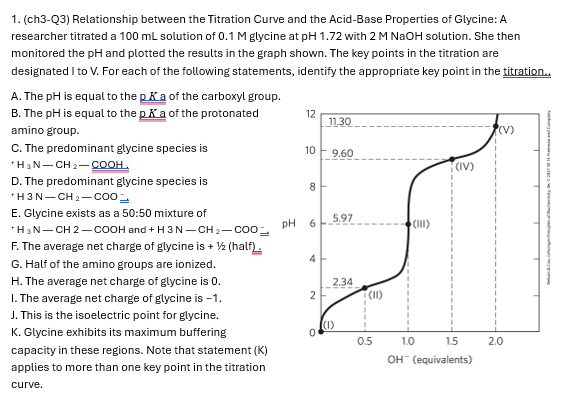
- **Glycine** has two ionizable groups:
- Carboxyl group (\(-COOH\)), pK₁ ≈ 2.34
- Amino group (\(-NH_3^+\)), pK₂ ≈ 9.60
- **Titration Curve Key Points:**
- **I:** Start (all in fully protonated form)
- **II:** pH = pK₁ (carboxyl group half-neutralized)
- **III:** Isoelectric point (zwitterion dominant)
- **IV:** pH = pK₂ (amino group half-neutralized)
- **V:** End (all in deprotonated form)
---
## **Step-by-Step Solution**
### **A. The pH is equal to the pKₐ of the carboxyl group.**
- **pK₁ = 2.34**
- **Corresponds to point II.**
### **B. The pH is equal to the pKₐ of the protonated amino group.**
- **pK₂ = 9.60**
- **Corresponds to point IV.**
### **C. The predominant glycine species is \( \text{H}_3\text{N}^+–\text{CH}_2–\text{COOH} \).**
- This is the fully protonated form (low pH, before first equivalence).
- **Corresponds to point I.**
### **D. The predominant glycine species is \( \text{H}_3\text{N}^+–\text{CH}_2–\text{COO}^- \).**
- This is the zwitterion (between pK₁ and pK₂, at isoelectric point).
- **Corresponds to point III.**
### **E. Glycine exists as a 50:50 mixture of \( \text{H}_3\text{N}^+–\text{CH}_2–\text{COOH} \) and \( \text{H}_3\text{N}^+–\text{CH}_2–\text{COO}^- \).**
- This occurs at pH = pK₁, where half the carboxyl groups are deprotonated.
- **Corresponds to point II.**
### **F. The average net charge of glycine is ½ (half).**
- At point II, half the molecules have a net charge of +1, half have , so the average is **+.5**.
- **Corresponds to point II.**
### **G. Half of the amino groups are ionized.**
- This occurs at pH = pK₂, where half the amino groups have lost their proton.
- **Corresponds to point IV.**
### **H. The average net charge of glycine is .**
- This is at the isoelectric point (zwitterion form).
- **Corresponds to point III.**
### **I. The average net charge of glycine is –1.**
- At high pH (all groups deprotonated).
- **Corresponds to point V.**
### **J. This is the isoelectric point for glycine.**
- Where glycine has no net charge (zwitterion).
- **Corresponds to point III.**
### **K. Glycine exhibits its maximum buffering capacity in these regions.**
- Maximum buffering occurs near pK₁ and pK₂ (where slope is flattest).
- **Corresponds to points II and IV.**
---
## **Summary Table**
| Statement | Key Point on Curve |
|-----------|-------------------|
| A | II |
| B | IV |
| C | I |
| D | III |
| E | II |
| F | II |
| G | IV |
| H | III |
| I | V |
| J | III |
| K | II and IV |
---
### **Final Answers**
- **A:** II
- **B:** IV
- **C:** I
- **D:** III
- **E:** II
- **F:** II
- **G:** IV
- **H:** III
- **I:** V
- **J:** III
- **K:** II and IV
Let me know if you have questions on any specific step!
Question:
Provide More detailed answer
This is AI generated Response.
Asked by: Edu
Created at: 2025-10-17 03:18:37
Final Answer:
RenderedRaw Text
Did you like this answer?
# Detailed Explanation of Glycine Titration Curve and Its Key Points
Glycine is an amino acid with two ionizable groups: the carboxyl group (\(-COOH\)) and the amino group (\(-NH_3^+\)). Understanding the relationship between its structure and the pH during titration is crucial for interpreting the titration curve.
---
## **Understanding Glycine's Ionizable Groups**
### **Ionization Constants**
- **pK₁** (Carboxyl group): Approximately 2.34
- **pK₂** (Amino group): Approximately 9.60
---
## **Titration Curve Key Points**
The titration curve for glycine can be divided into several key points:
1. **Point I**: Fully protonated form (\(\text{H}_3\text{N}^+–\text{CH}_2–\text{COOH}\))
2. **Point II**: pH = pK₁ (Half of the carboxyl groups are deprotonated)
3. **Point III**: Isoelectric point (Zwitterion form dominant)
4. **Point IV**: pH = pK₂ (Half of the amino groups are deprotonated)
5. **Point V**: Fully deprotonated form (\(\text{H}_2\text{N}–\text{CH}_2–\text{COO}^-\))
---
## **Step-by-Step Analysis of Statements**
### **A. The pH is equal to the pKₐ of the carboxyl group.**
- **Explanation**: At point II, glycine is at its pK₁, meaning that the carboxyl group is half neutralized.
- **Key Point**: **II**
### **B. The pH is equal to the pKₐ of the protonated amino group.**
- **Explanation**: At point IV, the pH equals pK₂, indicating that half of the amino groups have lost their protons.
- **Key Point**: **IV**
### **C. The predominant glycine species is \( \text{H}_3\text{N}^+–\text{CH}_2–\text{COOH} \).**
- **Explanation**: This occurs at low pH, where glycine exists mainly in its fully protonated form.
- **Key Point**: **I**
### **D. The predominant glycine species is \( \text{H}_3\text{N}^+–\text{CH}_2–\text{COO}^- \).**
- **Explanation**: The zwitterionic form dominates between pK₁ and pK₂.
- **Key Point**: **III**
### **E. Glycine exists as a 50:50 mixture of \( \text{H}_3\text{N}^+–\text{CH}_2–\text{COOH} \) and \( \text{H}_3\text{N}^+–\text{CH}_2–\text{COO}^- \).**
- **Explanation**: This occurs at pH = pK₁, where half of the carboxyl groups are deprotonated.
- **Key Point**: **II**
### **F. The average net charge of glycine is +½ (half).**
- **Explanation**: At point II, the average charge is +½, corresponding to the balance of charged species.
- **Key Point**: **II**
### **G. Half of the amino groups are ionized.**
- **Explanation**: This is true at pH = pK₂, where half of the amino groups have lost protons.
- **Key Point**: **IV**
### **H. The average net charge of glycine is 0.**
- **Explanation**: This is at the isoelectric point (point III), where glycine has no net charge.
- **Key Point**: **III**
### **I. The average net charge of glycine is -1.**
- **Explanation**: At high pH (point V), all groups are deprotonated, resulting in a net charge of -1.
- **Key Point**: **V**
### **J. This is the isoelectric point for glycine.**
- **Explanation**: At point III, glycine has no net charge, which defines the isoelectric point.
- **Key Point**: **III**
### **K. Glycine exhibits its maximum buffering capacity in these regions.**
- **Explanation**: Maximum buffering occurs near pK₁ and pK₂, where the pH is stable despite added acids or bases.
- **Key Points**: **II and IV**
---
## **Summary Table of Statements and Corresponding Key Points**
| Statement | Key Point on Curve |
|-----------|-------------------|
| A | II |
| B | IV |
| C | I |
| D | III |
| E | II |
| F | II |
| G | IV |
| H | III |
| I | V |
| J | III |
| K | II and IV |
---
## **Final Answers**
- **A:** II
- **B:** IV
- **C:** I
- **D:** III
- **E:** II
- **F:** II
- **G:** IV
- **H:** III
- **I:** V
- **J:** III
- **K:** II and IV
Feel free to ask if you need any clarifications on specific concepts!
VIPSolutions focuses on clear, step‑by‑step explanations so you can learn quickly. Whether you need an AI‑generated walkthrough or a short hint to get unstuck, each solution is organized for fast reading and easy review later.
Search similar questions, compare approaches, and bookmark the best answers for revision. Our goal is simple: quick, reliable study help that feels natural—not noisy.
 VIPSolutions
 1. (613.3) Relationship between the Tiraton Curve and the Acid-Base Properties of Giycing: A
researcher titrated a 100 mL solution of 0.1 M glycine at pH 1.72 with 2 M NaOH solution. She then
monitored the pH and plotted the rests in the graph shown, The key points i the tration are
designated 10 V. For each o th following statements, anti ths appropriate key point in th fiztion..
A. The pis equal tothe pK 2 of the carbon! group
5.The pH is squal to ths pA. of the protonated LE — P
amino group. H
C-Th predominant gine species ol seo ]
“HsN— CH. Coo. H
0. The predominant icine species is N !
“HIN—CH—C00-. i
. Glycine exists as 50:50 murs of sor i
“HN—CH2— COOH and + HN ~—CH:—coo= P1 © i
F. The average net charge of glycine is + ¥ (half. t
G. Half of the amino groups are ionized. “ {
H. The average net charge of glycine is 0. 234 i
1. The average net charge of glycine is ~1. 2
J. This isthe isoetscric point for cine.
K. Glycine exibit ts maximum buffering o
capacity in these regions. Note that statement (K) 0 © © 0
applies to more than one key point in the titration OH” (ecuivalents)
1. (613.3) Relationship between the Tiraton Curve and the Acid-Base Properties of Giycing: A
researcher titrated a 100 mL solution of 0.1 M glycine at pH 1.72 with 2 M NaOH solution. She then
monitored the pH and plotted the rests in the graph shown, The key points i the tration are
designated 10 V. For each o th following statements, anti ths appropriate key point in th fiztion..
A. The pis equal tothe pK 2 of the carbon! group
5.The pH is squal to ths pA. of the protonated LE — P
amino group. H
C-Th predominant gine species ol seo ]
“HsN— CH. Coo. H
0. The predominant icine species is N !
“HIN—CH—C00-. i
. Glycine exists as 50:50 murs of sor i
“HN—CH2— COOH and + HN ~—CH:—coo= P1 © i
F. The average net charge of glycine is + ¥ (half. t
G. Half of the amino groups are ionized. “ {
H. The average net charge of glycine is 0. 234 i
1. The average net charge of glycine is ~1. 2
J. This isthe isoetscric point for cine.
K. Glycine exibit ts maximum buffering o
capacity in these regions. Note that statement (K) 0 © © 0
applies to more than one key point in the titration OH” (ecuivalents)