 VIPSolutions
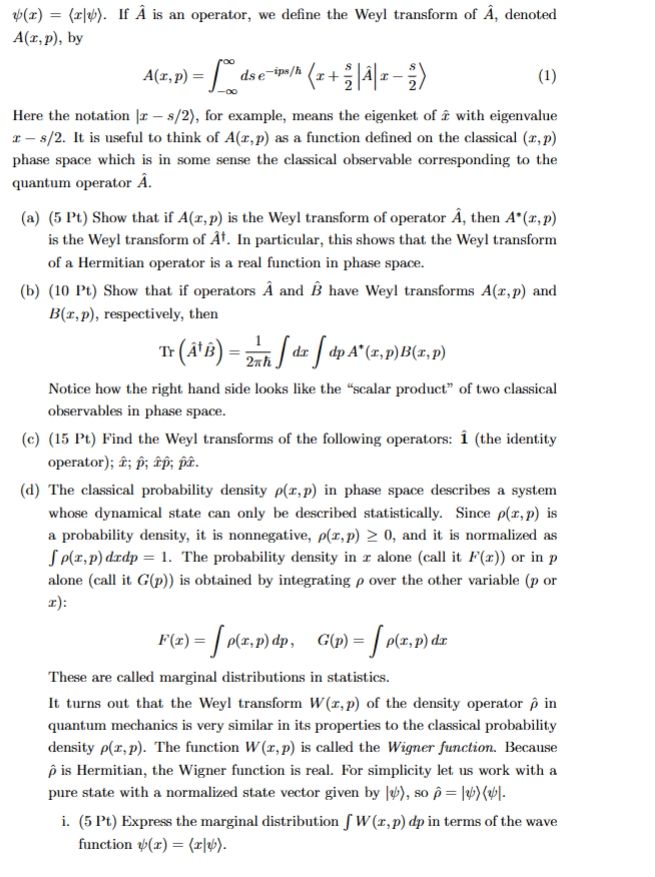
Provide the complete solution in structural manner from start to end, i need complete detailed solution in the format of - 1st - complete solution with all the calculation, 2nd - explanation of each and every parts, 3rd final conclusion statement of all part at the end. ( Note :- don't use pronoun in the solution)3. A question that has exercised various people is the relation between classical observ- ables (that is, functions of x and p) and quantum observables (that is, functions of # and p). One problem is to quantize a classical observable, that is, given a classical function A(x, p), what is the corresponding quantum observable? Dirac suggested that x and p should be associated with and p, but this gives rise to an ambiguity in cases like the classical function zp. Should it correspond to Zp or to jz, or maybe to their average (which at least would be Hermitian)? One answer to this question was given by Weyl. We introduce the Weyl transform in this problem because it is good exercise in the position and momentum representations. We denote operators with a hat, as in Z or A, and we denote cigenvalues or classical quantities without a hat, as in = or A(z,p). We work in one dimension, and think of a wave function (x) = (z]$). If A is an operator, we define the Weyl transform of A, denoted Al, p), by - p/h 2lale2 A(z,p) [ase ipo (= +34 3 (1) Here the notation |r — 5/2), for example, means the eigenket of # with eigenvalue z— 5/2. It is useful to think of A(z,p) as a function defined on the classical (z,p) phase space which is in some sense the classical observable corresponding to the ——_— (a) (51) Show that if A(z, p) is the Weyl transform of operator A, then A*(z,p) is the Wey! transform of Af. In particular, this shows that the Weyl transform of a Hermitian operator is a real function in phase space. (b) (10 Pt) Show that if operators A and 3 have Weyl transforms A(z,p) and B(x, p), respectively, then Pr 7 a . (4 i) = 5 [tr [ao (2,9) B(x, p) Notice how the right hand side looks like the “scalar product” of two classical observables in phase space. (¢) (15 Pt) Find the Weyl transforms of the following operators: 1 (the identity operator); &; p; ip; pi. (d) The classical probability density p(z,p) in phase space describes a system whose dynamical state can only be described statistically. Since p(z,p) is a probability density, it is nonnegative, p(z,p) > 0, and it is normalized as [ pz,p)dzdp = 1. The probability density in = alone (call it #(z)) or in p alone (call it G(p)) is obtained by integrating p over the other variable (p or 2): Fa) = [adn Go) = [ote These are called marginal distributions in statistics. It turns out that the Weyl transform W (z,p) of the density operator j in quantum mechanics is very similar in its properties to the classical probability density p(z,p). The function W (z,p) is called the Wigner function. Because J is Hermitian, the Wigner function is real. For simplicity let us work with a pure state with a normalized state vector given by |v), so 5 = |v) (1. i. (5 Pt) Express the marginal distribution [ W (z,p) dp in terms of the wave function ¥(z) = (x).
Question:
Provide the complete solution in structural manner from start to end, i need complete detailed solution in the format of - 1st - complete solution with all the calculation, 2nd - explanation of each and every parts, 3rd final conclusion statement of all part at the end. ( Note :- don't use pronoun in the solution)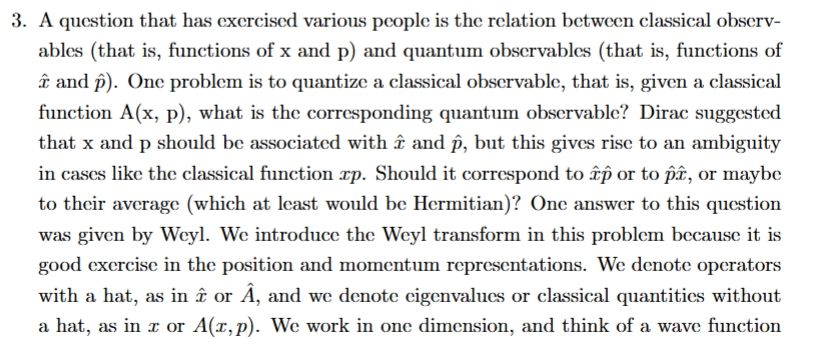
 3. A question that has exercised various people is the relation between classical observ-
ables (that is, functions of x and p) and quantum observables (that is, functions of
# and p). One problem is to quantize a classical observable, that is, given a classical
function A(x, p), what is the corresponding quantum observable? Dirac suggested
that x and p should be associated with and p, but this gives rise to an ambiguity
in cases like the classical function zp. Should it correspond to Zp or to jz, or maybe
to their average (which at least would be Hermitian)? One answer to this question
was given by Weyl. We introduce the Weyl transform in this problem because it is
good exercise in the position and momentum representations. We denote operators
with a hat, as in Z or A, and we denote cigenvalues or classical quantities without
a hat, as in = or A(z,p). We work in one dimension, and think of a wave function
(x) = (z]$). If A is an operator, we define the Weyl transform of A, denoted
Al, p), by
- p/h 2lale2
A(z,p) [ase ipo (= +34 3 (1)
Here the notation |r — 5/2), for example, means the eigenket of # with eigenvalue
z— 5/2. It is useful to think of A(z,p) as a function defined on the classical (z,p)
phase space which is in some sense the classical observable corresponding to the
——_—
(a) (51) Show that if A(z, p) is the Weyl transform of operator A, then A*(z,p)
is the Wey! transform of Af. In particular, this shows that the Weyl transform
of a Hermitian operator is a real function in phase space.
(b) (10 Pt) Show that if operators A and 3 have Weyl transforms A(z,p) and
B(x, p), respectively, then
Pr
7 a .
(4 i) = 5 [tr [ao (2,9) B(x, p)
Notice how the right hand side looks like the “scalar product” of two classical
observables in phase space.
(¢) (15 Pt) Find the Weyl transforms of the following operators: 1 (the identity
operator); &; p; ip; pi.
(d) The classical probability density p(z,p) in phase space describes a system
whose dynamical state can only be described statistically. Since p(z,p) is
a probability density, it is nonnegative, p(z,p) > 0, and it is normalized as
[ pz,p)dzdp = 1. The probability density in = alone (call it #(z)) or in p
alone (call it G(p)) is obtained by integrating p over the other variable (p or
2):
Fa) = [adn Go) = [ote
These are called marginal distributions in statistics.
It turns out that the Weyl transform W (z,p) of the density operator j in
quantum mechanics is very similar in its properties to the classical probability
density p(z,p). The function W (z,p) is called the Wigner function. Because
J is Hermitian, the Wigner function is real. For simplicity let us work with a
pure state with a normalized state vector given by |v), so 5 = |v) (1.
i. (5 Pt) Express the marginal distribution [ W (z,p) dp in terms of the wave
function ¥(z) = (x).
3. A question that has exercised various people is the relation between classical observ-
ables (that is, functions of x and p) and quantum observables (that is, functions of
# and p). One problem is to quantize a classical observable, that is, given a classical
function A(x, p), what is the corresponding quantum observable? Dirac suggested
that x and p should be associated with and p, but this gives rise to an ambiguity
in cases like the classical function zp. Should it correspond to Zp or to jz, or maybe
to their average (which at least would be Hermitian)? One answer to this question
was given by Weyl. We introduce the Weyl transform in this problem because it is
good exercise in the position and momentum representations. We denote operators
with a hat, as in Z or A, and we denote cigenvalues or classical quantities without
a hat, as in = or A(z,p). We work in one dimension, and think of a wave function
(x) = (z]$). If A is an operator, we define the Weyl transform of A, denoted
Al, p), by
- p/h 2lale2
A(z,p) [ase ipo (= +34 3 (1)
Here the notation |r — 5/2), for example, means the eigenket of # with eigenvalue
z— 5/2. It is useful to think of A(z,p) as a function defined on the classical (z,p)
phase space which is in some sense the classical observable corresponding to the
——_—
(a) (51) Show that if A(z, p) is the Weyl transform of operator A, then A*(z,p)
is the Wey! transform of Af. In particular, this shows that the Weyl transform
of a Hermitian operator is a real function in phase space.
(b) (10 Pt) Show that if operators A and 3 have Weyl transforms A(z,p) and
B(x, p), respectively, then
Pr
7 a .
(4 i) = 5 [tr [ao (2,9) B(x, p)
Notice how the right hand side looks like the “scalar product” of two classical
observables in phase space.
(¢) (15 Pt) Find the Weyl transforms of the following operators: 1 (the identity
operator); &; p; ip; pi.
(d) The classical probability density p(z,p) in phase space describes a system
whose dynamical state can only be described statistically. Since p(z,p) is
a probability density, it is nonnegative, p(z,p) > 0, and it is normalized as
[ pz,p)dzdp = 1. The probability density in = alone (call it #(z)) or in p
alone (call it G(p)) is obtained by integrating p over the other variable (p or
2):
Fa) = [adn Go) = [ote
These are called marginal distributions in statistics.
It turns out that the Weyl transform W (z,p) of the density operator j in
quantum mechanics is very similar in its properties to the classical probability
density p(z,p). The function W (z,p) is called the Wigner function. Because
J is Hermitian, the Wigner function is real. For simplicity let us work with a
pure state with a normalized state vector given by |v), so 5 = |v) (1.
i. (5 Pt) Express the marginal distribution [ W (z,p) dp in terms of the wave
function ¥(z) = (x).
Asked by: Dynamic
Created at: 2025-09-11 16:14:47
Final Answer:
📢 Instructions:
- Ask anything relatd to above question only.
- For new Question goto :