This is AI generated Response.
Asked by: Dynamic
Created at: 2025-09-12 14:56:37
Final Answer:
RenderedRaw Text
Did you like this answer?
# Complete Solution
## Part (a): Show that \( B \) and \( B' \) are two bases of \( \mathbb{R}^2 \) and draw those basis vectors
### Step 1: Vectors in Standard Basis
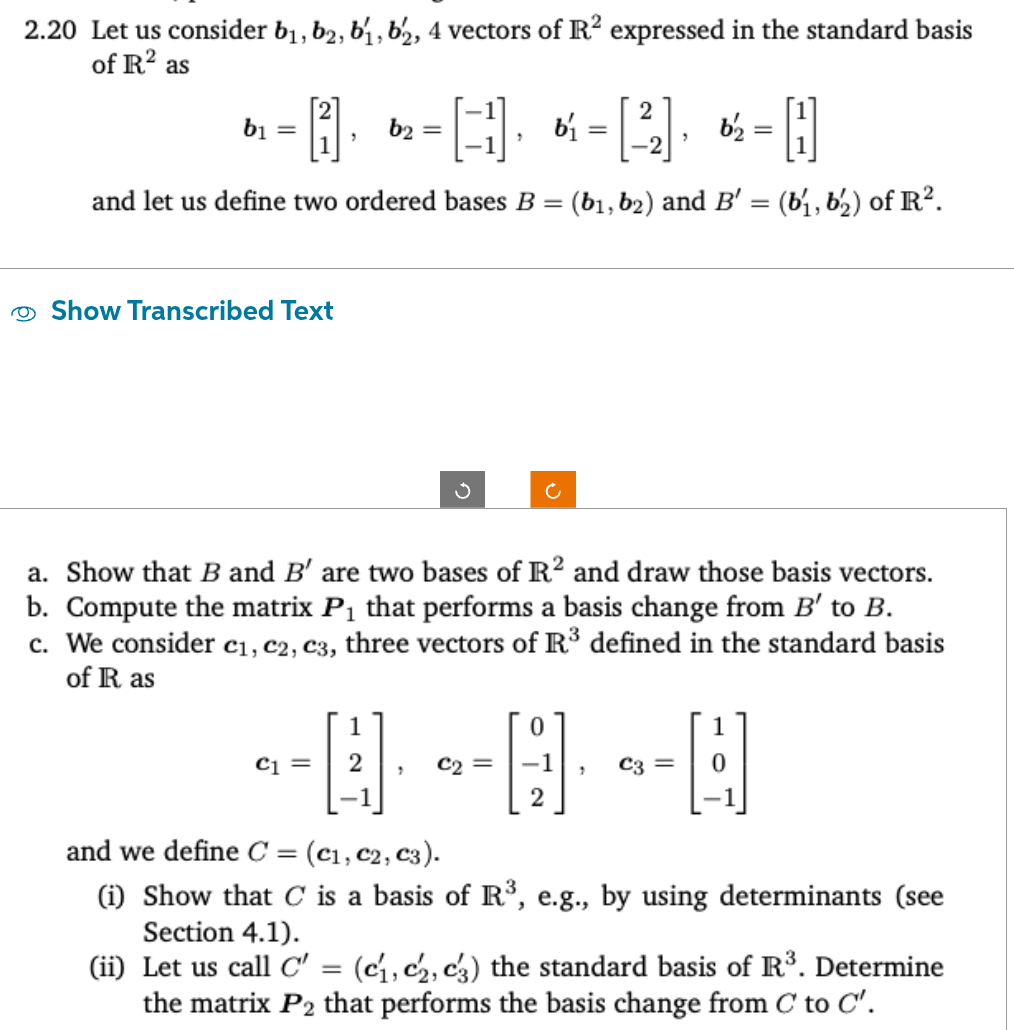
Given:
\[
b_1 = \begin{bmatrix} 2 \\ 1 \end{bmatrix}, \quad b_2 = \begin{bmatrix} -1 \\ -1 \end{bmatrix}
\]
\[
b_1' = \begin{bmatrix} 2 \\ -2 \end{bmatrix}, \quad b_2' = \begin{bmatrix} 1 \\ 1 \end{bmatrix}
\]
### Step 2: Check Linear Independence for \( B = (b_1, b_2) \)
Form matrix \( M_B = \begin{bmatrix} b_1 & b_2 \end{bmatrix} = \begin{bmatrix} 2 & -1 \\ 1 & -1 \end{bmatrix} \).
Calculate the determinant:
\[
\det(M_B) = (2)(-1) - (1)(-1) = -2 + 1 = -1 \neq 0
\]
Hence, \( b_1 \) and \( b_2 \) are linearly independent and form a basis.
### Step 3: Check Linear Independence for \( B' = (b_1', b_2') \)
Form matrix \( M_{B'} = \begin{bmatrix} b_1' & b_2' \end{bmatrix} = \begin{bmatrix} 2 & 1 \\ -2 & 1 \end{bmatrix} \).
Calculate the determinant:
\[
\det(M_{B'}) = (2)(1) - (-2)(1) = 2 + 2 = 4 \neq 0
\]
Hence, \( b_1' \) and \( b_2' \) are linearly independent and form a basis.
### Step 4: Drawing the Vectors
(Description for drawing: Plot the vectors in \( \mathbb{R}^2 \) starting from the origin:
- \( b_1 \) points to (2,1)
- \( b_2 \) points to (-1,-1)
- \( b_1' \) points to (2,-2)
- \( b_2' \) points to (1,1)
)
---
## Part (b): Compute the matrix \( P_1 \) that performs a basis change from \( B' \) to \( B \)
### Step 1: Express \( b_1' \) and \( b_2' \) in the \( B \) basis
Let \( [x\ y]^T_B \) be the coordinates in basis \( B \) such that:
\[
b_1' = a_{11}b_1 + a_{21}b_2
\]
\[
b_2' = a_{12}b_1 + a_{22}b_2
\]
So,
\[
\begin{bmatrix} 2 \\ -2 \end{bmatrix} = a_{11} \begin{bmatrix} 2 \\ 1 \end{bmatrix} + a_{21} \begin{bmatrix} -1 \\ -1 \end{bmatrix}
\]
\[
\begin{bmatrix} 1 \\ 1 \end{bmatrix} = a_{12} \begin{bmatrix} 2 \\ 1 \end{bmatrix} + a_{22} \begin{bmatrix} -1 \\ -1 \end{bmatrix}
\]
#### For \( b_1' \):
Set up the system:
\[
2 = 2a_{11} - a_{21}
\]
\[
-2 = a_{11} - a_{21}
\]
Subtract the second from the first:
\[
2 - (-2) = (2a_{11} - a_{21}) - (a_{11} - a_{21}) \implies 4 = a_{11}
\]
Plug back:
\[
-2 = 4 - a_{21} \implies a_{21} = 6
\]
So, \( b_1' = 4b_1 + 6b_2 \)
#### For \( b_2' \):
\[
1 = 2a_{12} - a_{22}
\]
\[
1 = a_{12} - a_{22}
\]
Subtract:
\[
1 - 1 = (2a_{12} - a_{22}) - (a_{12} - a_{22}) \implies 0 = a_{12}
\]
So, \( a_{12} = 0 \)
Plug back:
\[
1 = 0 - a_{22} \implies a_{22} = -1
\]
So, \( b_2' = 0b_1 - 1b_2 \)
### Step 2: The Change of Basis Matrix \( P_1 \):
\[
P_1 = \begin{bmatrix} 4 & 0 \\ 6 & -1 \end{bmatrix}
\]
This matrix transforms coordinates from \( B' \) to \( B \).
---
## Part (c): Basis for \( \mathbb{R}^3 \), and Change of Basis Matrix
### (i) Show that \( C = (c_1, c_2, c_3) \) is a basis of \( \mathbb{R}^3 \)
Given:
\[
c_1 = \begin{bmatrix} 1 \\ 2 \\ -1 \end{bmatrix}, \quad c_2 = \begin{bmatrix} 0 \\ -1 \\ 2 \end{bmatrix}, \quad c_3 = \begin{bmatrix} 1 \\ 0 \\ -1 \end{bmatrix}
\]
Form matrix:
\[
M_C = \begin{bmatrix} 1 & 0 & 1 \\ 2 & -1 & 0 \\ -1 & 2 & -1 \end{bmatrix}
\]
Calculate the determinant:
\[
\det(M_C) = 1 \cdot (-1 \cdot -1 - 0 \cdot 2) - 0 \cdot (2 \cdot -1 - 0 \cdot -1) + 1 \cdot (2 \cdot 2 - (-1) \cdot -1)
\]
\[
= 1 \cdot (1 - 0) - 0 \cdot (-2 - 0) + 1 \cdot (4 - 1)
\]
\[
= 1 + 0 + 3 = 4 \neq 0
\]
Therefore, \( c_1, c_2, c_3 \) are linearly independent and form a basis.
---
### (ii) Change of Basis Matrix \( P_2 \) from \( C \) to Standard Basis \( C' \)
The matrix that changes from \( C \) to \( C' \) is the matrix whose columns are \( c_1, c_2, c_3 \):
\[
P_2 = \begin{bmatrix} 1 & 0 & 1 \\ 2 & -1 & 0 \\ -1 & 2 & -1 \end{bmatrix}
\]
---
# Explanation of Each Part
## (a) Basis Verification
- A set of vectors is a basis if it is linearly independent and spans the space.
- For \( \mathbb{R}^2 \), two vectors are a basis if the determinant of the matrix formed by placing them as columns is nonzero.
- Both \( B \) and \( B' \) satisfy this condition.
## (b) Change of Basis Matrix
- To convert coordinates from basis \( B' \) to \( B \), express each \( B' \) vector as a linear combination of \( B \) vectors.
- The coefficients form the columns of the change of basis matrix.
## (c) Basis for \( \mathbb{R}^3 \), and Change of Basis Matrix
- Three vectors in \( \mathbb{R}^3 \) are a basis if the determinant of the matrix with them as columns is nonzero.
- The change of basis matrix from \( C \) to the standard basis is simply the matrix with \( C \)'s vectors as columns.
---
# Final Conclusion Statement
- Both \( B \) and \( B' \) are valid bases for \( \mathbb{R}^2 \), as shown by their nonzero determinants.
- The change of basis matrix from \( B' \) to \( B \) is \( P_1 = \begin{bmatrix} 4 & 0 \\ 6 & -1 \end{bmatrix} \).
- The set \( C = (c_1, c_2, c_3) \) forms a basis for \( \mathbb{R}^3 \) due to nonzero determinant.
- The change of basis matrix from \( C \) to the standard basis \( C' \) is \( P_2 = \begin{bmatrix} 1 & 0 & 1 \\ 2 & -1 & 0 \\ -1 & 2 & -1 \end{bmatrix} \).
- All steps confirm the bases and the basis change matrices as required.
VIPSolutions focuses on clear, step‑by‑step explanations so you can learn quickly. Whether you need an AI‑generated walkthrough or a short hint to get unstuck, each solution is organized for fast reading and easy review later.
Search similar questions, compare approaches, and bookmark the best answers for revision. Our goal is simple: quick, reliable study help that feels natural—not noisy.
 VIPSolutions
 2.20 Let us consider by, by, b}, b), 4 vectors of R? expressed in the standard basis
of R? as
_|2 1 ; | 2 , (1
el we[ i=l), we)
and let us define two ordered bases B = (b1,b2) and B' = (b}, by) of RZ.
© Show Transcribed Text
a. Show that B and B’ are two bases of R? and draw those basis vectors.
b. Compute the matrix P; that performs a basis change from B’ to B.
c. We consider ci, ea, e3, three vectors of R? defined in the standard basis
of R as
1 0 1
cp=12|, eca=|-1|, e3=|0
-1 2 —-1
and we define C = (e1, 2, ¢3).
(i) Show that C is a basis of R?, e.g., by using determinants (see
Section 4.1).
(ii) Let us call ¢’ = (¢}, ch, ¢}) the standard basis of R®. Determine
the matrix P that performs the basis change from C to C".
2.20 Let us consider by, by, b}, b), 4 vectors of R? expressed in the standard basis
of R? as
_|2 1 ; | 2 , (1
el we[ i=l), we)
and let us define two ordered bases B = (b1,b2) and B' = (b}, by) of RZ.
© Show Transcribed Text
a. Show that B and B’ are two bases of R? and draw those basis vectors.
b. Compute the matrix P; that performs a basis change from B’ to B.
c. We consider ci, ea, e3, three vectors of R? defined in the standard basis
of R as
1 0 1
cp=12|, eca=|-1|, e3=|0
-1 2 —-1
and we define C = (e1, 2, ¢3).
(i) Show that C is a basis of R?, e.g., by using determinants (see
Section 4.1).
(ii) Let us call ¢’ = (¢}, ch, ¢}) the standard basis of R®. Determine
the matrix P that performs the basis change from C to C".