Provide the detailed
2
D fabrication process flow and the mask design
(
s
)
needed to fabricate the PDMS
-
Glass device below if negative photoresist is to be used to make the master mold
(
s
)
.
Hi
,
there are two different chambers
(
pressure chamber on top, and cell culture chamber and micro channels at the bottom
)
.
do I need to create two different molds? for micro channels and cell culture chamber do I need to use different masks and different photoresists
(
because their sizes are different
)
?
the upper chamber
(
pressure chamber
)
has been attached to two small cubes. do I need another mask and mold for these two small cubes
(
on the top
)
,
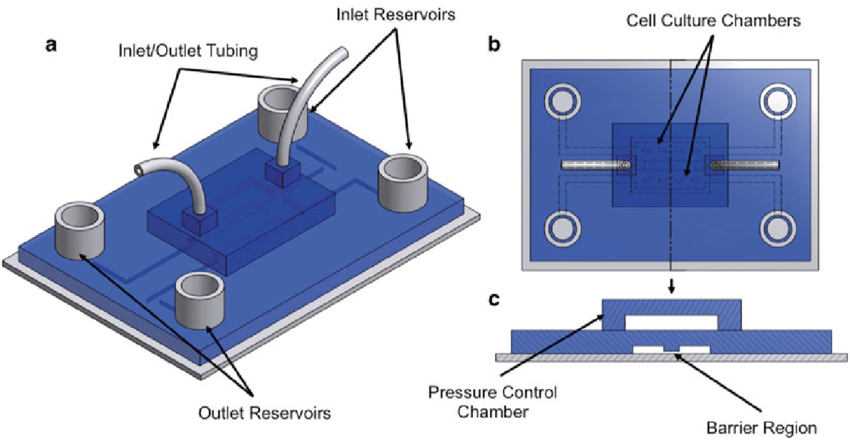
or I create them simultaneously with the pressure chamber? thanks in advanceInlet Reservoirs Cell Culture Chambers
a Inlet/Outlet Tubing b —/
® ®
D ~ O
) p> ® ®
Q ~ i
4
A ~- c
7d ; me 3
XC =
“2\N
Pressure Control
Outlet Reservoirs Chamber SN
Question:
Provide the detailed
2
D fabrication process flow and the mask design
(
s
)
needed to fabricate the PDMS
-
Glass device below if negative photoresist is to be used to make the master mold
(
s
)
.
Hi
,
there are two different chambers
(
pressure chamber on top, and cell culture chamber and micro channels at the bottom
)
.
do I need to create two different molds? for micro channels and cell culture chamber do I need to use different masks and different photoresists
(
because their sizes are different
)
?
the upper chamber
(
pressure chamber
)
has been attached to two small cubes. do I need another mask and mold for these two small cubes
(
on the top
)
,
or I create them simultaneously with the pressure chamber? thanks in advanceInlet Reservoirs Cell Culture Chambers
a Inlet/Outlet Tubing b —/
® ®
D ~ O
) p> ® ®
Q ~ i
4
A ~- c
7d ; me 3
XC =
“2\N
Pressure Control
Outlet Reservoirs Chamber SN
This is AI generated Response.
Asked by: Veera manikanta
Created at: 2025-08-22 20:33:09
Final Answer:
RenderedRaw Text
Did you like this answer?
Absolutely, your questions are **very relevant** to the microfluidic fabrication process! Below is a **comprehensive answer** for your PDMS-glass device fabrication, specifically when using negative photoresist to create the master molds.
---
## 1. Device Structure Overview
From your image and description:
- **Two-layer PDMS device** (Upper: Pressure chamber + cubes; Lower: microchannels + cell culture chambers), bonded to glass.
- **Multiple features with different heights** (e.g., chambers, microchannels, inlet/outlet/cube structures).
---
## 2. **Mask Design and Mold Requirement**
### **Q1: Do I need two different molds?**
**Yes.**
- You need **two separate master molds**:
- **Top mold** for the pressure chamber and cubes.
- **Bottom mold** for the cell culture chamber and microchannels.
### **Q2: Do I need different masks/photoresists for the microchannels and cell culture chamber?**
**Depends on height differences**:
- If **microchannels** and **cell culture chambers** are of **different heights**, you have two options:
1. **Two-layer photolithography** on the same wafer (requires careful alignment, two masks, two photoresist steps).
2. **Design both features on a single mask** if they are the same height (much simpler).
- **Different photoresists** are only required if you need **different feature heights** and the photoresists have different properties (which is uncommon; SU-8 negative resist is popular for all heights).
### **Q3: Do I need another mask/mold for the cubes on the pressure chamber?**
- **If the cubes are the same height as the pressure chamber:**
- **No extra mask/mold needed.**
- Design the cubes as part of the pressure chamber mask.
- **If the cubes are taller or shorter:**
- **Multi-layer photolithography** on the same mold is needed, requiring a second mask and alignment.
---
## 3. **Detailed 2D Fabrication Process Flow**
### **A. Master Mold Fabrication (Using Negative Photoresist, e.g., SU-8)**
#### **For Each Layer:**
#### a) **Design Masks**
- **Top Layer Mask:** Pressure chamber + cubes (drawn in CAD, exported as photomask).
- **Bottom Layer Mask:** Microchannels, cell culture chambers, inlet/outlet holes.
#### b) **Wafer Preparation**
- Clean Si wafer (piranha, DI water, dry).
- Bake to dehydrate (e.g., 120°C, 10 min).
#### c) **Photoresist Coating**
- **Spin-coat SU-8** (choose SU-8 type/thickness for required feature height).
- Example: SU-8 2050 for ~50 μm, SU-8 2100 for ~100 μm.
#### d) **Soft Bake**
- According to SU-8 datasheet (e.g., 95°C for 10–30 min).
#### e) **UV Exposure**
- Align mask over resist.
- UV expose (dose per datasheet).
#### f) **Post-exposure Bake**
- Per resist datasheet.
#### g) **Development**
- Immerse in SU-8 developer (PGMEA), rinse and dry.
#### h) **Hard Bake (Optional)**
- To improve mold durability.
---
### **B. Multi-layer Photolithography (if different heights/features on same wafer)**
- **Spin/Expose/Develop** first layer (e.g., microchannels).
- **Spin/Expose/Develop** second layer (e.g., cell chamber), using alignment marks.
---
### **C. PDMS Replica Molding**
1. **Mix and degas PDMS** (10:1 base:curing agent).
2. **Pour PDMS** onto mold(s), degas, and cure (e.g., 70°C, 1 hr).
3. **Peel off PDMS layer** from master mold.
---
### **D. Device Assembly**
1. **Punch holes** for inlet/outlet.
2. **Align and plasma bond** top and bottom PDMS layers together.
3. **Plasma bond** assembled PDMS device to a glass slide.
---
## **Summary Table**
| Feature | Mask Needed | Mold Needed | Photoresist | Notes |
|------------------------|-------------|-------------|-------------|-----------------------------------------------------------------|
| Microchannels/chambers | Yes | Yes | SU-8 | One or two heights: use single or dual-layer photolithography |
| Pressure chamber/cubes | Yes | Yes | SU-8 | Include cubes in mask if same height; else dual-layer needed |
---
## **References & Tips**
- [SU-8 datasheets and microfabrication guides](https://www.microchem.com/PDFs/SU-82000DataSheet2020.pdf)
- Multi-height structures benefit from dual-layer photolithography but require careful alignment.
- For many designs, **all features of a single height on a single mask** is much simpler and more robust.
---
**If you provide heights of each feature, I can suggest exact SU-8 types and spin conditions! Let me know if you want detailed mask design tips (e.g., CAD file setup).**
VIPSolutions focuses on clear, step‑by‑step explanations so you can learn quickly. Whether you need an AI‑generated walkthrough or a short hint to get unstuck, each solution is organized for fast reading and easy review later.
Search similar questions, compare approaches, and bookmark the best answers for revision. Our goal is simple: quick, reliable study help that feels natural—not noisy.
 VIPSolutions
 Inlet Reservoirs Cell Culture Chambers
a Inlet/Outlet Tubing b —/
® ®
D ~ O
) p> ® ®
Q ~ i
4
A ~- c
7d ; me 3
XC =
“2\N
Pressure Control
Outlet Reservoirs Chamber SN
Inlet Reservoirs Cell Culture Chambers
a Inlet/Outlet Tubing b —/
® ®
D ~ O
) p> ® ®
Q ~ i
4
A ~- c
7d ; me 3
XC =
“2\N
Pressure Control
Outlet Reservoirs Chamber SN