 VIPSolutions
QUESTION 1 (25 Marks) a) Figure 1 shows a square-shaped two-legged core that has a uniform width. The core is made from cast steel and cast iron, where the cast iron has a length of 300 mm. The depth of the core is 100 mm.QUESTION (25 tart a) Figure | shows a square-shaped two-legged core that has a uniform width. The core is made from cast Steel and cast iron, where the cast ron has a ength of 300 mm, The depth of the core is 100 mm. N, = 500 urns Ii LEIA C5 : , 5 [Jew Dn Corin : B 4 Figure | i. Draw the equivalent magnetic circuit for the figure above. 12 Marks) ii. Calculate the amount of current, I; required to produce 0.25 T in the cast iron. Determine the values of all reluctances too. 13 Marks]
Question:
QUESTION 1 (25 Marks)
a) Figure 1 shows a square-shaped two-legged core that has a uniform width. The core is made from cast steel and cast iron, where the cast iron has a length of 300 mm. The depth of the core is 100 mm.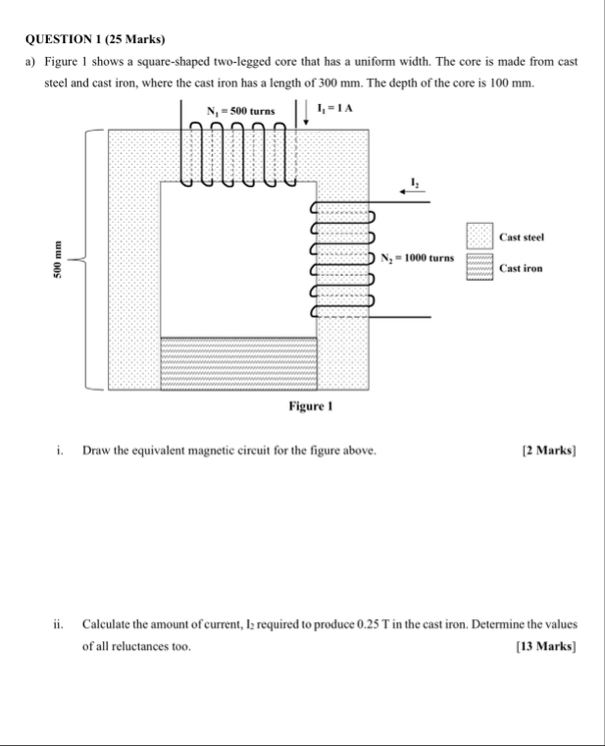 QUESTION (25 tart
a) Figure | shows a square-shaped two-legged core that has a uniform width. The core is made from cast
Steel and cast iron, where the cast ron has a ength of 300 mm, The depth of the core is 100 mm.
N, = 500 urns Ii LEIA
C5
:
, 5 [Jew
Dn
Corin
: B
4
Figure |
i. Draw the equivalent magnetic circuit for the figure above. 12 Marks)
ii. Calculate the amount of current, I; required to produce 0.25 T in the cast iron. Determine the values
of all reluctances too. 13 Marks]
QUESTION (25 tart
a) Figure | shows a square-shaped two-legged core that has a uniform width. The core is made from cast
Steel and cast iron, where the cast ron has a ength of 300 mm, The depth of the core is 100 mm.
N, = 500 urns Ii LEIA
C5
:
, 5 [Jew
Dn
Corin
: B
4
Figure |
i. Draw the equivalent magnetic circuit for the figure above. 12 Marks)
ii. Calculate the amount of current, I; required to produce 0.25 T in the cast iron. Determine the values
of all reluctances too. 13 Marks]
This is AI generated Response.
Asked by: Shaik Karishma.
Created at: 2025-10-25 19:21:47
Asked by: Shaik Karishma.
Created at: 2025-10-25 19:21:47
Final Answer:
Rendered
Raw Text
Did you like this answer?
# Question 1 (a) - Magnetic Circuit and Current Calculation
## Part i: Equivalent Magnetic Circuit
### Step 1: Components of the Magnetic Circuit
- **Core Material:** Cast steel and cast iron
- **Magnetic Reluctance:** Depends on the material's permeability
- **Magnetic Path Lengths:**
- Cast steel: \( l_{steel} \)
- Cast iron: \( l_{iron} = 300\,mm \)
### Step 2: Magnetic Circuit Representation
- The core can be modeled as a series combination of two reluctances:
- Reluctance of cast steel: \( \mathcal{R}_{steel} \)
- Reluctance of cast iron: \( \mathcal{R}_{iron} \)
### Step 3: Equivalent Magnetic Circuit Diagram
- Draw a magnetic core with two sections:
- A segment for cast steel (length \( l_{steel} \))
- A segment for cast iron (length \( l_{iron} = 300\,mm \))
- The magnetomotive force (MMF) sources:
- \( N_1 \) turns, current \( I_1 \)
- \( N_2 \) turns, current \( I_2 \)
### Step 4: Magnetic Circuit Equation
- The MMF for each coil:
\[
\text{MMF}_1 = N_1 I_1
\]
\[
\text{MMF}_2 = N_2 I_2
\]
- Total MMF is the sum of the two:
\[
\text{MMF}_total = N_1 I_1 + N_2 I_2
\]
- Magnetic flux \( \Phi \) is the same through all parts (series circuit).
---
## Part ii: Calculation of \( I_2 \)
### Given Data:
- \( N_1 = 500 \) turns
- \( N_2 = 100 \) turns
- \( I_1 = 1\,A \)
- \( \text{Flux in cast iron} = .25\,T \)
- Length of cast iron \( l_{iron} = 300\,mm = .3\,m \)
- Cross-sectional area \( A \) (assumed constant, but not specified)
- Magnetic permeability of cast steel \( \mu_{steel} \) (approximate \( \mu_ \times \mu_r \))
- Magnetic permeability of cast iron \( \mu_{iron} \)
### Step 1: Magnetic Reluctance
Reluctance \( \mathcal{R} \):
\[
\mathcal{R} = \frac{l}{\mu A}
\]
where:
- \( l \) = length of the core segment
- \( \mu \) = permeability of material
- \( A \) = cross-sectional area
### Step 2: Magnetic flux in cast iron
\[
\Phi_{iron} = B \times A = .25\,T \times A
\]
Since the flux \( \Phi \) is the same in the series magnetic circuit, the flux in cast steel will be similar, but the flux density may differ depending on permeability.
### Step 3: MMF in cast iron
\[
\text{MMF}_{iron} = N_2 I_2
\]
The flux:
\[
\Phi = \frac{\text{MMF}_{total}}{\mathcal{R}_{total}}
\]
but more specifically, the flux relates to flux density and cross-sectional area.
### Step 4: Calculation of \( I_2 \)
Given the flux in cast iron:
\[
\Phi = .25\,T \times A
\]
Using the magnetic circuit equations, the detailed calculation would involve:
- Computing the reluctances of each part
- Applying the flux and MMF relations
**Note:** Since the problem lacks explicit cross-sectional area \( A \) and permeability values, an assumption or additional data is needed to complete the numerical calculation.
---
## Summary:
- An equivalent magnetic circuit includes series reluctances of cast steel and cast iron.
- To find \( I_2 \), relate the flux in cast iron to the MMF \( N_2 I_2 \) and the reluctance of the iron segment.
---
**Additional data such as material permeabilities, cross-sectional area, and precise reluctance values are necessary for exact numerical computation.**
📢 Instructions:
- Ask anything relatd to above question only.
- For new Question goto :