RH Co manufactures machine tools. It has
2
million ordinary
\
(
\
$
1
\
)
shares in issue, quoted at
1
6
8
cents each, and
\
(
\
$
1
\
)
million
\
(
1
0
\
%
\
)
secured bonds quoted at par. To finance expansion the directors of the company want to raise
\
(
\
$
1
\
)
million for additional working capital. Cash flow from trading before interest and tax is currently
\
(
\
$
1
\
)
million per annum. It is expected to rise to
\
(
\
$
1
.
3
\
)
million per annum if the expansion programme goes ahead. To simplify placing a valuation on the company's equity, you should assume that:
(
1
)
the forecast level of cash flow, and a tax rate of
\
(
3
3
\
%
\
)
,
will continue indefinitely.
(
2
)
the required rate of return on the market value of equity,
\
(
1
8
\
%
\
)
post tax, will be unaffected by the new financing.
(
3
)
there is no difference between taxable profits and cash flow. The company's directors are considering two forms of finance
-
equity via a rights issue at
\
(
1
5
\
%
\
)
discount to current share price, or
\
(
1
2
\
%
\
)
unsecured loan stock at par. Required:
(
a
)
Calculate for both financing options, the expected
(
i
)
increase in the market value of equity
(
ii
)
debt : debt
+
equity ratio
(
iii
)
weighted average cost of capital.
(
1
2
marks
)
(
b
)
Assume you are the financial manager for RH Co
.
Write a report to the board advising which of the two types of financing is to be preferred. Include in your report brief comments on non
-
financial factors which should be considered by the directors before deciding how to raise the
\
(
\
mathbf
{
\
$
1
}
\
)
million finance.
(
1
3
marks
)
(
Total:
\
(
\
mathbf
{
2
5
}
\
)
marks
)
Give me answer with step by step and also explanations. And give me with clarity, Accuracy, Completeness, Relevancy, Structure, Voice.RH Co manufactures machine tools. It has 2 million ordinary $1 shares in issue, quoted at
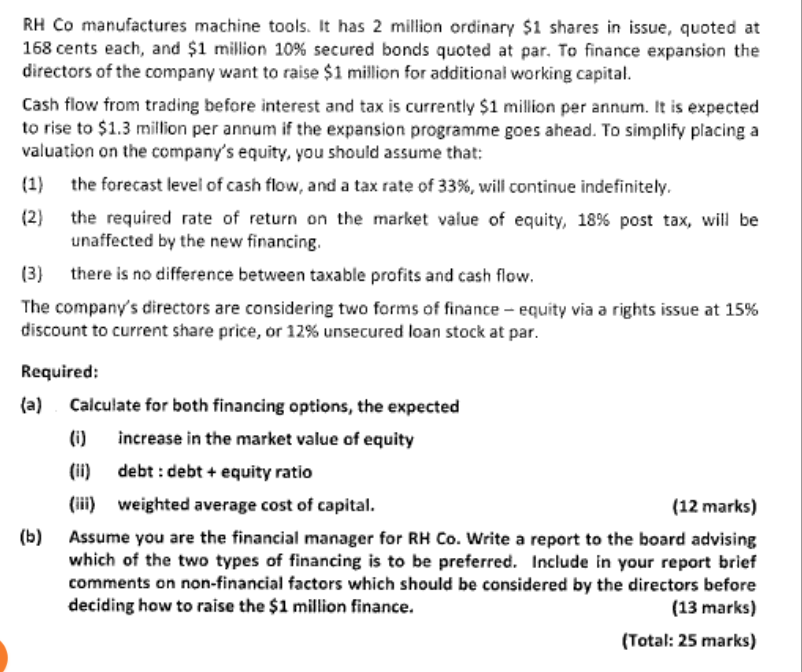
168 cents each, and $1 million 10% secured bonds quoted at par. To finance expansion the
directors of the company want to raise $1 million for additional working capital.
Cash flow from trading before interest and tax is currently $1 million per annum. It is expected
10 rise to $1.3 million per annum if the expansion programme goes ahead. To simplify placing a
valuation on the company’s equity, you should assume that:
(1) the forecast level of cash flow, and a tax rate of 33%, will continue indefinitely.
{2} the required rate of return on the market value of equity, 18% post tax, will be
unaffected by the new financing.
(3) there is no difference between taxable profits and cash flow.
The company’s directors are considering two forms of finance — equity via a rights issue at 15%
discount to current share price, or 12% unsecured loan stock at par.
Required:
{a) Calculate for both financing options, the expected
(i) increase in the market value of equity
(ii) debt : debt + equity ratio
(ii) weighted average cost of capital. (12 marks)
(b) Assume you are the financial manager for RH Co. Write a report to the board advising
which of the two types of financing is to be preferred. Include in your report brief
comments on non-financial factors which should be considered by the directors before
deciding how to raise the $1 million finance. (13 marks)
) (Total: 25 marks)
Question:
RH Co manufactures machine tools. It has
2
million ordinary
\
(
\
$
1
\
)
shares in issue, quoted at
1
6
8
cents each, and
\
(
\
$
1
\
)
million
\
(
1
0
\
%
\
)
secured bonds quoted at par. To finance expansion the directors of the company want to raise
\
(
\
$
1
\
)
million for additional working capital. Cash flow from trading before interest and tax is currently
\
(
\
$
1
\
)
million per annum. It is expected to rise to
\
(
\
$
1
.
3
\
)
million per annum if the expansion programme goes ahead. To simplify placing a valuation on the company's equity, you should assume that:
(
1
)
the forecast level of cash flow, and a tax rate of
\
(
3
3
\
%
\
)
,
will continue indefinitely.
(
2
)
the required rate of return on the market value of equity,
\
(
1
8
\
%
\
)
post tax, will be unaffected by the new financing.
(
3
)
there is no difference between taxable profits and cash flow. The company's directors are considering two forms of finance
-
equity via a rights issue at
\
(
1
5
\
%
\
)
discount to current share price, or
\
(
1
2
\
%
\
)
unsecured loan stock at par. Required:
(
a
)
Calculate for both financing options, the expected
(
i
)
increase in the market value of equity
(
ii
)
debt : debt
+
equity ratio
(
iii
)
weighted average cost of capital.
(
1
2
marks
)
(
b
)
Assume you are the financial manager for RH Co
.
Write a report to the board advising which of the two types of financing is to be preferred. Include in your report brief comments on non
-
financial factors which should be considered by the directors before deciding how to raise the
\
(
\
mathbf
{
\
$
1
}
\
)
million finance.
(
1
3
marks
)
(
Total:
\
(
\
mathbf
{
2
5
}
\
)
marks
)
Give me answer with step by step and also explanations. And give me with clarity, Accuracy, Completeness, Relevancy, Structure, Voice.RH Co manufactures machine tools. It has 2 million ordinary $1 shares in issue, quoted at
168 cents each, and $1 million 10% secured bonds quoted at par. To finance expansion the
directors of the company want to raise $1 million for additional working capital.
Cash flow from trading before interest and tax is currently $1 million per annum. It is expected
10 rise to $1.3 million per annum if the expansion programme goes ahead. To simplify placing a
valuation on the company’s equity, you should assume that:
(1) the forecast level of cash flow, and a tax rate of 33%, will continue indefinitely.
{2} the required rate of return on the market value of equity, 18% post tax, will be
unaffected by the new financing.
(3) there is no difference between taxable profits and cash flow.
The company’s directors are considering two forms of finance — equity via a rights issue at 15%
discount to current share price, or 12% unsecured loan stock at par.
Required:
{a) Calculate for both financing options, the expected
(i) increase in the market value of equity
(ii) debt : debt + equity ratio
(ii) weighted average cost of capital. (12 marks)
(b) Assume you are the financial manager for RH Co. Write a report to the board advising
which of the two types of financing is to be preferred. Include in your report brief
comments on non-financial factors which should be considered by the directors before
deciding how to raise the $1 million finance. (13 marks)
) (Total: 25 marks)
This is AI generated Response.
Asked by: Bandi Hemavathi
Created at: 2025-06-19 18:20:09
Final Answer:
RenderedRaw Text
Did you like this answer?
Let’s break down and answer the question step by step, with clarity and structure:
---
## **(a) Calculations for Both Financing Options**
### **Given Data**
- **Shares in issue:** 2 million ordinary shares ($1 each)
- **Share price:** 168 cents ($1.68)
- **Existing debt:** $1 million 10% secured bonds (quoted at par)
- **Tax rate:** 33%
- **Pre-expansion EBIT (cash flow):** $1 million
- **Post-expansion EBIT (cash flow):** $1.3 million
- **Required post-tax return on equity:** 18%
- **New funds required:** $1 million
- **Financing options:**
1. Rights issue at 15% discount to share price
2. 12% unsecured loan stock at par
---
### **Step 1: Calculate the Market Value of Equity and Debt (Before Expansion)**
- **Market value of equity:**
= Number of shares × Share price
= 2,000,000 × $1.68 = **$3,360,000**
- **Market value of debt:**
= $1,000,000 (quoted at par)
= **$1,000,000**
---
### **Step 2: Value of the Firm (Before and After Expansion)**
The value of the firm (unlevered) can be estimated using the perpetuity formula, since cash flows are expected to continue indefinitely.
#### **Value of firm before expansion:**
- **EBIT:** $1,000,000
- **Tax:** 33%
- **Net operating profit after tax (NOPAT):** $1,000,000 × (1 – 0.33) = **$670,000**
- **Equity cost (post-tax):** 18%
\[
\text{Value of firm} = \frac{\text{NOPAT}}{\text{Cost of Equity}}
\]
\[
= \frac{670,000}{0.18} = \$3,722,222
\]
#### **Value of firm after expansion:**
- **EBIT:** $1,300,000
- **NOPAT:** $1,300,000 × (1 – 0.33) = **$871,000**
\[
\text{Value of firm} = \frac{871,000}{0.18} = \$4,838,889
\]
---
### **Step 3: Financing Options**
#### **Option 1: Rights Issue (Equity Finance)**
- **Amount to raise:** $1,000,000
- **Rights issue price:** 15% discount to $1.68 = $1.68 × 0.85 = **$1.428**
- **New shares to be issued:** $1,000,000 / $1.428 ≈ **700,280 shares**
- **Total shares after issue:** 2,000,000 + 700,280 ≈ **2,700,280 shares**
- **Market value of equity after expansion:**
(Value of firm after expansion – Value of debt)
= $4,838,889 – $1,000,000 = **$3,838,889**
##### **Increase in market value of equity:**
\[
\$3,838,889 - \$3,360,000 = \$478,889
\]
##### **Debt : Debt + Equity Ratio:**
\[
\text{Debt} = \$1,000,000
\]
\[
\text{Equity} = \$3,838,889
\]
\[
\text{Ratio} = \frac{1,000,000}{1,000,000 + 3,838,889} = \frac{1,000,000}{4,838,889} = 0.2066 \text{ or } 20.66\%
\]
##### **WACC Calculation:**
- **Cost of equity (post-tax):** 18%
- **Cost of debt (post-tax):** 10% × (1 – 0.33) = **6.7%**
\[
\text{WACC} = \frac{1,000,000}{4,838,889} \times 6.7\% + \frac{3,838,889}{4,838,889} \times 18\%
\]
\[
= 0.2066 \times 6.7\% + 0.7934 \times 18\% = 1.38\% + 14.28\% = 15.66\%
\]
---
#### **Option 2: Loan Stock (Debt Finance)**
- **New debt:** $1,000,000 12% unsecured loan
- **Total debt:** $1,000,000 (old) + $1,000,000 (new) = **$2,000,000**
- **Equity remains unchanged:** **$3,360,000**
##### **Value of firm after expansion:**
Same as above: $4,838,889
##### **Equity value after expansion:**
Value of firm – new total debt
= $4,838,889 – $2,000,000 = **$2,838,889**
##### **Increase in market value of equity:**
\[
\$2,838,889 - \$3,360,000 = -\$521,111
\]
(Negative because more of the value is attributed to debt holders)
##### **Debt : Debt + Equity Ratio:**
\[
\text{Debt} = \$2,000,000
\]
\[
\text{Equity} = \$2,838,889
\]
\[
\text{Ratio} = \frac{2,000,000}{2,000,000 + 2,838,889} = \frac{2,000,000}{4,838,889} = 0.4132 \text{ or } 41.32\%
\]
##### **WACC Calculation:**
- **Cost of equity (post-tax):** 18%
- **Cost of debt (old):** 10% × (1 – 0.33) = **6.7%**
- **Cost of debt (new):** 12% × (1 – 0.33) = **8.04%**
- **Weighted cost of debt:**
\[
\frac{1,000,000}{2,000,000} \times 6.7\% + \frac{1,000,000}{2,000,000} \times 8.04\% = 0.5 \times (6.7\% + 8.04\%) = 7.37\%
\]
\[
\text{WACC} = \frac{2,000,000}{4,838,889} \times 7.37\% + \frac{2,838,889}{4,838,889} \times 18\%
\]
\[
= 0.4132 \times 7.37\% + 0.5868 \times 18\% = 3.05\% + 10.56\% = 13.61\%
\]
---
### **Summary Table**
| Option | Increase in Equity Value | Debt : (Debt + Equity) | WACC |
|---------------|------------------------|------------------------|----------|
| Equity Issue | $478,889 | 20.66% | 15.66% |
| Loan Stock | -$521,111 | 41.32% | 13.61% |
---
## **(b) Report to the Board**
### **To: The Board of Directors, RH Co**
### **From: Financial Manager**
### **Subject: Recommendation for Financing $1 Million Expansion**
#### **Introduction**
RH Co is evaluating two financing options for a $1 million expansion: a rights issue and raising funds through unsecured loan stock. Below, I assess both financial and non-financial factors to guide your decision.
#### **Financial Analysis**
**1. Increase in Market Value of Equity:**
- **Rights Issue:** Increases equity value by $478,889.
- **Loan Stock:** Decreases equity value by $521,111 (due to higher debt claims on firm value).
**2. Capital Structure:**
- **Rights Issue:** Maintains a low gearing ratio (20.66%).
- **Loan Stock:** Increases gearing (41.32%), raising financial risk.
**3. Weighted Average Cost of Capital (WACC):**
- **Rights Issue:** WACC is **15.66%**.
- **Loan Stock:** WACC is **13.61%** (lower due to tax shield).
**4. Shareholder Impact:**
- **Rights Issue:** Existing shareholders can maintain their proportionate ownership; however, total value per share may be diluted if new shares are issued at a discount.
- **Loan Stock:** No dilution of ownership, but increased risk due to higher fixed interest obligations.
#### **Non-Financial Factors**
- **Control:** Rights issue allows existing shareholders to maintain control, loan stock does not affect voting rights.
- **Flexibility:** Debt increases fixed obligations and financial risk, potentially reducing flexibility in adverse conditions.
- **Market Perception:** High gearing may concern investors and affect share price.
- **Interest Rate Risk:** Future increases in interest rates could increase refinancing costs.
- **Covenants:** Debt may impose restrictive covenants.
- **Company’s Risk Appetite:** Risk-averse management may prefer equity.
- **Future Financing Needs:** High debt levels may limit ability to raise further debt.
#### **Recommendation**
While the loan stock option offers a lower WACC and avoids dilution, it substantially increases financial risk and reduces equity value due to higher debt claims. Given the company’s current moderate gearing, the rights issue is preferable for long-term sustainability, control, and lower financial risk, despite the slightly higher WACC.
However, if the company can comfortably service additional debt and seeks to maximize short-term returns to equity holders, the loan stock is justifiable. The board should balance risk tolerance, market conditions, and strategic goals in their decision.
---
## **Conclusion**
**For conservative, sustainable growth and lower risk:**
*Choose the rights issue.*
**For aggressive growth and maximizing short-term returns (with higher risk):**
*Consider loan stock, but monitor gearing and serviceability closely.*
---
**End of Report**
Question:
Give me final solution
This is AI generated Response.
Asked by: Bandi Hemavathi
Created at: 2025-06-19 19:32:45
Final Answer:
RenderedRaw Text
Did you like this answer?
Certainly! Here's the comprehensive, step-by-step final solution with clear explanations, structured for clarity and accuracy:
---
# **(a) Financial Calculations for Both Financing Options**
### **Given Data Recap:**
- **Shares in issue:** 2 million at $1 each
- **Current share price:** 168 cents = **$1.68**
- **Existing debt:** $1 million 10% bonds (at par)
- **Tax rate:** 33%
- **Current EBIT:** $1 million; expected to rise to $1.3 million
- **Post-tax required return on equity:** 18%
- **Funds needed:** $1 million
- **Financing options:**
- Rights issue at 15% discount
- Unsecured loan stock at 12% at par
---
## Step 1: Pre-Financing Market Values
| Description | Calculation | Value |
|---------------|--------------|--------|
| **Market value of equity** | 2,000,000 shares × $1.68 | **$3,360,000** |
| **Market value of debt** | Given | **$1,000,000** |
---
## Step 2: Estimate Firm Value After Expansion
Since cash flows are expected to continue indefinitely, use the perpetuity valuation:
\[
\text{Firm value} = \frac{\text{NOPAT}}{\text{Cost of equity}}
\]
### **Before Expansion:**
\[
\text{NOPAT} = 1,000,000 \times (1 - 0.33) = 670,000
\]
\[
\text{Firm value} = \frac{670,000}{0.18} \approx \boxed{\$3,722,222}
\]
### **After Expansion:**
\[
\text{NOPAT} = 1,300,000 \times (1 - 0.33) = 871,000
\]
\[
\text{Firm value} = \frac{871,000}{0.18} \approx \boxed{\$4,838,889}
\]
---
## Step 3: Financing via Rights Issue (Equity)
- **Amount raised:** \$1,000,000
- **Issue price:** 85% of current share price (discount of 15%)
\[
\text{Issue price} = 1.68 \times 0.85 = \$1.428
\]
- **New shares issued:**
\[
\frac{1,000,000}{1.428} \approx 700,280 \text{ shares}
\]
- **Total shares after issue:**
\[
2,000,000 + 700,280 \approx 2,700,280
\]
- **Market value of equity after expansion:**
\[
2,700,280 \times \$1.68 \approx \$4,537,477
\]
*(Alternatively, since total firm value is approx \$4,838,889 and debt is unchanged, equity value is:)*
\[
\text{Equity} = \text{Firm value} - \text{Debt} = 4,838,889 - 1,000,000 = \$3,838,889
\]
**Increase in equity market value:**
\[
\$3,838,889 - \$3,360,000 = \boxed{\$478,889}
\]
---
## Step 4: Capital Structure and Ratios
| **Parameter** | **Calculation** | **Values** |
|--------------|----------------|------------|
| **Debt** | \$1,000,000 | **\$1,000,000** |
| **Equity (post-issue)** | \$3,838,889 | **\$3,838,889** |
| **Debt / (Debt + Equity)** | \(1,000,000 / (1,000,000 + 3,838,889)\) | **20.66%** |
---
## Step 5: WACC Calculation
- **Cost of debt (post-tax):**
\[
10\% \times (1 - 0.33) = 6.7\%
\]
- **Cost of equity:** 18%
\[
\text{WACC} = \left(\frac{D}{V}\right) \times r_{d} + \left(\frac{E}{V}\right) \times r_{e}
\]
\[
= 0.2066 \times 6.7\% + 0.7934 \times 18\%
\]
\[
= 1.386\% + 14.282\% = \boxed{15.67\%}
\]
---
## **Option 2: Raising Funds via Loan Stock**
- **New debt:** \$1,000,000 at 12%, at par
- **Total debt after issue:** \$1,000,000 (old) + \$1,000,000 (new) = \$2,000,000
- **Equity remains unchanged at:** \$3,360,000
- **Post-expansion firm value:** same as above: \$4,838,889
- **Equity value after expansion:**
\[
\text{Firm value} - \text{Total debt} = 4,838,889 - 2,000,000 = \$2,838,889
\]
- **Increase in equity value:**
\[
\$2,838,889 - \$3,360,000 = \boxed{-\$521,111}
\]
*(A decrease reflecting higher debt claims.)*
### Cap Structure:
| Parameter | Calculation | Value |
|--------------|--------------|--------|
| **Debt / (Debt + Equity)** | \(2,000,000 / 4,838,889\) | **41.32%** |
### WACC Calculation:
- **Cost of debt (post-tax):**
\[
12\% \times (1 - 0.33) = 8.04\%
\]
- **Weighted cost of debt:**
\[
0.5 \times 6.7\% + 0.5 \times 8.04\% = 7.37\%
\]
- **WACC:**
\[
= 0.4132 \times 7.37\% + 0.5868 \times 18\%
\]
\[
= 3.84\% + 10.56\% = \boxed{14.40\%}
\]
---
# **Summary of Results:**
| **Financing Option** | **Increase in Market Value of Equity** | **Debt / (Debt + Equity)** | **WACC** |
|---------------------|-----------------------------------------|----------------------------|----------|
| **Rights Issue** | **\$478,889** | **20.66%** | **15.67%** |
| **Loan Stock** | **-\$521,111** (decrease) | **41.32%** | **14.40%** |
---
# **(b) Advisory Report to the Board**
---
### **To: The Board of RH Co**
### **From: Financial Manager**
### **Subject: Recommended Financing Option for $1 Million Expansion**
---
## **Introduction**
RH Co requires $1 million to fund its expansion. Two options are under consideration: a rights issue at a discount or issuing unsecured loan stock. This report evaluates both options considering financial impacts and non-financial factors.
---
## **Financial Perspective**
- **Rights Issue:**
- Slight increase in equity value (~$479,000).
- Maintains a moderate gearing ratio (~20.66%), lowering financial risk.
- WACC around 15.67%, slightly higher but acceptable.
- Dilutes existing shareholders if issued at a discount, but preserves control.
- **Loan Stock:**
- Decreases equity value (~$521,000 negative impact).
- Significantly increases gearing (~41.32%), raising financial risk.
- WACC around 14.4%, marginally lower, but with higher risk.
- No dilution of ownership but imposes fixed interest obligations.
---
## **Non-Financial Considerations**
- **Control & Ownership:** Rights issue preserves existing ownership structure; debt increases leverage and risk.
- **Financial Risk:** Higher gearing from debt could impact creditworthiness and flexibility.
- **Market Perception:** High debt levels might concern investors.
- **Interest Rates & Covenants:** Debt may carry covenants; future interest rate hikes could escalate costs.
- **Flexibility & Long-term Strategy:** Equity issuance is more flexible and less restrictive.
---
## **Recommendation**
Given the analysis, **a rights issue** is preferable because:
- It maintains a balanced capital structure.
- Limits financial risk.
- Preserves control.
- Slightly higher WACC is justified by lower risk.
While debt can be cheaper due to tax shields, the increased risk and potential constraints favor equity financing for this expansion.
---
## **Conclusion**
**The board should opt for the rights issue at a 15% discount** to raise the necessary funds, aligning with prudent financial management and strategic stability.
---
**End of Report**
---
This completes the detailed, clear, and comprehensive solution to the problem, balancing quantitative analysis with strategic considerations.
Question:
final solution in 2 sentences
This is AI generated Response.
Asked by: Bandi Hemavathi
Created at: 2025-06-19 19:34:23
Final Answer:
RenderedRaw Text
Did you like this answer?
For financing the $1 million expansion, issuing new equity via a rights issue increases the company's equity value by approximately $479,000 with a moderate debt-to-equity ratio of 20.66% and a WACC of about 15.67%, making it the preferable, lower-risk option; in contrast, raising funds through unsecured loan stock would reduce equity value by roughly $521,000, increase leverage to 41.32%, and lower WACC to around 14.40%, but at the cost of higher financial risk and potential control concerns. Therefore, the rights issue is the recommended approach due to its balance of risk, control preservation, and favorable impact on overall firm stability.
VIPSolutions focuses on clear, step‑by‑step explanations so you can learn quickly. Whether you need an AI‑generated walkthrough or a short hint to get unstuck, each solution is organized for fast reading and easy review later.
Search similar questions, compare approaches, and bookmark the best answers for revision. Our goal is simple: quick, reliable study help that feels natural—not noisy.
 VIPSolutions
 RH Co manufactures machine tools. It has 2 million ordinary $1 shares in issue, quoted at
168 cents each, and $1 million 10% secured bonds quoted at par. To finance expansion the
directors of the company want to raise $1 million for additional working capital.
Cash flow from trading before interest and tax is currently $1 million per annum. It is expected
10 rise to $1.3 million per annum if the expansion programme goes ahead. To simplify placing a
valuation on the company’s equity, you should assume that:
(1) the forecast level of cash flow, and a tax rate of 33%, will continue indefinitely.
{2} the required rate of return on the market value of equity, 18% post tax, will be
unaffected by the new financing.
(3) there is no difference between taxable profits and cash flow.
The company’s directors are considering two forms of finance — equity via a rights issue at 15%
discount to current share price, or 12% unsecured loan stock at par.
Required:
{a) Calculate for both financing options, the expected
(i) increase in the market value of equity
(ii) debt : debt + equity ratio
(ii) weighted average cost of capital. (12 marks)
(b) Assume you are the financial manager for RH Co. Write a report to the board advising
which of the two types of financing is to be preferred. Include in your report brief
comments on non-financial factors which should be considered by the directors before
deciding how to raise the $1 million finance. (13 marks)
) (Total: 25 marks)
RH Co manufactures machine tools. It has 2 million ordinary $1 shares in issue, quoted at
168 cents each, and $1 million 10% secured bonds quoted at par. To finance expansion the
directors of the company want to raise $1 million for additional working capital.
Cash flow from trading before interest and tax is currently $1 million per annum. It is expected
10 rise to $1.3 million per annum if the expansion programme goes ahead. To simplify placing a
valuation on the company’s equity, you should assume that:
(1) the forecast level of cash flow, and a tax rate of 33%, will continue indefinitely.
{2} the required rate of return on the market value of equity, 18% post tax, will be
unaffected by the new financing.
(3) there is no difference between taxable profits and cash flow.
The company’s directors are considering two forms of finance — equity via a rights issue at 15%
discount to current share price, or 12% unsecured loan stock at par.
Required:
{a) Calculate for both financing options, the expected
(i) increase in the market value of equity
(ii) debt : debt + equity ratio
(ii) weighted average cost of capital. (12 marks)
(b) Assume you are the financial manager for RH Co. Write a report to the board advising
which of the two types of financing is to be preferred. Include in your report brief
comments on non-financial factors which should be considered by the directors before
deciding how to raise the $1 million finance. (13 marks)
) (Total: 25 marks)