 VIPSolutions
Give step-by-step solution with explanation and final answer: ( give me the answer without using bullet points)Question # 1. Concepts 20 pts a. A plug flow reactor always gives better performance than CSTR, if true explain why if false explain why? b. Why is RTD and Mixing important for a chemical reactor c. What are the key design parameters to scale up flow ideal reactors.
Question:
Give step-by-step solution with explanation and final answer:
( give me the answer without using bullet points)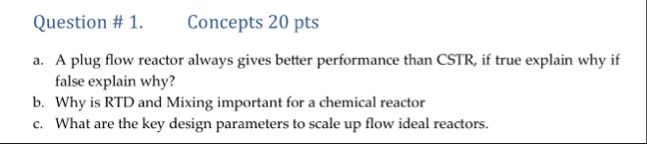 Question # 1. Concepts 20 pts
a. A plug flow reactor always gives better performance than CSTR, if true explain why if
false explain why?
b. Why is RTD and Mixing important for a chemical reactor
c. What are the key design parameters to scale up flow ideal reactors.
Question # 1. Concepts 20 pts
a. A plug flow reactor always gives better performance than CSTR, if true explain why if
false explain why?
b. Why is RTD and Mixing important for a chemical reactor
c. What are the key design parameters to scale up flow ideal reactors.
This is AI generated Response.
Asked by: Francis
Created at: 2026-01-22 07:33:21
Asked by: Francis
Created at: 2026-01-22 07:33:21
Final Answer:
Rendered
Raw Text
Did you like this answer?
## Step-by-Step Solution and Explanation
### a. Does a plug flow reactor (PFR) always give better performance than a CSTR? Explain.
This statement is generally true for many reactions but **not always**. A plug flow reactor (PFR) typically gives better performance than a continuous stirred-tank reactor (CSTR) for reactions where a higher conversion is desired for the same reactor volume, especially for first-order and many higher-order reactions. This is because, in a PFR, the concentration of reactants decreases along the length of the reactor, leading to higher rates at the inlet and better overall conversion. In contrast, a CSTR is perfectly mixed, so the reactant concentration is uniform (and lower), resulting in lower reaction rates and conversion for the same volume. However, for reactions with strong inhibition or autocatalysis, or where temperature control or safety is critical, a CSTR might be preferred. Therefore, the statement is **false** in that a PFR does not always give better performance; the actual choice depends on reaction kinetics, heat management, and safety considerations.
### b. Why is RTD and Mixing Important for a Chemical Reactor?
Residence Time Distribution (RTD) and mixing are crucial for chemical reactors because they directly affect the reactor's efficiency, selectivity, and safety. RTD provides information about how long different fluid elements spend inside the reactor, which impacts the extent of reaction and product distribution. Ideal reactors (PFR and CSTR) assume specific mixing patterns, but real reactors may deviate due to poor mixing or channeling. Poor mixing can lead to hot spots, incomplete reactions, or undesired by-products, whereas good mixing ensures uniform conditions, better control over reaction rates, and safer operation.
### c. What are the Key Design Parameters to Scale Up Ideal Flow Reactors?
The key design parameters for scaling up ideal flow reactors include reactor volume, flow rate, residence time, mixing characteristics (to ensure the reactor approaches ideal behavior), heat and mass transfer rates, and reactor geometry. It is also important to maintain similar dimensionless numbers, such as Reynolds, Peclet, and Damköhler numbers, to ensure that the scaled-up reactor behaves similarly to the laboratory-scale version. Proper scale-up requires maintaining the same conversion, selectivity, and safety profiles as in the smaller system.
---
**Final Answers:**
a. The statement is false. A PFR does not always give better performance than a CSTR; the actual performance depends on reaction kinetics, heat management, and safety requirements.
b. RTD and mixing are important because they affect reactor efficiency, selectivity, and safety by influencing how reactants are distributed and how long they reside in the reactor.
c. The key design parameters for scaling up ideal flow reactors are reactor volume, flow rate, residence time, mixing characteristics, heat and mass transfer rates, reactor geometry, and maintaining similar dimensionless numbers.
Question:
same answer ni humanise chesi evvi, Ai detect avvakunda.
This is AI generated Response.
Asked by: Francis
Created at: 2026-01-22 07:36:07
Asked by: Francis
Created at: 2026-01-22 07:36:07
Final Answer:
Rendered
Raw Text
Did you like this answer?
# Step-by-Step Solution and Explanation
## a. Do Plug Flow Reactors (PFR) Always Outperform CSTRs?
This assertion is generally true but not universally applicable. Plug flow reactors (PFRs) often achieve better performance than continuous stirred-tank reactors (CSTRs) when higher conversion rates are desired in the same reactor volume, especially for first-order reactions and many higher-order reactions. In a PFR, reactant concentrations diminish along the reactor length, enabling higher reaction rates at the inlet and leading to better overall conversion. Conversely, CSTRs are well-mixed, resulting in uniform but lower reactant concentrations, which can negatively affect reaction rates and conversions for the same reactor volume.
However, in some scenarios, such as reactions exhibiting strong inhibition, autocatalysis, or those requiring strict temperature control and safety measures, CSTRs may be more advantageous. Thus, the statement is not entirely accurate; the choice between a PFR and a CSTR hinges on factors like reaction kinetics, heat management, and safety considerations.
## b. Importance of RTD and Mixing in Chemical Reactors
Residence Time Distribution (RTD) and mixing are vital components in the operation of chemical reactors. They significantly influence the reactor's efficiency, selectivity, and safety. RTD informs us about the duration that different fluid elements spend within the reactor, which in turn affects the extent of reactions and the distribution of products.
While ideal reactors assume specific mixing patterns, real-world reactors can deviate from these assumptions due to inadequate mixing or channeling. Poor mixing can lead to issues such as hot spots, incomplete reactions, or the formation of unwanted by-products. On the other hand, effective mixing ensures uniform conditions, enhances control over reaction rates, and promotes safe operation.
## c. Key Design Parameters for Scaling Up Ideal Flow Reactors
When scaling up ideal flow reactors, several key design parameters must be considered. These include:
1. **Reactor Volume**: The total volume should be appropriately scaled to accommodate the desired throughput.
2. **Flow Rate**: The flow rate must be adjusted to ensure that residence times remain comparable.
3. **Residence Time**: Maintaining similar residence times is critical for achieving the same conversion efficiency.
4. **Mixing Characteristics**: Ensuring effective mixing is essential for maintaining ideal reactor behavior.
5. **Heat and Mass Transfer Rates**: These rates should be optimized to ensure efficient reaction conditions.
6. **Reactor Geometry**: The design and shape of the reactor can affect flow patterns and mixing.
7. **Dimensionless Numbers**: It’s important to maintain similar Reynolds, Peclet, and Damköhler numbers to ensure that the scaled reactor behaves similarly to the smaller version.
In summary, proper scale-up involves maintaining the same conversion, selectivity, and safety profiles as observed in smaller systems.
---
**Final Answers:**
a. The statement is not entirely accurate; a PFR does not always outperform a CSTR. The choice depends on various factors, including reaction kinetics and safety needs.
b. RTD and mixing are crucial as they significantly impact efficiency, selectivity, and safety, influencing reactant distribution and residence time.
c. Key design parameters for scaling up ideal flow reactors include reactor volume, flow rate, residence time, mixing characteristics, heat and mass transfer rates, reactor geometry, and maintaining similar dimensionless numbers.
📢 Instructions:
- Ask anything relatd to above question only.
- For new Question goto :