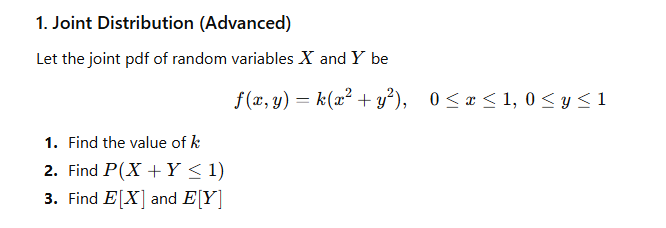
Act like a helpful tutor and exlain me :1. Joint Distribution (Advanced)
Let the joint pdf of random variables X and ¥ be
Jey) =k’ +4), 0
Question:
Act like a helpful tutor and exlain me :1. Joint Distribution (Advanced)
Let the joint pdf of random variables X and ¥ be
Jey) =k’ +4), 0
This is AI generated Response.
Asked by: Alok Kumar
Created at: 2026-02-02 12:37:10
Final Answer:
RenderedRaw Text
Did you like this answer?
Let's work through the problem step by step!
---
## 1. **Find the value of \( k \)**
Since \( f(x, y) \) is a **joint probability density function (pdf)**, it must integrate to **1** over the given region:
\[
\int_^1 \int_^1 k(x^2 + y^2) \, dy \, dx = 1
\]
Let's solve it:
### Step 1: Integrate with respect to \( y \):
\[
\int_^1 (x^2 + y^2) \, dy = x^2 \int_^1 dy + \int_^1 y^2 dy = x^2[y]_^1 + \left[\frac{y^3}{3}\right]_^1 = x^2(1) + \frac{1}{3}
\]
So,
\[
\int_^1 (x^2 + y^2) \, dy = x^2 + \frac{1}{3}
\]
### Step 2: Integrate with respect to \( x \):
\[
\int_^1 \left( x^2 + \frac{1}{3} \right) dx = \int_^1 x^2 dx + \int_^1 \frac{1}{3} dx = \left[ \frac{x^3}{3} \right]_^1 + \frac{1}{3}[x]_^1 = \frac{1}{3} + \frac{1}{3} = \frac{2}{3}
\]
### Step 3: Set total integral to 1 and solve for \( k \):
\[
k \cdot \frac{2}{3} = 1 \implies k = \frac{3}{2}
\]
---
## 2. **Find \( P(X + Y \leq 1) \)**
This is the probability over the region \( \leq x \leq 1 \), \( \leq y \leq 1-x \):
\[
P(X+Y \leq 1) = \int_^1 \int_^{1-x} k(x^2 + y^2) \, dy \, dx
\]
Recall \( k = \frac{3}{2} \):
First, integrate with respect to \( y \):
\[
\int_^{1-x} (x^2 + y^2) \, dy = x^2 \int_^{1-x} dy + \int_^{1-x} y^2 dy = x^2 (1-x) + \left[ \frac{y^3}{3} \right]_^{1-x} = x^2 (1-x) + \frac{(1-x)^3}{3}
\]
Now integrate with respect to \( x \):
\[
\int_^1 \left( x^2(1-x) + \frac{(1-x)^3}{3} \right) dx
\]
Let's break this up:
- \( \int_^1 x^2(1-x) dx = \int_^1 (x^2 - x^3) dx = \left[ \frac{x^3}{3} - \frac{x^4}{4} \right]_^1 = \frac{1}{3} - \frac{1}{4} = \frac{1}{12} \)
- \( \int_^1 \frac{(1-x)^3}{3} dx = \frac{1}{3} \int_^1 (1 - 3x + 3x^2 - x^3) dx = \frac{1}{3} \left[ x - \frac{3x^2}{2} + x^3 - \frac{x^4}{4} \right]_^1 \)
- \( = \frac{1}{3} \left( 1 - \frac{3}{2} + 1 - \frac{1}{4} \right) = \frac{1}{3} \left(2 - \frac{3}{2} - \frac{1}{4}\right) = \frac{1}{3} \left(2 - 1.75 \right) = \frac{1}{3} \times .25 = \frac{1}{12} \)
So the total is \( \frac{1}{12} + \frac{1}{12} = \frac{1}{6} \).
Multiply by \( k = \frac{3}{2} \):
\[
P(X+Y \leq 1) = \frac{3}{2} \times \frac{1}{6} = \frac{1}{4}
\]
---
## 3. **Find \( E[X] \) and \( E[Y] \)**
Recall,
\[
E[X] = \iint x f(x, y) \, dy \, dx
\]
\[
E[Y] = \iint y f(x, y) \, dy \, dx
\]
### **For \( E[X] \):**
\[
E[X] = \int_^1 \int_^1 x \cdot k(x^2 + y^2) dy dx
\]
\[
= k \int_^1 \int_^1 (x^3 + x y^2) dy dx
\]
Integrate with respect to \( y \):
\[
\int_^1 (x^3 + x y^2) dy = x^3 \int_^1 dy + x \int_^1 y^2 dy = x^3 (1) + x \left(\frac{1}{3}\right) = x^3 + \frac{x}{3}
\]
Now integrate with respect to \( x \):
\[
\int_^1 \left( x^3 + \frac{x}{3} \right) dx = \left[ \frac{x^4}{4} + \frac{x^2}{6} \right]_^1 = \frac{1}{4} + \frac{1}{6} = \frac{5}{12}
\]
Multiply by \( k = \frac{3}{2} \):
\[
E[X] = \frac{3}{2} \cdot \frac{5}{12} = \frac{15}{24} = \frac{5}{8}
\]
### **For \( E[Y] \):**
By symmetry (since \( x^2 + y^2 \) is symmetric in \( x \) and \( y \) over the same interval), \( E[Y] = E[X] = \frac{5}{8} \).
---
## **Summary Table**
| Part | Answer |
|------|--------|
| 1. \( k \) | \( \frac{3}{2} \) |
| 2. \( P(X+Y \leq 1) \) | \( \frac{1}{4} \) |
| 3. \( E[X], E[Y] \) | \( \frac{5}{8} \), \( \frac{5}{8} \) |
If you need any step explained in more detail, just let me know!
Question:
1
.
(
Conditional
+
Bayes
–
Tricky
)
A box contains
3
fair coins and
2
double
-
headed coins. A coin is chosen at random and tossed
4
times. All
4
tosses result in heads. What is the probability that the chosen coin is double
-
headed?
This is AI generated Response.
Asked by: Alok Kumar
Created at: 2026-02-02 14:52:20
Final Answer:
RenderedRaw Text
Did you like this answer?
# Conditional Probability Problem
## Problem Statement
A box contains:
- 3 fair coins
- 2 double-headed coins
A coin is chosen at random and tossed 4 times, resulting in heads each time. We need to find the probability that the chosen coin is double-headed given that all 4 tosses resulted in heads.
## Definitions and Notation
- Let \( A \) be the event that the chosen coin is double-headed.
- Let \( B \) be the event that all 4 tosses result in heads.
## Step 1: Find \( P(A) \) and \( P(A^c) \)
- Total coins = \( 3 + 2 = 5 \)
- Probability of choosing a double-headed coin:
\[
P(A) = \frac{2}{5}
\]
- Probability of choosing a fair coin:
\[
P(A^c) = \frac{3}{5}
\]
## Step 2: Find \( P(B | A) \) and \( P(B | A^c) \)
### For double-headed coin (\( A \)):
- If the coin is double-headed, all tosses will result in heads:
\[
P(B | A) = 1
\]
### For fair coin (\( A^c \)):
- For a fair coin, the probability of getting heads in one toss is \( \frac{1}{2} \). Thus, for 4 tosses:
\[
P(B | A^c) = \left( \frac{1}{2} \right)^4 = \frac{1}{16}
\]
## Step 3: Use Bayes' Theorem
We want to find \( P(A | B) \):
\[
P(A | B) = \frac{P(B | A) P(A)}{P(B)}
\]
### Step 3.1: Calculate \( P(B) \) using the law of total probability:
\[
P(B) = P(B | A) P(A) + P(B | A^c) P(A^c)
\]
Substituting the values:
\[
P(B) = (1) \cdot \frac{2}{5} + \left( \frac{1}{16} \right) \cdot \frac{3}{5}
\]
Calculating:
\[
P(B) = \frac{2}{5} + \frac{3}{80} = \frac{32}{80} + \frac{3}{80} = \frac{35}{80} = \frac{7}{16}
\]
### Step 3.2: Substitute back into Bayes' Theorem:
\[
P(A | B) = \frac{P(B | A) P(A)}{P(B)} = \frac{1 \cdot \frac{2}{5}}{\frac{7}{16}} = \frac{\frac{2}{5}}{\frac{7}{16}} = \frac{2 \cdot 16}{5 \cdot 7} = \frac{32}{35}
\]
## Final Answer
The probability that the chosen coin is double-headed given that all 4 tosses resulted in heads is:
\[
\boxed{\frac{32}{35}}
\]
Question:
find the median of the given data:
2
,
8
,
6
,
7
,
1
0
,
1
6
,
1
8
,
1
1
,
5
This is AI generated Response.
Asked by: Alok Kumar
Created at: 2026-02-03 04:08:48
Final Answer:
RenderedRaw Text
Did you like this answer?
# Finding the Median of a Given Data Set
## Step 1: Organize the Data
First, we need to arrange the data in **ascending order**:
Data:
\[ 2, 5, 6, 7, 8, 10, 11, 16, 18 \]
## Step 2: Determine the Number of Data Points
Count the data points:
- There are **9 data points**.
## Step 3: Find the Median
Since the number of data points is odd, the median is the middle value.
### Calculation:
- The middle index can be found using the formula:
\[
\text{Median Index} = \frac{n + 1}{2}
\]
Where \( n \) is the number of data points.
For our data:
\[
\text{Median Index} = \frac{9 + 1}{2} = 5
\]
### Step 4: Identify the Median Value
- The median is the value at the 5th position in the ordered data set:
\[
\text{Ordered Data: } 2, 5, 6, 7, \textbf{8}, 10, 11, 16, 18
\]
## Final Answer
The median of the given data set is:
\[
\boxed{8}
\]
Question:
Scenario Sipho and Amina are close friends who plan to start a renewable energy business in South Africa that manufactures and installs affordable solar home systems for rural communities. They estimate needing R
8
million in start
-
up capital. They are considering whether to register as a Private Company
(
Pty
)
Ltd or a Partnership. Sipho can invest R
5
million and Amina R
3
million. They also plan to approach banks and development finance institutions for loans. Sipho prefers a partnership for its flexibility, while Amina insists on a Pty Ltd for limited liability and investor confidence. They approach you as a financial planning consultant to assist them. Question
1
(
8
Marks
)
Analyse and discuss four
(
4
)
key differences between a partnership and a private company that Sipho and Amina should consider. Question
2
(
1
2
Marks
)
Using the six
-
step financial planning process, advise Sipho and Amina on how to structure their financial planning for the new venture. Question
3
(
1
0
Marks
)
Recommend the most appropriate business entity for Sipho and Amina, justifying your answer with reference to liability, capital raising, tax, and continuity.
This is AI generated Response.
Asked by: Alok Kumar
Created at: 2026-02-03 05:50:27
Final Answer:
RenderedRaw Text
Did you like this answer?
# Analysis of Business Structure for Sipho and Amina
## Question 1: Key Differences Between a Partnership and a Private Company (Pty Ltd)
1. **Liability**:
- **Partnership**: Partners have unlimited liability, meaning personal assets can be at risk if the business incurs debts.
- **Private Company (Pty Ltd)**: Limited liability is offered, protecting personal assets from business debts.
2. **Ownership and Control**:
- **Partnership**: Ownership is shared among partners, and decisions are made collectively.
- **Private Company (Pty Ltd)**: Ownership can be divided into shares, allowing for easier transfer of ownership and structured decision-making.
3. **Regulatory Requirements**:
- **Partnership**: Fewer formalities and less regulatory oversight, making it simpler to establish and operate.
- **Private Company (Pty Ltd)**: Subject to stricter regulations, including annual returns, financial statements, and compliance with company law.
4. **Raising Capital**:
- **Partnership**: Limited to the contributions of partners, which may hinder growth opportunities.
- **Private Company (Pty Ltd)**: Easier to raise capital through the sale of shares, attracting investors and potentially securing larger loans due to perceived credibility.
---
## Question 2: Six-Step Financial Planning Process
1. **Establish Goals**:
- Define short-term and long-term financial goals for the solar energy business, such as revenue targets, market share, and expansion plans.
2. **Gather Data**:
- Collect financial information, including current assets, liabilities, and investment contributions from Sipho and Amina (R5 million and R3 million).
3. **Analyze Financial Status**:
- Assess the current financial health, including cash flow projections and potential profitability based on market research for solar energy systems.
4. **Develop a Financial Plan**:
- Outline a budget for start-up costs and operational expenses. Include a financial model that incorporates expected sales, funding sources, and loan repayment plans.
5. **Implement the Plan**:
- Execute the financial plan by registering the business structure, securing funding, and initiating operations. Establish roles and responsibilities for Sipho and Amina.
6. **Monitor and Review**:
- Regularly review financial performance against goals. Adjust the financial plan as needed based on actual performance and changing market conditions.
---
## Question 3: Recommended Business Entity
### Recommendation: Private Company (Pty Ltd)
**Justification**:
1. **Liability**:
- The limited liability structure of a Pty Ltd protects Sipho’s and Amina's personal assets. This is essential in the renewable energy sector, which can involve significant financial risks.
2. **Capital Raising**:
- A Pty Ltd can raise capital more efficiently by issuing shares. This feature is advantageous for attracting investors or securing loans from banks and financial institutions.
3. **Tax Benefits**:
- A Pty Ltd may have access to certain tax benefits and incentives related to renewable energy initiatives, which can enhance overall profitability.
4. **Continuity**:
- A Pty Ltd has perpetual succession, meaning the business can continue to exist independently of the owners. This is crucial for long-term sustainability and growth, especially in a sector like renewable energy.
By choosing a Private Company structure, Sipho and Amina can effectively balance their investment needs with personal protection, fostering a more robust business foundation.
Question:
ncutt News was told that the woman, who lives at Valsayn South, was also robbed of her purse which contained personal items. Around
1
:
3
0
pm on Monday
2
4
th April
2
0
2
3
,
the victim emerged from Scotia Bank at the corner of St
.
John's Road and Eastern Main Road in St
.
Augustine and was walking through the car park when a car stopped near her. Two suspects got out of a grey Toyota motorcar Reg. No
.
PDJ
9
2
5
2
and approached her. One of the suspects pointed a gun at the woman and announced a robbery. The victim, Uncutt understands, handed over a white envelope that contained TTD
2
3
,
0
0
0
.
She was also relieved of two gold rings, and a black wallet with personal items including her Driver's Permit and national ID card. The suspects re
-
entered their vehicle and fled the scene. A report was made to the police and PC Mosan of the St
.
Joseph CID was detailed to investigate the incident. Flashback: On Tuesday
1
1
th April
2
0
2
3
: A
6
9
-
year
-
old female pensioner of Caroni was robbed of an envelope that contained $
1
7
,
0
0
0
moments after she left the Valpark branch of Republic Bank. Two suspects followed the woman's vehicle near a Happiness Supermarket and robbed her of the cash. Question, should banks be mandated to implement regulations regarding the conduct of bank employees as it relates to their possible involvement with the criminal unworld and or facilitating crime against its customers. Critically discuss.
This is AI generated Response.
Asked by: Alok Kumar
Created at: 2026-02-03 06:08:15
Final Answer:
RenderedRaw Text
Did you like this answer?
# Discussion on Bank Regulations Regarding Employee Conduct
## Introduction
The recent robbery incidents involving bank customers highlight potential vulnerabilities in the banking sector, particularly regarding employee conduct and the prevention of crime. This discussion examines whether banks should be mandated to implement regulations to oversee employee behavior and prevent potential collusion with criminals.
## Arguments for Mandating Regulations
1. **Customer Safety**:
- Banks have a duty of care to protect their customers. Employees often have access to sensitive information, including customer transactions and personal details, which could be exploited if proper oversight is not in place.
- Rigorous regulations could help prevent employees from engaging in or facilitating criminal activities, thus enhancing customer safety.
2. **Trust and Confidence in Banking**:
- Customer confidence is vital for the stability of financial institutions. High-profile cases of employee misconduct can erode trust, leading to reduced customer retention and potential financial loss for banks.
- Implementing strict conduct regulations can reassure customers that the bank prioritizes their safety and ethical standards.
3. **Preventing Internal Collusion**:
- Employees who are aware of customer transactions or who may have access to cash can potentially collude with criminals. Regulations could include background checks, regular audits, and reporting mechanisms for suspicious behavior.
- Proactive measures can deter employees from engaging in unethical practices with external criminal elements.
4. **Legal and Ethical Responsibilities**:
- Banks operate under a social contract with the public, which includes ethical considerations beyond mere profit-making. Mandated regulations would align employee conduct with broader ethical standards expected in financial services.
- Failure to implement such regulations could result in legal liabilities for banks, particularly if they are found to be complicit or negligent in preventing crime.
## Arguments Against Mandating Regulations
1. **Operational Burden**:
- Mandating regulations may impose significant operational burdens on banks, particularly smaller institutions that may lack resources for extensive compliance measures.
- Increased regulation may lead to higher operational costs, which could be passed on to customers through fees.
2. **Employee Morale and Trust**:
- Overly stringent regulations may create an environment of distrust between management and employees, potentially harming workplace morale.
- Trusting employees to act ethically can foster a positive workplace culture, leading to better customer service and employee satisfaction.
3. **Existing Safeguards**:
- Many banks already have internal policies and procedures to address employee conduct, including training programs and compliance departments. Additional regulations may be redundant and unnecessarily complicate existing frameworks.
- Focusing on enhancing current practices rather than imposing new regulations may be a more efficient approach.
4. **Market Dynamics**:
- The banking sector is competitive, and banks that fail to protect their customers risk losing them to competitors. Market forces may, in effect, regulate employee conduct more effectively than mandated regulations.
## Conclusion
While there are valid arguments both for and against mandating regulations regarding bank employee conduct, the balance leans towards the necessity of such measures given the critical importance of customer safety and trust. Banks should be encouraged to adopt comprehensive employee conduct regulations to mitigate risks associated with criminal activity, while also ensuring that such regulations are implemented in a way that does not hinder operational efficiency or employee morale. Implementing a balanced approach that includes both regulation and employee training may provide a comprehensive solution to enhance customer safety and trust in the banking sector.
VIPSolutions focuses on clear, step‑by‑step explanations so you can learn quickly. Whether you need an AI‑generated walkthrough or a short hint to get unstuck, each solution is organized for fast reading and easy review later.
Search similar questions, compare approaches, and bookmark the best answers for revision. Our goal is simple: quick, reliable study help that feels natural—not noisy.
 VIPSolutions
 1. Joint Distribution (Advanced)
Let the joint pdf of random variables X and ¥ be
Jey) =k’ +4), 0
1. Joint Distribution (Advanced)
Let the joint pdf of random variables X and ¥ be
Jey) =k’ +4), 0