Show Attempt History
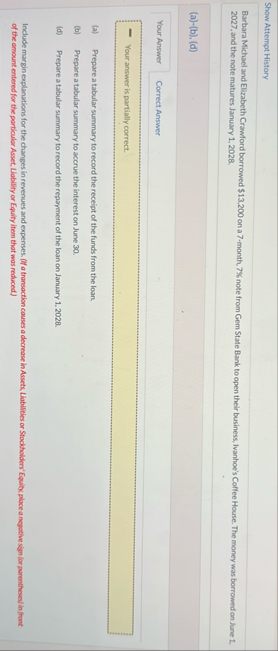
Barbara Michael and Elizabeth Crawford borrowed $
1
3
,
2
0
0
on a
7
-
month,
7
%
note from Gem State Bank to open their business, Ivanhoe's Coffee House. The money was borrowed on June
1
,
2
0
2
7
,
and the note matures January
1
,
2
0
2
8
.
(
a
)
-
(
b
)
,
(
d
)
Correct Answer
Your answer is partially correct.
(
a
)
Prepare a tabular summary to record the receipt of the funds from the loan,
(
b
)
Prepare a tabular summary to accrue the interest on June
3
0
.
(
d
)
Prepare a tabular summary to record the repayment of the loan on January
1
.
2
0
2
8
.
Include margin explanations for the changes in revenues and experses.
(
If a transaction causes a decrease in Assets, Liabilities or Stockholders' Equiby, place a negative sign
(
or parenthese
)
in front of the amount entered for the particular Asset, Liability or Equily item that was reduced
)Pe — {
wma
TERI did
Hori] i
Ennlre
iol [
til
foi
i; i
| i
i
a
i
i
:
y |
il
bd i
Question:
Show Attempt History
Barbara Michael and Elizabeth Crawford borrowed $
1
3
,
2
0
0
on a
7
-
month,
7
%
note from Gem State Bank to open their business, Ivanhoe's Coffee House. The money was borrowed on June
1
,
2
0
2
7
,
and the note matures January
1
,
2
0
2
8
.
(
a
)
-
(
b
)
,
(
d
)
Correct Answer
Your answer is partially correct.
(
a
)
Prepare a tabular summary to record the receipt of the funds from the loan,
(
b
)
Prepare a tabular summary to accrue the interest on June
3
0
.
(
d
)
Prepare a tabular summary to record the repayment of the loan on January
1
.
2
0
2
8
.
Include margin explanations for the changes in revenues and experses.
(
If a transaction causes a decrease in Assets, Liabilities or Stockholders' Equiby, place a negative sign
(
or parenthese
)
in front of the amount entered for the particular Asset, Liability or Equily item that was reduced
)Pe — {
wma
TERI did
Hori] i
Ennlre
iol [
til
foi
i; i
| i
i
a
i
i
:
y |
il
bd i
This is AI generated Response.
Asked by: Veera manikanta
Created at: 2025-07-28 16:28:04
Final Answer:
RenderedRaw Text
Did you like this answer?
Let's break down each requirement and provide the tabular summaries with margin notes for each transaction.
### Given Data
- **Principal borrowed:** $13,200
- **Interest Rate:** 7%
- **Loan term:** 7 months
- **Date borrowed:** June 1, 2027
- **Maturity date:** January 1, 2028
---
## (a) Receipt of Funds (June 1, 2027)
| Date | Assets (Cash) | Liabilities (Notes Payable) | Stockholders’ Equity | Explanation |
|------------|--------------|-----------------------------|---------------------|----------------------------------------|
| June 1 | +$13,200 | +$13,200 | | Borrowed cash by signing note payable. |
---
## (b) Accrue Interest on June 30, 2027
**Interest for 1 month:**
\[
\text{Interest} = \$13,200 \times 7\% \times \frac{1}{12} = \$77
\]
| Date | Assets (Cash) | Liabilities (Interest Payable) | Stockholders’ Equity (Interest Expense) | Explanation |
|------------|--------------|-------------------------------|----------------------------------------|--------------------------------------|
| June 30 | | +$77 | -$77 | Accrued 1 month interest expense. |
---
## (d) Repayment of the Loan (January 1, 2028)
**Total interest for 7 months:**
\[
\text{Interest} = \$13,200 \times 7\% \times \frac{7}{12} = \$539
\]
**Interest already accrued at June 30:** $77
**Interest to expense from July 1 to Dec 31 (6 months):**
\[
\$13,200 \times 7\% \times \frac{6}{12} = \$462
\]
| Date | Assets (Cash) | Liabilities (Notes Payable) | Liabilities (Interest Payable) | Stockholders’ Equity (Interest Expense) | Explanation |
|------------|--------------|-----------------------------|-------------------------------|----------------------------------------|------------------------------------------------------------------------------------------------------|
| Jan 1, 2028| -$13,739 | -$13,200 | -$77 | -$462 | Paid off note and total interest. (Remaining 6 months interest expensed, all liabilities settled.) |
---
### **Margin Explanations**
- **(a) Receipt of funds:** Assets (cash) and liabilities (notes payable) both increase by the loan amount.
- **(b) Accrued interest:** Interest expense reduces equity; interest payable liability increases.
- **(d) Repayment:** Cash decreases by the total payment (principal + full interest), liabilities are cleared, and the remaining interest expense for July–December is recognized.
---
**Let me know if you need the table in a different format or more explanation!**
Question:
1: Introduction:
Provide the complete necessary conceptual background concepts explanation and the
introduction required to understand and answer the given question. Add an Explanation
block at the end of the introduction by adding various relevant supporting statements and
explaining the introduction concisely.
Note: Do not use personal pronouns like I, we, you, etc. The response must look as if it is
written by a human.
Explanation: Articulate the importance of the introduction, providing more relevant
comprehensive supporting statements that link these concepts directly to the question.
This explanation should clarify how the introduction aids in comprehending the
subsequent steps.
2: Presentation of Relevant Formulas Required To Solve The Question:
List and also describe all formulas required to solve the question. Ensure each formula is
presented clearly and is directly applicable to the problem.
Explanation: Detail the derivation or rationale behind each formula, explaining its
relevance and necessity in the context of the problem-solving process. Use more relavent
comprehensive supporting statements to reinforce the significance of these mathematical
tools.
3: A Detailed Step-by-Step Solution:
Write a step-by-step in-depth comprehensive straight forward complete solution in a
structured way without missing anything as per the requirements and also include
explanation [ Write relevant supporting statements in the explanation block ] for every step
in the solution.
Conclusion:
Conclude with a concise summary of the solution, succinctly presenting the final answer
short summary derived from the calculations.
Follow These Guidelines While Answering The Question:
1. Maintain a professional and impersonal tone throughout, avoiding personal
pronouns such as 'I', 'we', 'you', etc.
2. Ensure more accuracy and adherence to the necessary concepts and correct
textbook based correct formulas and other relevant, required to solve the question.
3. Include an Explanation block at the end of each step to provide context and clarify
the methodology used by providing the necessary supporting statements.
4. Focus solely on delivering a well-explained direct and complete answer to the
question, without additional guidance [ I don’t need any guidance of how to solve
the question – I just need well-explained complete solution ] or extraneous content.
5. Make sure that strictly follow the specified format, ensuring that each section,
especially the introduction and each step of the solution, is accompanied by a
detailed relevant supporting statement in the explanation.
6. I need the exact detailed comprehensive direct step-by-step answer as I don’t need
any guidance to write the answer and strictly add the explanation for each with the
required supporting statement & Please give me the complete answer as per the
question requirements without skipping anything in the answer.
7. Always provide correct, complete detailed & well-explained solution.
8. Ensure that there are no typo/formula/calculation/programming/grammatical errors
are present in your solution.
9. Give the correct graphs/diagrams/tables/charts whenever required in the solution.
10. Ensure that there are NO Errors in Units/Notations are there in your solution.
11. Avoid missing any vital part in the solution [ Don’t miss any part in the solution ].
This is AI generated Response.
Asked by: Veera manikanta
Created at: 2025-07-28 16:35:23
Final Answer:
RenderedRaw Text
Did you like this answer?
**Introduction**
In accounting, when a business borrows funds through a note payable, it must record the initial receipt of cash as well as subsequent interest accruals and eventual repayment. The core concepts involved include the recognition of assets (cash received), liabilities (notes payable), and expenses (interest expense) that accrue over time. The process involves analyzing the timing of transactions and applying principles of accrual accounting to recognize expenses in the period they are incurred, regardless of when cash payments are made. Understanding the calculation of interest on a note payable, especially over partial periods, is essential for accurately recording accrued interest and preparing financial statements. This involves applying the formula for interest calculation and systematically updating accounts as transactions occur.
**Explanation:**
This introduction establishes the fundamental accounting principles necessary to understand the subsequent transaction recordings. Recognizing the importance of timing and accruals ensures accurate financial reporting. It also prepares for the application of specific formulas and systematic recording of the loan transaction, interest accrual, and repayment, which are crucial for maintaining accurate financial statements.
---
**Presentation of Relevant Formulas Required To Solve The Question**
1. **Interest Calculation Formula:**
\[
\text{Interest} = \text{Principal} \times \text{Interest Rate} \times \frac{\text{Time Period (in months)}}{12}
\]
- **Purpose & Relevance:**
This formula calculates the amount of interest accrued over a specific period on a principal amount at a given annual interest rate. It is essential for determining interest expense and interest payable at different points in time, especially when interest accrues gradually over multiple periods.
2. **Total Interest for the Loan:**
\[
\text{Total Interest} = \text{Principal} \times \text{Interest Rate} \times \frac{\text{Loan Duration (in months)}}{12}
\]
- **Purpose & Relevance:**
Used to find the full interest amount payable at the loan’s maturity, aiding in total liability recognition and repayment planning.
3. **Interest Expense Recognition:**
Interest expense is recognized based on the interest accrued during each accounting period, whether or not cash has been paid.
---
**A Detailed Step-by-Step Solution**
### Step 1: Record the receipt of funds on June 1, 2027
- **Transaction:** Barbara Michael and Elizabeth Crawford borrow $13,200 at 7% for 7 months.
- **Journal Entry:**
| Date | Accounts | Debit | Credit | Explanation |
|---------|------------------------------|----------------|-----------------|-----------------------------------------------------------|
| June 1 | Cash | $13,200 | | Receipt of loan funds from Gem State Bank. |
| | Notes Payable | | $13,200 | Obligation to repay the borrowed amount. |
**Explanation:**
The business receives cash, increasing assets, and recognizes a liability in the form of notes payable.
---
### Step 2: Accrue interest on June 30, 2027
- **Interest for 1 month (June):**
\[
\$13,200 \times 7\% \times \frac{1}{12} = \$77
\]
- **Journal Entry:**
| Date | Accounts | Debit | Credit | Explanation |
|----------|---------------------------------|-----------|-------------|-----------------------------------------------|
| June 30 | Interest Expense | $77 | | Interest expense accrued for June. |
| | Interest Payable | | $77 | Liability for accrued interest at period end.|
**Explanation:**
Interest is accrued for June, recognizing an expense and a liability, following the matching principle in accrual accounting.
---
### Step 3: Record the repayment on January 1, 2028
- **Total interest for 7 months:**
\[
\$13,200 \times 7\% \times \frac{7}{12} = \$539
\]
- **Interest already accrued as of June 30, 2027:** $77
- **Interest expense for July 1 to December 31 (6 months):**
\[
\$13,200 \times 7\% \times \frac{6}{12} = \$462
\]
- **Total interest payable at repayment:**
\[
\$77 (\text{already accrued}) + \$462 (\text{for July–December}) = \$539
\]
- **Total amount to be paid:**
\[
\$13,200 (\text{principal}) + \$539 (\text{total interest}) = \$13,739
\]
- **Journal Entry:**
| Date | Accounts | Debit | Credit | Explanation |
|-------------|---------------------------------|-------------|--------------|------------------------------------------------------------------|
| Jan 1, 2028 | Notes Payable | $13,200 | | Pay off the principal amount. |
| | Interest Payable | $77 | | Settle the accrued interest from June 30. |
| | Interest Expense (July–Dec) | $462 | | Recognize interest expense for July–December. |
| | Cash | | $13,739 | Total payment covering principal and interest. |
**Note:**
The interest expense for July–December ($462) is recognized at the time of payment to match expenses with the period incurred; the interest payable liability is cleared by paying the accrued interest.
---
### **Summary of Changes with Margin Explanations:**
- **June 1:** Assets (cash) and liabilities (notes payable) increase equally.
- **June 30:** Interest expense is recognized, increasing expenses and decreasing equity; interest payable liability increases.
- **January 1:** Cash decreases by the total repayment amount; liabilities (notes payable and interest payable) are reduced to zero; interest expense for the remaining period is recognized.
---
**Conclusion:**
The step-by-step recording of the loan, interest accrual, and repayment involves systematic application of interest calculation formulas, accrual principles, and proper journal entries. Accurate recognition of interest expenses and liabilities ensures the financial statements reflect the true financial position at each stage, aligning with generally accepted accounting principles.
VIPSolutions focuses on clear, step‑by‑step explanations so you can learn quickly. Whether you need an AI‑generated walkthrough or a short hint to get unstuck, each solution is organized for fast reading and easy review later.
Search similar questions, compare approaches, and bookmark the best answers for revision. Our goal is simple: quick, reliable study help that feels natural—not noisy.
 VIPSolutions
 Pe — {
wma
TERI did
Hori] i
Ennlre
iol [
til
foi
i; i
| i
i
a
i
i
:
y |
il
bd i
Pe — {
wma
TERI did
Hori] i
Ennlre
iol [
til
foi
i; i
| i
i
a
i
i
:
y |
il
bd i