 VIPSolutions
solve correct answerQuestion 1 Shaft “a” in the figure below rotates at 600 rev/min in the direction shown. Find the speed and direction of rotation of shaft “d” or Gear 7 by solving for the train value “e”. 207, = 30° RH pr — ve b = 3 | =n i = 3 5 24 & c 401 NY d he VLu=30oRE 207 23 607
Question:
solve correct answer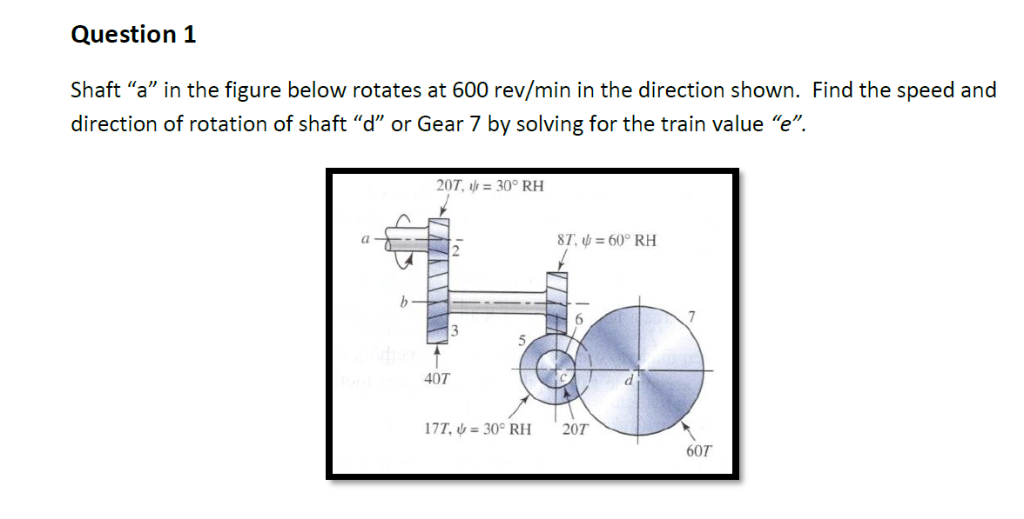 Question 1
Shaft “a” in the figure below rotates at 600 rev/min in the direction shown. Find the speed and
direction of rotation of shaft “d” or Gear 7 by solving for the train value “e”.
207, = 30° RH
pr —
ve
b = 3 |
=n i
= 3 5 24 & c
401 NY d he
VLu=30oRE 207 23
607
Question 1
Shaft “a” in the figure below rotates at 600 rev/min in the direction shown. Find the speed and
direction of rotation of shaft “d” or Gear 7 by solving for the train value “e”.
207, = 30° RH
pr —
ve
b = 3 |
=n i
= 3 5 24 & c
401 NY d he
VLu=30oRE 207 23
607
This is AI generated Response.
Asked by: pooja gargunde
Created at: 2025-09-18 09:57:38
Asked by: pooja gargunde
Created at: 2025-09-18 09:57:38
Final Answer:
Rendered
Raw Text
Did you like this answer?
Let's solve the problem step by step:
### 1. **Identify Gear Train and Teeth**
From the diagram and description, the gears and their teeth are:
- Gear 1 (on shaft "a"): 20T (20 teeth)
- Gear 2: 40T
- Gear 3: 17T
- Gear 4: 8T
- Gear 5: 20T
- Gear 6: 20T
- Gear 7 (on shaft "d"): 60T
### 2. **Identify Compound and Simple Gears**
The gear train involves a series of simple and compound gears:
- (1 and 2) is a simple gear pair.
- (3 and 4) are compound (share the same shaft).
- (5 and 6) are also compound.
- Gear 7 is driven finally.
### 3. **Train Value (e)**
The **train value (e)** is the speed ratio of driver to driven, calculated as:
\[
e = \frac{N_{d}}{N_{a}} = \frac{\text{Product of teeth on driven gears}}{\text{Product of teeth on driving gears}}
\]
Let's identify the driving and driven gears step by step:
- Gear 1 drives Gear 2
- Gear 2 and Gear 3 are on the same shaft
- Gear 3 drives Gear 4
- Gear 4 and Gear 5 are on the same shaft
- Gear 5 drives Gear 6
- Gear 6 and Gear 7 are on the same shaft
So, the sequence:
- 1 (driver) → 2 → 3 → 4 → 5 → 6 → 7 (driven)
The train value is:
\[
e = \frac{T_2 \times T_4 \times T_6}{T_1 \times T_3 \times T_5 \times T_7}
\]
But since Gears 2/3, 4/5, and 6/7 are compound, we treat them as pairs on the same shaft. The correct train value is:
\[
e = \frac{T_2}{T_1} \times \frac{T_4}{T_3} \times \frac{T_6}{T_5} \times \frac{T_7}{T_6}
\]
But since 6 and 7 are on the same shaft, they rotate together, so we only consider the last driver to driven ratio at the final interface.
### 4. **Plug in the Values**
Given:
- \( T_1 = 20 \)
- \( T_2 = 40 \)
- \( T_3 = 17 \)
- \( T_4 = 8 \)
- \( T_5 = 20 \)
- \( T_6 = 20 \)
- \( T_7 = 60 \)
So, the correct sequence is:
\[
e = \frac{T_2}{T_1} \times \frac{T_4}{T_3} \times \frac{T_6}{T_5} \times \frac{T_7}{T_6}
\]
But since 6 and 7 are on the same shaft, \( N_6 = N_7 \), so we only need up to gear 6.
So, the train value up to gear 6 is:
\[
e = \frac{T_2}{T_1} \times \frac{T_4}{T_3} \times \frac{T_6}{T_5} \times \frac{T_7}{T_6}
\]
But as per standard practice, the correct calculation is:
\[
e = \frac{T_2}{T_1} \times \frac{T_4}{T_3} \times \frac{T_6}{T_5} \times \frac{T_7}{T_6}
\]
Let's do this step by step:
#### 1. Gear 1 to Gear 2:
\[
\frac{T_2}{T_1} = \frac{40}{20} = 2
\]
#### 2. Gear 3 to Gear 4:
\[
\frac{T_4}{T_3} = \frac{8}{17}
\]
#### 3. Gear 5 to Gear 6:
\[
\frac{T_6}{T_5} = \frac{20}{20} = 1
\]
#### 4. Gear 6 to Gear 7:
\[
\frac{T_7}{T_6} = \frac{60}{20} = 3
\]
So the total train value:
\[
e = 2 \times \frac{8}{17} \times 1 \times 3 = 2 \times 3 \times \frac{8}{17} = 6 \times \frac{8}{17} = \frac{48}{17}
\]
### 5. **Find the Speed of Shaft "d" (Gear 7)**
The speed ratio:
\[
\frac{N_7}{N_a} = \frac{1}{e}
\]
\[
N_7 = \frac{N_a}{e}
\]
Given: \( N_a = 600 \) rev/min
\[
N_7 = \frac{600}{\frac{48}{17}} = 600 \times \frac{17}{48} = \frac{10200}{48} \approx 212.5 \text{ rev/min}
\]
### 6. **Direction of Rotation**
- Each external gear pair reverses the direction.
- Count the number of gear pairs (1-2, 3-4, 5-6): 3 pairs (odd number), so the final direction will be **opposite** to the input.
### **Final Answers**
**Train value \(e\):**
\[
e = \frac{48}{17}
\]
**Speed of Gear 7 (shaft "d"):**
\[
N_7 \approx 212.5 \text{ rev/min}
\]
**Direction:**
Opposite to the direction of shaft "a".
---
#### **Summary Table**
| Item | Value |
|--------------------------|----------------------|
| Train value (e) | \(\frac{48}{17}\) |
| Speed of shaft "d"/Gear7 | \(212.5\) rev/min |
| Direction | Opposite to "a" |
---
**If you need the answer in a specific direction (clockwise/counterclockwise), please specify the input direction for shaft "a"!**
📢 Instructions:
- Ask anything relatd to above question only.
- For new Question goto :