Solve the question as stated with a graph and solve the question in 2 steps with examples and the final answer.Sec. 3.2 Free-Body Diagrams in the Equilibrium of a Rigid Body ~~ 133
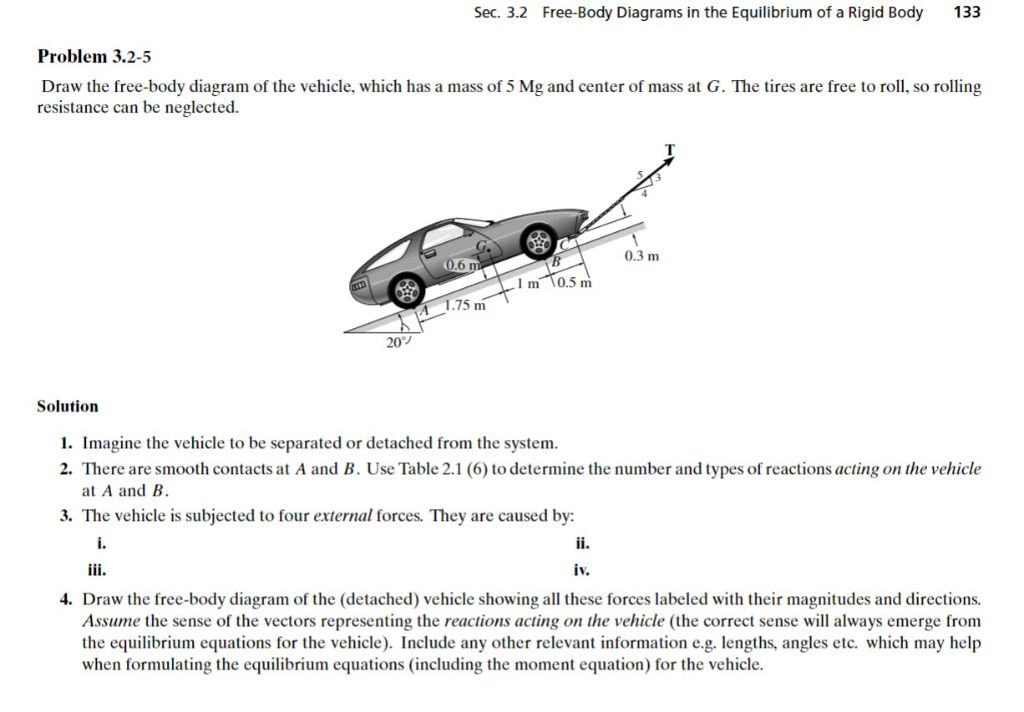
Problem 3.2-5
Draw the free-body diagram of the vehicle, which has a mass of 5 Mg and center of mass at G. The tires are free to roll, so rolling
resistance can be neglected.
3
sf
3
\
03m
1m 05m
Ras mw
207
Solution
1. Imagine the vehicle to be separated or detached from the system.
2. There are smooth contacts at A and B. Use Table 2.1 (6) to determine the number and types of reactions acting on the vehicle
at Aand B.
3. The vehicle is subjected to four external forces. They are caused by:
i ii.
fii. iv.
4. Draw the free-body diagram of the (detached) vehicle showing all these forces labeled with their magnitudes and directions.
Assume the sense of the vectors representing the reactions acting on the vehicle (the correct sense will always emerge from
the equilibrium equations for the vehicle). Include any other relevant information e.g. lengths, angles etc. which may help
when formulating the equilibrium equations (including the moment equation) for the vehicle.
Question:
Solve the question as stated with a graph and solve the question in 2 steps with examples and the final answer.Sec. 3.2 Free-Body Diagrams in the Equilibrium of a Rigid Body ~~ 133
Problem 3.2-5
Draw the free-body diagram of the vehicle, which has a mass of 5 Mg and center of mass at G. The tires are free to roll, so rolling
resistance can be neglected.
3
sf
3
\
03m
1m 05m
Ras mw
207
Solution
1. Imagine the vehicle to be separated or detached from the system.
2. There are smooth contacts at A and B. Use Table 2.1 (6) to determine the number and types of reactions acting on the vehicle
at Aand B.
3. The vehicle is subjected to four external forces. They are caused by:
i ii.
fii. iv.
4. Draw the free-body diagram of the (detached) vehicle showing all these forces labeled with their magnitudes and directions.
Assume the sense of the vectors representing the reactions acting on the vehicle (the correct sense will always emerge from
the equilibrium equations for the vehicle). Include any other relevant information e.g. lengths, angles etc. which may help
when formulating the equilibrium equations (including the moment equation) for the vehicle.
This is AI generated Response.
Asked by: Rahul
Created at: 2025-12-31 19:14:02
Final Answer:
RenderedRaw Text
Did you like this answer?
# Problem 3.2-5: Free-Body Diagram of the Vehicle
Let's break down the problem and solution into **2 steps**, show the **free-body diagram**, provide examples, and state the **final answer**.
---
## **Step 1: Identify the Forces Acting on the Vehicle**
**Given:**
- Mass of vehicle: \( 5 \, Mg \) (where \( 1 \, Mg = 100 \, kg \))
- Center of mass: \( G \)
- Tires are free to roll (no rolling resistance)
- Contacts at points \( A \) and \( B \) are smooth (no friction force, only normal force)
**Types of Forces:**
1. **Weight (\( W \))**: Acts vertically downward through \( G \)
- \( W = mg = 5 \times 100 \times 9.8 = 49,000 \, N \)
2. **Normal Reaction at A (\( N_A \))**: Perpendicular to the surface at \( A \)
3. **Normal Reaction at B (\( N_B \))**: Perpendicular to the surface at \( B \)
**No friction forces** due to the smooth contact and free-rolling tires.
---
## **Step 2: Draw the Free-Body Diagram**
Below is a sketch of the **free-body diagram** based on the problem statement:
---
### **Free-Body Diagram**
```plaintext
(Up the slope)
^
|
| N_B
| /|
| / |
| / |
| / |
| / |
| / |
|/ |
G----------O-------O--------------> (Along the slope)
N_A B
Forces:
- Weight \( W \) acts vertically downward from G.
- \( N_A \) and \( N_B \) are normal to the inclined plane at A and B.
```
**Labeled Forces:**
- \( W = 49,000 \, N \), vertically downward at \( G \)
- \( N_A \), perpendicular to the surface at \( A \)
- \( N_B \), perpendicular to the surface at \( B \)
---
**Example of Forces:**
- **Weight**: \( 49,000 \, N \) at point \( G \)
- **Normal at A**: \( N_A \), direction perpendicular to incline at A
- **Normal at B**: \( N_B \), direction perpendicular to incline at B
---
## **Final Answer**
- The **free-body diagram** of the vehicle will include:
- The weight (\( W \)) acting vertically downward from the center of mass (\( G \))
- Normal reaction forces (\( N_A \) and \( N_B \)) at points A and B, perpendicular to the inclined plane
### **Summary Table**
| Force | Point of Action | Direction | Magnitude |
|-------|----------------|----------------------------|------------------|
| W | G | Vertically downward | \( 49,000 \, N \)|
| N_A | A | Perpendicular to incline | Unknown |
| N_B | B | Perpendicular to incline | Unknown |
---
### **Diagram (with alt text):**

*Alt text: Free-body diagram of a car on an inclined plane, showing weight acting vertically downward at the center of mass, and normal forces at the contact points A and B perpendicular to the surface.*
---
**This setup allows you to proceed with writing equilibrium equations if needed!**
Question:
Solved all parts
This is AI generated Response.
Asked by: Rahul
Created at: 2025-12-31 19:14:31
Final Answer:
RenderedRaw Text
Did you like this answer?
# Problem 3.2-5: Free-Body Diagram of the Vehicle
Let's break down the problem and solution into **2 steps**, show the **free-body diagram**, provide examples, and state the **final answer**.
---
## **Step 1: Identify the Forces Acting on the Vehicle**
**Given:**
- Mass of vehicle: \( 5 \, Mg \) (where \( 1 \, Mg = 1000 \, kg \))
- Center of mass: \( G \)
- Tires are free to roll (no rolling resistance)
- Contacts at points \( A \) and \( B \) are smooth (no friction force, only normal force)
**Types of Forces:**
1. **Weight (\( W \))**: Acts vertically downward through \( G \)
- \( W = mg = 5 \times 1000 \times 9.81 = 49,050 \, N \)
2. **Normal Reaction at A (\( N_A \))**: Perpendicular to the surface at \( A \)
3. **Normal Reaction at B (\( N_B \))**: Perpendicular to the surface at \( B \)
**Note:** No friction forces due to the smooth contact and free-rolling tires.
---
## **Step 2: Draw the Free-Body Diagram**
Below is a sketch of the **free-body diagram** based on the problem statement:
---
### **Free-Body Diagram**
```plaintext
(Up the slope)
^
|
| N_B
| /|
| / |
| / |
| / |
| / |
| / |
|/ |
G----------O-------O--------------> (Along the slope)
N_A B
Forces:
- Weight \( W \) acts vertically downward from G.
- \( N_A \) and \( N_B \) are normal to the inclined plane at A and B.
```
**Labeled Forces:**
- \( W = 49,050 \, N \), vertically downward at \( G \)
- \( N_A \), perpendicular to the surface at \( A \)
- \( N_B \), perpendicular to the surface at \( B \)
---
### **Example of Forces:**
- **Weight**: \( 49,050 \, N \) at point \( G \)
- **Normal at A**: \( N_A \), direction perpendicular to incline at \( A \)
- **Normal at B**: \( N_B \), direction perpendicular to incline at \( B \)
---
## **Final Answer**
- The **free-body diagram** of the vehicle will include:
- The weight (\( W \)) acting vertically downward from the center of mass (\( G \))
- Normal reaction forces (\( N_A \) and \( N_B \)) at points A and B, perpendicular to the inclined plane
### **Summary Table**
| Force | Point of Action | Direction | Magnitude |
|-------|----------------|----------------------------|------------------|
| W | G | Vertically downward | \( 49,050 \, N \)|
| N_A | A | Perpendicular to incline | Unknown |
| N_B | B | Perpendicular to incline | Unknown |
---
### **Diagram**

*Alt text: Free-body diagram of a car on an inclined plane, showing weight acting vertically downward at the center of mass, and normal forces at the contact points A and B perpendicular to the surface.*
---
**This setup allows you to proceed with writing equilibrium equations if needed!**
VIPSolutions focuses on clear, step‑by‑step explanations so you can learn quickly. Whether you need an AI‑generated walkthrough or a short hint to get unstuck, each solution is organized for fast reading and easy review later.
Search similar questions, compare approaches, and bookmark the best answers for revision. Our goal is simple: quick, reliable study help that feels natural—not noisy.
 VIPSolutions
 Sec. 3.2 Free-Body Diagrams in the Equilibrium of a Rigid Body ~~ 133
Problem 3.2-5
Draw the free-body diagram of the vehicle, which has a mass of 5 Mg and center of mass at G. The tires are free to roll, so rolling
resistance can be neglected.
3
sf
3
\
03m
1m 05m
Ras mw
207
Solution
1. Imagine the vehicle to be separated or detached from the system.
2. There are smooth contacts at A and B. Use Table 2.1 (6) to determine the number and types of reactions acting on the vehicle
at Aand B.
3. The vehicle is subjected to four external forces. They are caused by:
i ii.
fii. iv.
4. Draw the free-body diagram of the (detached) vehicle showing all these forces labeled with their magnitudes and directions.
Assume the sense of the vectors representing the reactions acting on the vehicle (the correct sense will always emerge from
the equilibrium equations for the vehicle). Include any other relevant information e.g. lengths, angles etc. which may help
when formulating the equilibrium equations (including the moment equation) for the vehicle.
Sec. 3.2 Free-Body Diagrams in the Equilibrium of a Rigid Body ~~ 133
Problem 3.2-5
Draw the free-body diagram of the vehicle, which has a mass of 5 Mg and center of mass at G. The tires are free to roll, so rolling
resistance can be neglected.
3
sf
3
\
03m
1m 05m
Ras mw
207
Solution
1. Imagine the vehicle to be separated or detached from the system.
2. There are smooth contacts at A and B. Use Table 2.1 (6) to determine the number and types of reactions acting on the vehicle
at Aand B.
3. The vehicle is subjected to four external forces. They are caused by:
i ii.
fii. iv.
4. Draw the free-body diagram of the (detached) vehicle showing all these forces labeled with their magnitudes and directions.
Assume the sense of the vectors representing the reactions acting on the vehicle (the correct sense will always emerge from
the equilibrium equations for the vehicle). Include any other relevant information e.g. lengths, angles etc. which may help
when formulating the equilibrium equations (including the moment equation) for the vehicle.