solve this complete problem step by step with each step explanation and final conclusion110.74 Solar energy generation along highways. The potential of solar panels on roofs built above
national highways as a source of solar energy was investigated in the International Journal of Energy and
Environmental Engineering (Dec. 2013). Computer simulation was used to estimate the monthly solar
energy (kilowatt-hours) generated from solar panels installed across a 200-kilometer stretch of highway
in India. Each month, the simulation was run under each of four conditions: single-layer solar panels,
double-layer solar panels 1 meter apart, double-layer solar panels 2 meters apart, and -double-layer
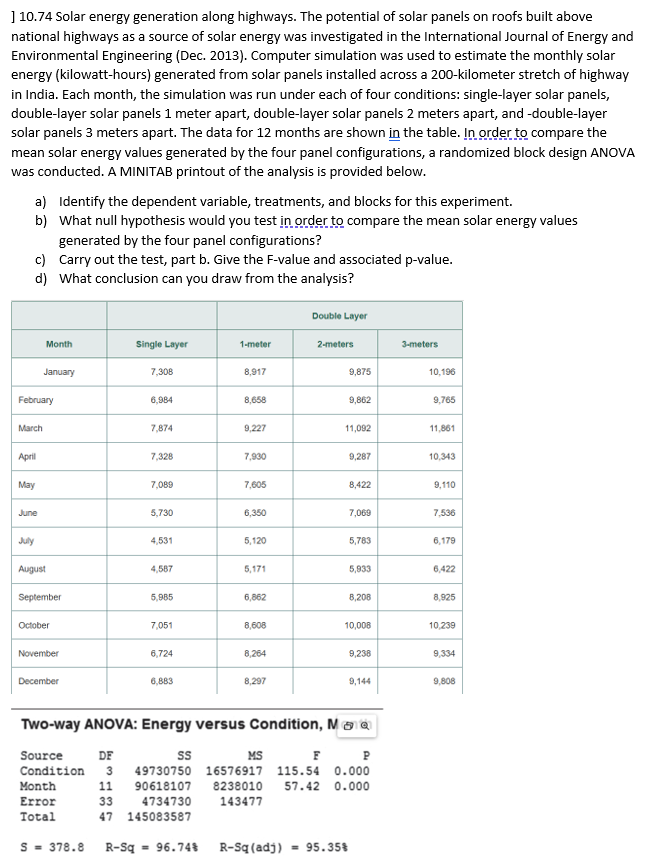
solar panels 3 meters apart. The data for 12 months are shown In the table. In order to compare the
mean solar energy values generated by the four panel configurations, a randomized block design ANOVA
was conducted. A MINITAB printout of the analysis is provided below.
a) Identify the dependent variable, treatments, and blocks for this experiment.
b) What null hypothesis would you test in order to compare the mean solar energy values
generated by the four panel configurations?
¢) Carry out the test, part b. Give the F-value and associated p-value.
d) What conclusion can you draw from the analysis?
= los elles Too |
f— 7208 as Pr 1019
Feary oom ™ pr ares
™ ram 19% oan T0303
™ 7089 ra08 sez aro
I. sm sx T080 PP
wy asm I) am am
[— or2e az oz asst
Two-way ANOVA: Energy versus Condition, M & a
Source DF ss us £ ®
Condition 3 49730750 16576317 115.54 0.000
Month 11 90618107 232010 57.42 0.000
Error 33 4734730 143477
Total 47 145083587
$= 378.8 R-Sq = 96.74% R-Sq(adj) = 95.35%
Question:
solve this complete problem step by step with each step explanation and final conclusion110.74 Solar energy generation along highways. The potential of solar panels on roofs built above
national highways as a source of solar energy was investigated in the International Journal of Energy and
Environmental Engineering (Dec. 2013). Computer simulation was used to estimate the monthly solar
energy (kilowatt-hours) generated from solar panels installed across a 200-kilometer stretch of highway
in India. Each month, the simulation was run under each of four conditions: single-layer solar panels,
double-layer solar panels 1 meter apart, double-layer solar panels 2 meters apart, and -double-layer
solar panels 3 meters apart. The data for 12 months are shown In the table. In order to compare the
mean solar energy values generated by the four panel configurations, a randomized block design ANOVA
was conducted. A MINITAB printout of the analysis is provided below.
a) Identify the dependent variable, treatments, and blocks for this experiment.
b) What null hypothesis would you test in order to compare the mean solar energy values
generated by the four panel configurations?
¢) Carry out the test, part b. Give the F-value and associated p-value.
d) What conclusion can you draw from the analysis?
= los elles Too |
f— 7208 as Pr 1019
Feary oom ™ pr ares
™ ram 19% oan T0303
™ 7089 ra08 sez aro
I. sm sx T080 PP
wy asm I) am am
[— or2e az oz asst
Two-way ANOVA: Energy versus Condition, M & a
Source DF ss us £ ®
Condition 3 49730750 16576317 115.54 0.000
Month 11 90618107 232010 57.42 0.000
Error 33 4734730 143477
Total 47 145083587
$= 378.8 R-Sq = 96.74% R-Sq(adj) = 95.35%
This is AI generated Response.
Asked by: Priyanshu Yadav
Created at: 2025-10-03 00:52:59
Final Answer:
RenderedRaw Text
Did you like this answer?
Let's solve each part step by step, referring to the table and ANOVA results.
---
## a) Identify the dependent variable, treatments, and blocks for this experiment.
**Dependent Variable:**
- Monthly solar energy generated (in kilowatt-hours).
- **Treatments:**
- The four panel configurations (conditions):
1. Single-layer solar panels
2. Double-layer solar panels 1 meter apart
3. Double-layer solar panels 2 meters apart
4. Double-layer solar panels 3 meters apart
- **Blocks:**
- The months (January to December) are the blocks, as each configuration is tested in each month to account for variability due to time.
---
## b) What null hypothesis would you test to compare the mean solar energy values generated by the four panel configurations?
- **Null Hypothesis (\(H_\)):**
The mean solar energy generated by all panel configurations is equal.
\[
H_: \mu_1 = \mu_2 = \mu_3 = \mu_4
\]
where \(\mu_1, \mu_2, \mu_3, \mu_4\) are the mean energies for each configuration.
- **Alternative Hypothesis (\(H_A\)):**
At least one configuration's mean is different.
---
## c) Carry out the test, part b. Give the F-value and associated p-value.
From the ANOVA output in the image:
- For **Condition (panel configuration):**
- **F-value:** 115.54
- **p-value:** .000
---
## d) What conclusion can you draw from the analysis?
- Since the **p-value (.000) is much less than .05**, we reject the null hypothesis.
- **Conclusion:**
There is statistically significant evidence that the mean solar energy generated differs among the four panel configurations.
---
## ### Final Conclusion
The experiment shows that the type of panel configuration significantly affects solar energy generation. The differences in mean energy values among the configurations are statistically significant, suggesting at least one panel configuration is more effective than the others.
---
**Summary Table:**
| Part | Answer |
|------|--------|
| a | Dependent: Energy (kWh); Treatments: Panel configuration; Blocks: Month |
| b | \(H_\): All means equal (\(\mu_1 = \mu_2 = \mu_3 = \mu_4\)) |
| c | F = 115.54; p = .000 |
| d | Means differ significantly; panel configuration matters for energy generation |
If you have questions about interpreting the post-hoc results or identifying which configuration is best, let me know!
Question:
add explantion after each part a,b,c,d
This is AI generated Response.
Asked by: Priyanshu Yadav
Created at: 2025-10-03 00:54:19
Final Answer:
RenderedRaw Text
Did you like this answer?
# Solar Energy Generation ANOVA Analysis
This document provides a detailed analysis of an experiment that investigates solar energy generation from different solar panel configurations along highways.
---
## a) Identify the dependent variable, treatments, and blocks for this experiment.
### Dependent Variable
- **Monthly solar energy generated (in kilowatt-hours)**: This is what we are measuring and analyzing based on different treatments.
### Treatments
- **The four panel configurations (conditions)**:
1. Single-layer solar panels
2. Double-layer solar panels 1 meter apart
3. Double-layer solar panels 2 meters apart
4. Double-layer solar panels 3 meters apart
### Blocks
- **Months (January to December)**: Each month acts as a block in the design, allowing us to control for seasonal variations in solar energy production. Each panel configuration is tested across all months to ensure variability is accounted for.
**Explanation**: Identifying the dependent variable, treatments, and blocks lays the foundation for conducting the ANOVA. The dependent variable is what we are measuring, while treatments help us understand the impact of different conditions. Blocks control for variability that may affect results.
---
## b) What null hypothesis would you test to compare the mean solar energy values generated by the four panel configurations?
### Null Hypothesis (\(H_0\))
- The mean solar energy generated by all panel configurations is equal:
\[
H_0: \mu_1 = \mu_2 = \mu_3 = \mu_4
\]
where \(\mu_1, \mu_2, \mu_3, \mu_4\) are the mean energies for each configuration.
### Alternative Hypothesis (\(H_A\))
- At least one configuration's mean is different.
**Explanation**: The null hypothesis serves as a starting point for statistical testing. By assuming that all configurations generate equal amounts of energy, we can assess whether the evidence from the data supports a different conclusion.
---
## c) Carry out the test, part b. Give the F-value and associated p-value.
From the ANOVA output:
- **Condition (panel configuration)**:
- **F-value:** 115.54
- **p-value:** .000
**Explanation**: The F-value indicates the ratio of variance between the group means to the variance within the groups. A high F-value suggests that there is a significant difference between the means of the groups. The p-value shows the probability of observing the data under the null hypothesis. A p-value of .000 indicates strong evidence against the null hypothesis.
---
## d) What conclusion can you draw from the analysis?
- Since the **p-value (.000) is much less than .05**, we reject the null hypothesis.
- **Conclusion**: There is statistically significant evidence that the mean solar energy generated differs among the four panel configurations.
**Explanation**: Rejecting the null hypothesis means we have sufficient evidence to conclude that at least one of the panel configurations is more effective than the others in generating solar energy. This finding is critical for optimizing solar energy installations.
---
## Final Conclusion
The experiment shows that the type of panel configuration significantly affects solar energy generation. The differences in mean energy values among the configurations are statistically significant, suggesting that at least one panel configuration is more effective than the others.
---
### Summary Table
| Part | Answer |
|------|--------|
| a | Dependent: Energy (kWh); Treatments: Panel configuration; Blocks: Month |
| b | \(H_0\): All means equal (\(\mu_1 = \mu_2 = \mu_3 = \mu_4\)) |
| c | F = 115.54; p = .000 |
| d | Means differ significantly; panel configuration matters for energy generation |
If you have questions about interpreting the post-hoc results or identifying which configuration is best, please ask!
VIPSolutions focuses on clear, step‑by‑step explanations so you can learn quickly. Whether you need an AI‑generated walkthrough or a short hint to get unstuck, each solution is organized for fast reading and easy review later.
Search similar questions, compare approaches, and bookmark the best answers for revision. Our goal is simple: quick, reliable study help that feels natural—not noisy.
 VIPSolutions
 110.74 Solar energy generation along highways. The potential of solar panels on roofs built above
national highways as a source of solar energy was investigated in the International Journal of Energy and
Environmental Engineering (Dec. 2013). Computer simulation was used to estimate the monthly solar
energy (kilowatt-hours) generated from solar panels installed across a 200-kilometer stretch of highway
in India. Each month, the simulation was run under each of four conditions: single-layer solar panels,
double-layer solar panels 1 meter apart, double-layer solar panels 2 meters apart, and -double-layer
solar panels 3 meters apart. The data for 12 months are shown In the table. In order to compare the
mean solar energy values generated by the four panel configurations, a randomized block design ANOVA
was conducted. A MINITAB printout of the analysis is provided below.
a) Identify the dependent variable, treatments, and blocks for this experiment.
b) What null hypothesis would you test in order to compare the mean solar energy values
generated by the four panel configurations?
¢) Carry out the test, part b. Give the F-value and associated p-value.
d) What conclusion can you draw from the analysis?
= los elles Too |
f— 7208 as Pr 1019
Feary oom ™ pr ares
™ ram 19% oan T0303
™ 7089 ra08 sez aro
I. sm sx T080 PP
wy asm I) am am
[— or2e az oz asst
Two-way ANOVA: Energy versus Condition, M & a
Source DF ss us £ ®
Condition 3 49730750 16576317 115.54 0.000
Month 11 90618107 232010 57.42 0.000
Error 33 4734730 143477
Total 47 145083587
$= 378.8 R-Sq = 96.74% R-Sq(adj) = 95.35%
110.74 Solar energy generation along highways. The potential of solar panels on roofs built above
national highways as a source of solar energy was investigated in the International Journal of Energy and
Environmental Engineering (Dec. 2013). Computer simulation was used to estimate the monthly solar
energy (kilowatt-hours) generated from solar panels installed across a 200-kilometer stretch of highway
in India. Each month, the simulation was run under each of four conditions: single-layer solar panels,
double-layer solar panels 1 meter apart, double-layer solar panels 2 meters apart, and -double-layer
solar panels 3 meters apart. The data for 12 months are shown In the table. In order to compare the
mean solar energy values generated by the four panel configurations, a randomized block design ANOVA
was conducted. A MINITAB printout of the analysis is provided below.
a) Identify the dependent variable, treatments, and blocks for this experiment.
b) What null hypothesis would you test in order to compare the mean solar energy values
generated by the four panel configurations?
¢) Carry out the test, part b. Give the F-value and associated p-value.
d) What conclusion can you draw from the analysis?
= los elles Too |
f— 7208 as Pr 1019
Feary oom ™ pr ares
™ ram 19% oan T0303
™ 7089 ra08 sez aro
I. sm sx T080 PP
wy asm I) am am
[— or2e az oz asst
Two-way ANOVA: Energy versus Condition, M & a
Source DF ss us £ ®
Condition 3 49730750 16576317 115.54 0.000
Month 11 90618107 232010 57.42 0.000
Error 33 4734730 143477
Total 47 145083587
$= 378.8 R-Sq = 96.74% R-Sq(adj) = 95.35%