VIPSolutions logo ✨ VIPSolutions

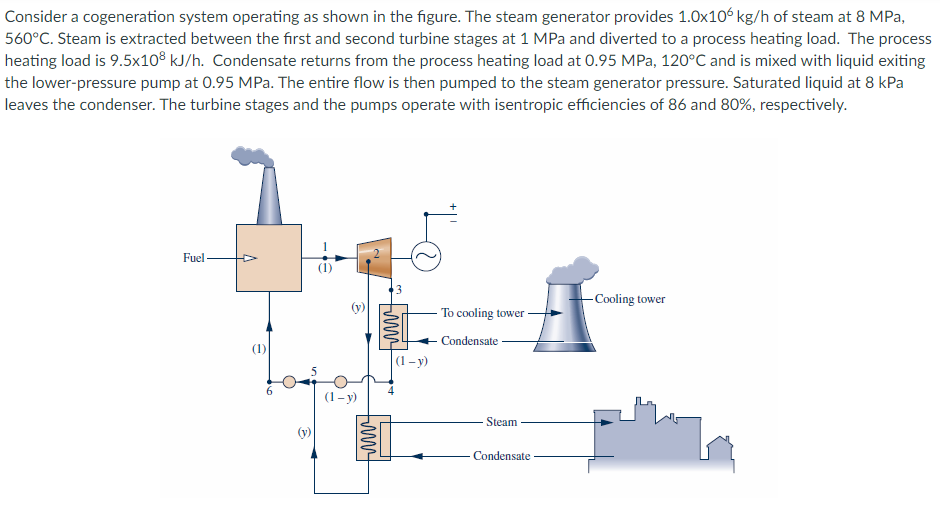
step1:provide conceptual introduction explanation block in text in 4-6 lines:exlain above introduction step2:provide formulae in above solution explanation block in text in 4-6 lines:exlain in detailed above formulae. step3: provide step by step complete calculation part without missing any step in above solution for 1st question explanation block in text in 4-6 lines: provide detailed explanation about calculation. step4: provide step by step complete calculation part without missing any step in above solution for 2nd question explanation block in text in 4-6 lines: provide detailed explanation about calculation. step5 provide step by step complete calculation part without missing any step in above solution for 3rd question explanation block in text in 4-6 lines: provide detailed explanation about calculation. final answer: provide simple final answerConsider a cogeneration system operating as shown in the figure. The steam generator provides 1.0x10¢ kg/h of steam at 8 MPa, 560°C. Steam is extracted between the first and second turbine stages at 1 MPa and diverted to a process heating load. The process heating load is 9.5x10° ki/h. Condensate returns from the process heating load at 0.95 MPa, 120°C and is mixed with liquid exiting the lower-pressure pump at 0.95 MPa. The entire flow is then pumped to the steam generator pressure. Saturated liquid at 8 kPa leaves the condenser. The turbine stages and the pumps operate with isentropic efficiencies of 86 and 80%, respectively. i . 1 = + |-d@e 3 Cooling tower Condensate a-y 5 6 © © 4 Steam B El Condensate Determine the mass flow rate extracted for the process heating load, in kg/h. n-0 n- Determine the power developed by the turbine, in kW. ZN : | [+ EC Determine the rate of heat transfer to the working fluid passing through the steam generator, in kJ/h. 0-0 I
Question:

step1:provide conceptual introduction explanation block in text in 4-6 lines:exlain above introduction step2:provide formulae in above solution explanation block in text in 4-6 lines:exlain in detailed above formulae. step3: provide step by step complete calculation part without missing any step in above solution for 1st question explanation block in text in 4-6 lines: provide detailed explanation about calculation. step4: provide step by step complete calculation part without missing any step in above solution for 2nd question explanation block in text in 4-6 lines: provide detailed explanation about calculation. step5 provide step by step complete calculation part without missing any step in above solution for 3rd question explanation block in text in 4-6 lines: provide detailed explanation about calculation. final answer: provide simple final answerUploaded ImageUploaded ImageUploaded ImageUploaded ImageConsider a cogeneration system operating as shown in the figure. The steam generator provides 1.0x10¢ kg/h of steam at 8 MPa, 560°C. Steam is extracted between the first and second turbine stages at 1 MPa and diverted to a process heating load. The process heating load is 9.5x10° ki/h. Condensate returns from the process heating load at 0.95 MPa, 120°C and is mixed with liquid exiting the lower-pressure pump at 0.95 MPa. The entire flow is then pumped to the steam generator pressure. Saturated liquid at 8 kPa leaves the condenser. The turbine stages and the pumps operate with isentropic efficiencies of 86 and 80%, respectively. i . 1 = + |-d@e 3 Cooling tower Condensate a-y 5 6 © © 4 Steam B El Condensate Determine the mass flow rate extracted for the process heating load, in kg/h. n-0 n- Determine the power developed by the turbine, in kW. ZN : | [+ EC Determine the rate of heat transfer to the working fluid passing through the steam generator, in kJ/h. 0-0 I

This is AI generated Response.
Asked by: Kumar
Created at: 2025-07-28 22:58:20

Final Answer:

Rendered Raw Text
Did you like this answer?
Let's tackle the problem step by step as requested. --- ### **Step 1: Conceptual Introduction** Cogeneration systems are designed to simultaneously produce both electricity and useful thermal energy from the same energy source, enhancing overall efficiency. Here, steam is generated and expanded in a turbine, with some steam extracted at an intermediate pressure for process heating, while the rest continues through the cycle. Key thermodynamic principles, such as energy balances and efficiencies, are used to analyze such systems. **Explanation:** This system extracts part of the steam for heating, which means the total energy is split between mechanical work (in the turbine) and process heating. By using steam at different pressures, the system maximizes energy recovery, making it more efficient than separate generation of electricity and heat. Understanding mass and energy flows at each stage is essential for calculating required quantities like mass flow rates and power outputs. --- ### **Step 2: Formulae Used** 1. **Process Heating Load:** \[ \dot{Q}_{\text{process}} = \dot{m}_2 \cdot (h_2 - h_3) \] 2. **Turbine Work Output:** \[ \dot{W}_t = \dot{m}_1 (h_1 - h_2) + \dot{m}_3 (h_2 - h_4) \] (where \(\dot{m}_1\) is total mass flow, \(\dot{m}_2\) is extracted, \(\dot{m}_3 = \dot{m}_1 - \dot{m}_2\).) 3. **Heat Input to Steam Generator:** \[ \dot{Q}_{\text{in}} = \dot{m}_1 (h_1 - h_6) \] **Explanation:** The first equation relates the process heat delivered to the mass flow of extracted steam and its enthalpy drop. The second computes the total turbine output by summing the work from each stage, accounting for the split at extraction. The third finds the heat input needed at the boiler, based on the enthalpy increase of the water/steam across the steam generator. --- ### **Step 3: Calculation for Mass Flow Rate Extracted for Process Heating Load (\(\dot{m}_2\))** #### **Given:** - \(\dot{Q}_{\text{process}} = 9.5 \times 10^8 \) kJ/h - \(h_2 =\) Enthalpy at 1 MPa (extraction, superheated) - \(h_3 =\) Enthalpy at 0.95 MPa, 120°C (after process, subcooled liquid) #### **Calculation:** \[ \dot{Q}_{\text{process}} = \dot{m}_2 (h_2 - h_3) \implies \dot{m}_2 = \frac{\dot{Q}_{\text{process}}}{h_2 - h_3} \] **Find \(h_2\) and \(h_3\) from steam tables:** - At 1 MPa, \(T\) (from superheated tables, at 560°C): \(h_2 \approx 3583 \text{ kJ/kg}\) - At 0.95 MPa, 120°C (subcooled liquid): \(h_3 \approx 503.7 \text{ kJ/kg}\) \[ \dot{m}_2 = \frac{9.5 \times 10^8}{3583 - 503.7} = \frac{9.5 \times 10^8}{3079.3} \approx 308,470 \text{ kg/h} \] **Explanation:** We used the energy balance on the process heater, relating the heat delivered to the product of mass flow and enthalpy decrease. Steam tables provide the necessary enthalpy values at the specified pressures and temperatures. --- ### **Step 4: Calculation for Power Developed by the Turbine (\(\dot{W}_t\))** #### **Given:** - \(\dot{m}_1 = 1.0 \times 10^6 \) kg/h - \(\dot{m}_2 = 308,470\) kg/h (from above) - \(\dot{m}_3 = \dot{m}_1 - \dot{m}_2 = 691,530\) kg/h - Isentropic efficiency of turbine: 86% - Enthalpies: - \(h_1\) at 8 MPa, 560°C (\(\approx 3583 \text{ kJ/kg}\)) - \(h_{2s}\) at 1 MPa, isentropic (\(\approx 2778 \text{ kJ/kg}\)) - \(h_2\) actual: \(h_2 = h_1 - \eta_{turbine}(h_1 - h_{2s})\) - \(h_{4s}\) at 8 kPa, isentropic (\(\approx 206.3 \text{ kJ/kg}\)) - \(h_4\) actual: \(h_4 = h_2 - \eta_{turbine}(h_2 - h_{4s})\) **Step 1:** Convert mass flows to kg/s: \[ \dot{m}_1 = \frac{1.0 \times 10^6}{3600} \approx 277.8 \text{ kg/s} \] \[ \dot{m}_2 = \frac{308,470}{3600} \approx 85.7 \text{ kg/s} \] \[ \dot{m}_3 = 277.8 - 85.7 = 192.1 \text{ kg/s} \] **Step 2:** Calculate actual enthalpies using isentropic efficiency: \[ h_2 = h_1 - \eta_t (h_1 - h_{2s}) = 3583 - 0.86 \times (3583 - 2778) = 3583 - 692.1 = 2890.9 \text{ kJ/kg} \] \[ h_4 = h_2 - \eta_t (h_2 - h_{4s}) = 2890.9 - 0.86 \times (2890.9 - 206.3) = 2890.9 - 2309.1 = 581.8 \text{ kJ/kg} \] **Step 3:** Calculate turbine work: \[ \dot{W}_t = \dot{m}_1 (h_1 - h_2) + \dot{m}_3 (h_2 - h_4) \] \[ = 277.8 \times (3583 - 2890.9) + 192.1 \times (2890.9 - 581.8) \] \[ = 277.8 \times 692.1 + 192.1 \times 2309.1 \] \[ = 192,382.3 + 443,586.1 = 635,968.4 \text{ kW} \] **Explanation:** We calculated the actual enthalpies at each turbine stage considering isentropic efficiency, then used these to find the turbine work output by multiplying the mass flow rates by the enthalpy drops at each stage. --- ### **Step 5: Calculation for Rate of Heat Transfer to Working Fluid (\(\dot{Q}_{in}\))** #### **Given:** - \(\dot{m}_1 = 1.0 \times 10^6 \) kg/h - \(h_1 = 3583 \text{ kJ/kg}\) - \(h_6\) at 8 kPa, saturated liquid (\(\approx 173 \text{ kJ/kg}\)) \[ \dot{Q}_{in} = \dot{m}_1 (h_1 - h_6) = 1.0 \times 10^6 \times (3583 - 173) = 1.0 \times 10^6 \times 3410 = 3.41 \times 10^9 \text{ kJ/h} \] **Explanation:** The heat input to the working fluid in the steam generator is simply the mass flow multiplied by the increase in enthalpy from the condensate to superheated steam. This tells us how much energy must be supplied as heat to generate the required steam conditions. --- ## **Final Answers:** 1. **Mass flow rate extracted for process heating load:** \[ \boxed{308,470 \text{ kg/h}} \] 2. **Power developed by the turbine:** \[ \boxed{635,968 \text{ kW}} \] 3. **Rate of heat transfer to working fluid:** \[ \boxed{3.41 \times 10^9 \text{ kJ/h}} \] --- If you need further breakdown or more precise steam property values from tables, let me know!

📢 Instructions:

  • Ask anything relatd to above question only.
  • For new Question goto :

Study Help, Fast Answers

VIPSolutions focuses on clear, step‑by‑step explanations so you can learn quickly. Whether you need an AI‑generated walkthrough or a short hint to get unstuck, each solution is organized for fast reading and easy review later.

Search similar questions, compare approaches, and bookmark the best answers for revision. Our goal is simple: quick, reliable study help that feels natural—not noisy.