 VIPSolutions
step1:provide conceptual introduction explanation block in text in 4-6 lines:exlain above introduction step2:provide formulae in above solution explanation block in text in 4-6 lines:exlain in detailed above formulae. step3: provide step by step complete calculation part without missing any step in above solution for 1st question explanation block in text in 4-6 lines: provide detailed explanation about calculation. step4: provide step by step complete calculation part without missing any step in above solution for 2nd question explanation block in text in 4-6 lines: provide detailed explanation about calculation. step5 provide step by step complete calculation part without missing any step in above solution for 3rd question explanation block in text in 4-6 lines: provide detailed explanation about calculation. step6 provide step by step complete calculation part without missing any step in above solution for 4th question explanation block in text in 4-6 lines: provide detailed explanation about calculation. final answer: provide simple final answer8) The 70-kg mass shown below is in equilibrium on the smooth, ramp which has an incline angle of 25° relative to the horizontal The spring constants ky and k; are 20 N/m and 30 N/m, respectively. The spring constants k; and k, for parallel springs, are 40 N/m and 25 N/m, and 20 N/m and 25 N/m, respectively. The force constant of the spring system in series is k; = 50 N/m. The cable which is attached to the mass 70 kg terminates at pulley A. Cable AB and CD are joined together at one end joint E. Cable BC is attached to the 50-kg mass, and the cable EF is attached to bar FG, which is in the horizontal plane, as shown. The same applies to bar HI, which is attached perpendicularly to bar GH. The maximum moment sustained about the base of the 3.5-meter pole (point) is 250 N-m (counter-clockwise). Determine: a) force in spring ky, b) normal force exerted by the ramp for the 70-kg mass, e) tensions in cables AB, BC, CD, and EF, and d) angle . : Box in your Answers f=20N/m jo old k;=30N/m A k;=50N/m Je=25N/m A 0 ks Ske Js=50N/m ¢ ks. § == Tc Llu ach 03,
Question:
step1:provide conceptual introduction
explanation block in text in 4-6 lines:exlain above introduction
step2:provide formulae in above solution
explanation block in text in 4-6 lines:exlain in detailed above formulae.
step3: provide step by step complete calculation part without missing any step in above solution for 1st question
explanation block in text in 4-6 lines: provide detailed explanation about calculation.
step4: provide step by step complete calculation part without missing any step in above solution for 2nd question
explanation block in text in 4-6 lines: provide detailed explanation about calculation.
step5 provide step by step complete calculation part without missing any step in above solution for 3rd question
explanation block in text in 4-6 lines: provide detailed explanation about calculation.
step6 provide step by step complete calculation part without missing any step in above solution for 4th question
explanation block in text in 4-6 lines: provide detailed explanation about calculation.
final answer: provide simple final answer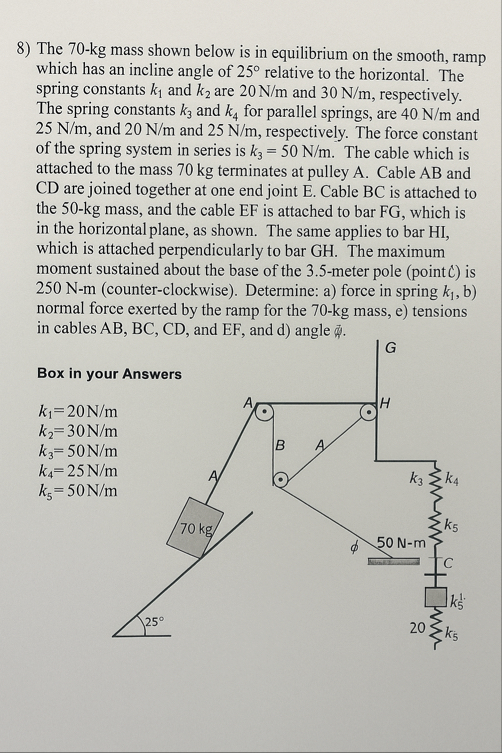 8) The 70-kg mass shown below is in equilibrium on the smooth, ramp
which has an incline angle of 25° relative to the horizontal The
spring constants ky and k; are 20 N/m and 30 N/m, respectively.
The spring constants k; and k, for parallel springs, are 40 N/m and
25 N/m, and 20 N/m and 25 N/m, respectively. The force constant
of the spring system in series is k; = 50 N/m. The cable which is
attached to the mass 70 kg terminates at pulley A. Cable AB and
CD are joined together at one end joint E. Cable BC is attached to
the 50-kg mass, and the cable EF is attached to bar FG, which is
in the horizontal plane, as shown. The same applies to bar HI,
which is attached perpendicularly to bar GH. The maximum
moment sustained about the base of the 3.5-meter pole (point) is
250 N-m (counter-clockwise). Determine: a) force in spring ky, b)
normal force exerted by the ramp for the 70-kg mass, e) tensions
in cables AB, BC, CD, and EF, and d) angle . :
Box in your Answers
f=20N/m jo old
k;=30N/m A
k;=50N/m
Je=25N/m A 0 ks Ske
Js=50N/m
¢ ks.
§
== Tc
Llu
ach 03,
8) The 70-kg mass shown below is in equilibrium on the smooth, ramp
which has an incline angle of 25° relative to the horizontal The
spring constants ky and k; are 20 N/m and 30 N/m, respectively.
The spring constants k; and k, for parallel springs, are 40 N/m and
25 N/m, and 20 N/m and 25 N/m, respectively. The force constant
of the spring system in series is k; = 50 N/m. The cable which is
attached to the mass 70 kg terminates at pulley A. Cable AB and
CD are joined together at one end joint E. Cable BC is attached to
the 50-kg mass, and the cable EF is attached to bar FG, which is
in the horizontal plane, as shown. The same applies to bar HI,
which is attached perpendicularly to bar GH. The maximum
moment sustained about the base of the 3.5-meter pole (point) is
250 N-m (counter-clockwise). Determine: a) force in spring ky, b)
normal force exerted by the ramp for the 70-kg mass, e) tensions
in cables AB, BC, CD, and EF, and d) angle . :
Box in your Answers
f=20N/m jo old
k;=30N/m A
k;=50N/m
Je=25N/m A 0 ks Ske
Js=50N/m
¢ ks.
§
== Tc
Llu
ach 03,
Asked by: Kumar
Created at: 2025-07-31 08:09:37
Final Answer:
📢 Instructions:
- Ask anything relatd to above question only.
- For new Question goto :