 VIPSolutions
structure the answer content given below rewrite same don't miss anything which is given below and write in step by step and also add image in the correct place Adjust the Graph: We will adjust the current graph to reflect the new tax, showing how the tariff impacts the price and quantity in the market. Calculate the Deadweight Loss: We'll calculate the deadweight loss due to the tariff, showing our work and the calculations. Step 1: Adjusting the Graph Let's first recreate the graph you showed with the world price and then show how it adjusts due to the 33% tariff. The tariff increases the price of imported solar panels by 33%, thus shifting the world price line upward by this amount. Step 2: Calculating Deadweight Loss The deadweight loss from a tariff occurs because it decreases the quantity of imports, thereby reducing the total surplus in the market. It can be visualized as a triangle in the supply and demand diagram where the base of the triangle is the reduction in quantity and the height is the tariff. I will start by recreating the graph based on the description and then move on to adjust it for the tariff. After that, I'll compute the deadweight loss. Let's begin by creating the initial graph. The initial graph above represents the market for solar panels under conditions of free trade, where the world price is constant at $1000. Now let's adjust this graph to account for a 33% tariff on imported solar panels. This tariff effectively increases the cost of imported panels by 33%, making the new world price $1000 + 0.33 * $1000 = $1330. I will adjust the graph to reflect this new world price and then find the new equilibrium, which will help us identify the quantity imported and the domestic quantity supplied and demanded. Step 2: Adjusting for Tariff and Calculating Deadweight Loss After adjusting the graph, we will identify the new equilibrium and calculate the deadweight loss, which is represented as a triangular area between the original and new demand curves, above the supply curve. Let's proceed with these adjustments The graph now shows the effect of a 33% tariff on the market for solar panels. The world price increases from $1000 to $1330 due to the tariff. The new equilibrium quantity, where domestic supply and the new world price intersect, is approximately 15.375 thousand units, and the domestic demand at this quantity is around 470 units. Calculating Deadweight Loss Deadweight loss occurs because the tariff causes a reduction in the quantity of solar panels sold, compared to the free trade scenario. The reduction in quantity sold leads to a loss in consumer and producer surplus not transferred to anyone else. To calculate the deadweight loss: Determine the quantity without the tariff: This was the quantity where the world price without the tariff intersected with the demand curve. Determine the quantity with the tariff: Already found as 15.375 thousand units. Calculate the base and height of the deadweight loss triangle. Original equilibrium quantity without the tariff: 11.25 thousand units Reduction in quantity due to the tariff: 4.125 thousand units Deadweight loss due to the tariff: approximately $680.63 This deadweight loss represents the economic inefficiency created by the tariff. It reflects the lost welfare to consumers and producers that is not offset by increased revenue to the government or domestic producers, thus resulting in a net loss to the economy1750 1500 1250 o -2 1000 & 750 500 —— Supply (Domestic) —— Demand (Domestic) 250 —— World Price (No Tariff) === World Price with Tariff © New Equilibrium with Tariff 0 0.0 2.5 5.0 7" 10.0 12.5 15.0 17.5 20.0 + .ntity (thousands)
Question:
structure the answer content given below rewrite same don't miss anything which is given below and write in step by step and also add image in the correct place
Adjust the Graph: We will adjust the current graph to reflect the new tax, showing how the tariff impacts the price and quantity in the market.
Calculate the Deadweight Loss: We'll calculate the deadweight loss due to the tariff, showing our work and the calculations.
Step 1: Adjusting the Graph
Let's first recreate the graph you showed with the world price and then show how it adjusts due to the 33% tariff. The tariff increases the price of imported solar panels by 33%, thus shifting the world price line upward by this amount.
Step 2: Calculating Deadweight Loss
The deadweight loss from a tariff occurs because it decreases the quantity of imports, thereby reducing the total surplus in the market. It can be visualized as a triangle in the supply and demand diagram where the base of the triangle is the reduction in quantity and the height is the tariff.
I will start by recreating the graph based on the description and then move on to adjust it for the tariff. After that, I'll compute the deadweight loss. Let's begin by creating the initial graph.
The initial graph above represents the market for solar panels under conditions of free trade, where the world price is constant at $1000. Now let's adjust this graph to account for a 33% tariff on imported solar panels. This tariff effectively increases the cost of imported panels by 33%, making the new world price $1000 + 0.33 * $1000 = $1330.
I will adjust the graph to reflect this new world price and then find the new equilibrium, which will help us identify the quantity imported and the domestic quantity supplied and demanded.
Step 2: Adjusting for Tariff and Calculating Deadweight Loss
After adjusting the graph, we will identify the new equilibrium and calculate the deadweight loss, which is represented as a triangular area between the original and new demand curves, above the supply curve. Let's proceed with these adjustments
The graph now shows the effect of a 33% tariff on the market for solar panels. The world price increases from $1000 to $1330 due to the tariff. The new equilibrium quantity, where domestic supply and the new world price intersect, is approximately 15.375 thousand units, and the domestic demand at this quantity is around 470 units.
Calculating Deadweight Loss
Deadweight loss occurs because the tariff causes a reduction in the quantity of solar panels sold, compared to the free trade scenario. The reduction in quantity sold leads to a loss in consumer and producer surplus not transferred to anyone else.
To calculate the deadweight loss:
Determine the quantity without the tariff: This was the quantity where the world price without the tariff intersected with the demand curve.
Determine the quantity with the tariff: Already found as 15.375 thousand units.
Calculate the base and height of the deadweight loss triangle.
Original equilibrium quantity without the tariff: 11.25 thousand units
Reduction in quantity due to the tariff: 4.125 thousand units
Deadweight loss due to the tariff: approximately $680.63
This deadweight loss represents the economic inefficiency created by the tariff. It reflects the lost welfare to consumers and producers that is not offset by increased revenue to the government or domestic producers, thus resulting in a net loss to the economy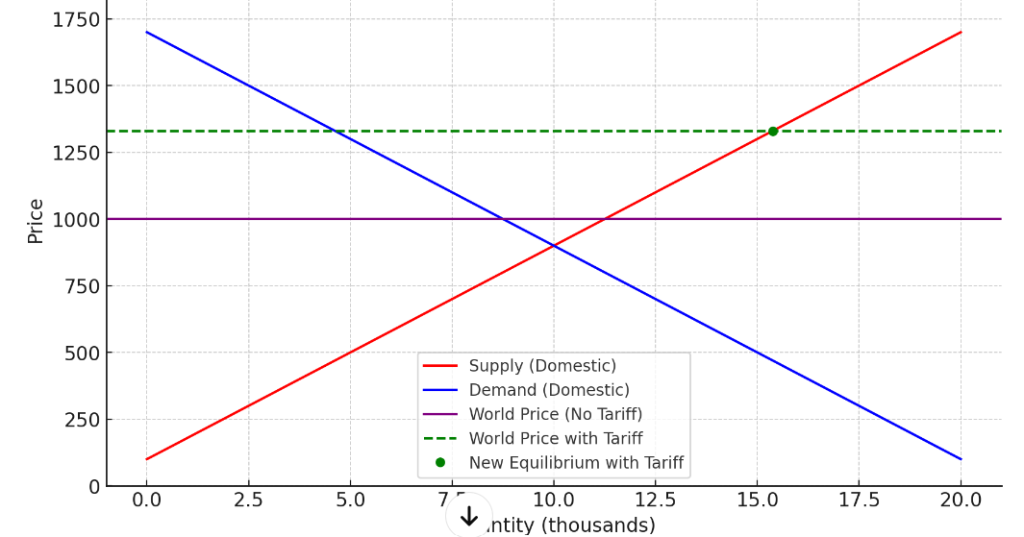 1750
1500
1250
o
-2 1000
&
750
500 —— Supply (Domestic)
—— Demand (Domestic)
250 —— World Price (No Tariff)
=== World Price with Tariff
© New Equilibrium with Tariff
0 0.0 2.5 5.0 7" 10.0 12.5 15.0 17.5 20.0
+ .ntity (thousands)
1750
1500
1250
o
-2 1000
&
750
500 —— Supply (Domestic)
—— Demand (Domestic)
250 —— World Price (No Tariff)
=== World Price with Tariff
© New Equilibrium with Tariff
0 0.0 2.5 5.0 7" 10.0 12.5 15.0 17.5 20.0
+ .ntity (thousands)
Asked by: prem
Created at: 2025-08-27 18:57:03
Final Answer:
📢 Instructions:
- Ask anything relatd to above question only.
- For new Question goto :