Summarize briefly about :Rubric Marks Description
Question 1a: Definition and 10 Clear definition of automation and robotics, along with a
Relationship comprehensive explanation.
Question 1b: Characteristics ~~ 10 Thorough discussion of the key characteristics and
of Automation benefits of automation.
Question 1c: Fundamental 10 Detailed analysis of the fundamental principles and
Principles of Robotics components of robotics.
Question 2a: Importance of 10 Effective explanation of the importance of sensors in
Sensors robotics.
Question 2b: Types of 15 In-depth discussion of various types of sensors, their
Sensors principles, and applications.
Question 2c: Sensor Fusion ~~ 5 Clear description of sensor fusion techniques and their
Techniques role in robotic perception.
Question 3a: Industrial 10 Accurate overview of the main industrial sectors that
Sectors utilize robotics.
Question 3b: Industrial 20 Detailed description of three specific industrial
Applications applications of robots, with benefits and challenges.
Question 3c: Impact on 10 Insightful discussion of the impact of robots on the
Workforce workforce and potential future developments.
Word Count and 5 Adherence to the word count limit and proper formatting,
Presentation references, and citations.
Total Marks 100
Question:
Summarize briefly about :Rubric Marks Description
Question 1a: Definition and 10 Clear definition of automation and robotics, along with a
Relationship comprehensive explanation.
Question 1b: Characteristics ~~ 10 Thorough discussion of the key characteristics and
of Automation benefits of automation.
Question 1c: Fundamental 10 Detailed analysis of the fundamental principles and
Principles of Robotics components of robotics.
Question 2a: Importance of 10 Effective explanation of the importance of sensors in
Sensors robotics.
Question 2b: Types of 15 In-depth discussion of various types of sensors, their
Sensors principles, and applications.
Question 2c: Sensor Fusion ~~ 5 Clear description of sensor fusion techniques and their
Techniques role in robotic perception.
Question 3a: Industrial 10 Accurate overview of the main industrial sectors that
Sectors utilize robotics.
Question 3b: Industrial 20 Detailed description of three specific industrial
Applications applications of robots, with benefits and challenges.
Question 3c: Impact on 10 Insightful discussion of the impact of robots on the
Workforce workforce and potential future developments.
Word Count and 5 Adherence to the word count limit and proper formatting,
Presentation references, and citations.
Total Marks 100
This is AI generated Response.
Asked by: admin3
Created at: 2025-08-12 14:55:17
Final Answer:
RenderedRaw Text
Did you like this answer?
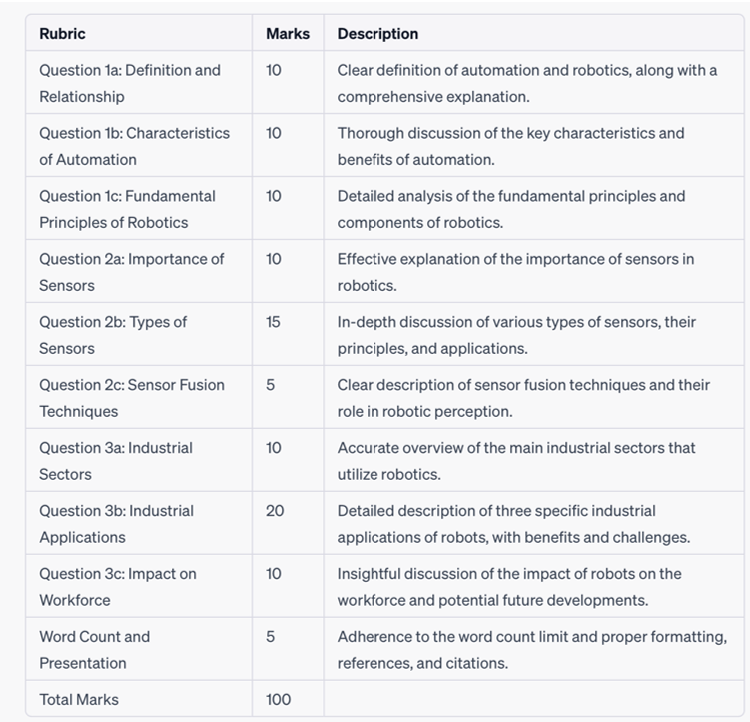
This table is a **marking rubric** for an assignment on automation and robotics, totaling 100 marks. It breaks down the marks for each question based on specific criteria, such as definitions, characteristics, principles, sensor importance and types, industrial sectors and applications, workforce impact, and presentation quality. Each rubric item outlines what is expected for full marks, focusing on clear explanations, in-depth discussions, and proper formatting.
Question:
so please explain all the points
This is AI generated Response.
Asked by: admin3
Created at: 2025-08-12 14:56:13
Final Answer:
RenderedRaw Text
Did you like this answer?
Certainly! Here's a comprehensive explanation of each point outlined in the rubric related to automation and robotics:
---
### **Question 1a: Definition and Relationship of Automation and Robotics (10 marks)**
**Automation:**
Automation refers to the use of technology to perform tasks with minimal human intervention. It involves the deployment of control systems, computers, and information technologies to operate equipment or processes automatically, increasing efficiency, consistency, and safety.
**Robotics:**
Robotics is a branch of engineering focused on designing, constructing, and operating robots—programmable machines capable of performing tasks autonomously or semi-autonomously.
**Relationship:**
Robotics is a subset of automation. While automation covers a broad range of systems that automate processes (like manufacturing lines, software automation), robotics specifically deals with physical machines (robots) that can perform tasks in environments that may be hazardous or inaccessible to humans. Robots often incorporate automation principles to carry out complex, repetitive, or precise tasks.
---
### **Question 1b: Characteristics and Benefits of Automation (10 marks)**
**Characteristics:**
- **Repeatability:** Performs the same task consistently without variation.
- **Speed:** Executes tasks faster than humans in many cases.
- **Precision:** Achieves high accuracy and precision in operations.
- **Reliability:** Operates continuously with minimal downtime.
- **Flexibility:** Capable of adapting to different tasks with programming changes.
- **Reduced Human Intervention:** Limits the need for manual control, reducing human error.
- **Cost Efficiency:** Lowers operational costs over time.
- **Safety:** Minimizes human exposure to hazardous environments.
- **Data Collection:** Facilitates real-time data gathering for analysis.
- **Scalability:** Easily scaled up for larger production or tasks.
**Benefits:**
- Increased productivity and efficiency.
- Improved quality and consistency of products.
- Reduction in labor costs.
- Enhanced safety in dangerous tasks.
- Better resource utilization.
- Faster turnaround times.
- Ability to perform complex or dangerous tasks that are difficult for humans.
---
### **Question 1c: Principles and Components of Robotics (10 marks)**
**Fundamental Principles:**
- **Perception:** Robots sense their environment through sensors.
- **Navigation and Movement:** Robots use actuators and motors to move precisely.
- **Manipulation:** Robots manipulate objects with end-effectors like grippers or tools.
- **Autonomy:** Robots operate based on programmed instructions and sensor inputs.
- **Control Systems:** Use algorithms to process data and command actuators.
**Components of Robotics:**
- **Sensors:** Detect environmental data (e.g., vision, proximity).
- **Actuators:** Motors and drives that enable movement.
- **Controllers:** Process sensor data and execute commands.
- **End-effectors:** Tools or hands that interact with objects.
- **Power Supply:** Provides energy to operate the robot.
- **Communication Modules:** Facilitate data exchange with other systems or operators.
---
### **Question 2a: Importance of Sensors in Robotics (10 marks)**
Sensors are vital in robotics because they provide robots with the ability to perceive their environment, enabling autonomous decision-making and precise operations. They help robots detect obstacles, measure distances, identify objects, and monitor internal conditions. Without sensors, robots would lack situational awareness, limiting their functionality to pre-programmed tasks.
---
### **Question 2b: Types of Sensors, Principles, and Applications (15 marks)**
**Types of Sensors:**
| Sensor Type | Principles | Applications |
|-------------------------|-----------------------------------------------------|-----------------------------------------------------------|
| **Proximity Sensors** | Detect presence or absence of objects using electromagnetic fields or infrared. | Robot obstacle detection, object avoidance. |
| **Vision Sensors (Cameras)** | Capture visual data for image processing and recognition. | Quality inspection, navigation, facial recognition. |
| **Touch Sensors (Force/Pressure)** | Detect physical contact or force exerted. | Grippers, collision detection. |
| **Temperature Sensors** | Measure heat levels via thermocouples or thermistors. | Monitoring in manufacturing processes. |
| **Ultrasonic Sensors** | Emit ultrasonic waves and measure echo time to determine distance. | Distance measurement, obstacle detection. |
| **Infrared Sensors** | Use infrared light to detect objects or measure proximity. | Line following, obstacle avoidance. |
| **Accelerometers and Gyroscopes** | Measure acceleration and orientation based on inertial forces. | Balance, navigation, motion tracking. |
**Applications:**
Sensors are used in assembly lines, autonomous vehicles, medical robots, and more, enabling precise control, safety, and adaptability.
---
### **Question 2c: Sensor Fusion Techniques and Role in Robotic Perception (5 marks)**
**Sensor Fusion Techniques:**
Sensor fusion combines data from multiple sensors to improve accuracy, reliability, and environmental understanding. Techniques include Kalman filtering, particle filtering, and data averaging.
**Role in Robotic Perception:**
Sensor fusion enhances perception by integrating diverse data sources, enabling robots to interpret complex environments, improve decision-making, and perform tasks more reliably, especially in uncertain or dynamic settings.
---
### **Question 3a: Industrial Sectors Utilizing Robotics (10 marks)**
Major industrial sectors employing robotics include:
- **Manufacturing:** Automotive assembly, electronics, consumer goods.
- **Healthcare:** Surgery robots, laboratory automation.
- **Agriculture:** Automated planting, harvesting, and monitoring.
- **Logistics:** Warehousing, package sorting, delivery robots.
- **Construction:** Bricklaying, excavation, heavy lifting.
- **Mining:** Material extraction, safety inspections.
---
### **Question 3b: Specific Industrial Applications of Robots, Benefits, and Challenges (20 marks)**
**1. Automotive Assembly:**
Robots perform welding, painting, and assembling parts.
*Benefits:* Increased speed, consistency, and safety.
*Challenges:* High initial investment, maintenance, and programming complexity.
**2. Electronics Manufacturing:**
Robots handle delicate components through precise placement and soldering.
*Benefits:* High accuracy, reduced defects.
*Challenges:* Adaptability to new designs, cost of customization.
**3. Food Packaging:**
Robots sort, pack, and palletize products.
*Benefits:* Hygiene, speed, and efficiency.
*Challenges:* Flexibility for different packaging types, sanitation standards.
---
### **Question 3c: Impact of Robots on Workforce and Future Developments (10 marks)**
**Impact on Workforce:**
Robots have transformed industries by automating repetitive and dangerous tasks, leading to increased productivity but also concerns over job displacement. Workforce skills are shifting towards robot programming, maintenance, and oversight.
**Future Developments:**
Advances in AI and machine learning will enable more autonomous, adaptable robots capable of handling complex tasks. Integration with IoT and cloud computing will enhance connectivity and data-driven decision-making. Ethical considerations and workforce retraining will be vital as robotics become more pervasive.
---
### **Additional Notes:**
- **Word Count & Formatting:** Ensure clarity, proper structure, and citations if referencing sources.
- **Presentation:** Use headings, bullet points, and diagrams where appropriate to improve readability.
---
If you need further details or specific references, feel free to ask!
VIPSolutions focuses on clear, step‑by‑step explanations so you can learn quickly. Whether you need an AI‑generated walkthrough or a short hint to get unstuck, each solution is organized for fast reading and easy review later.
Search similar questions, compare approaches, and bookmark the best answers for revision. Our goal is simple: quick, reliable study help that feels natural—not noisy.
 VIPSolutions
 Rubric Marks Description
Question 1a: Definition and 10 Clear definition of automation and robotics, along with a
Relationship comprehensive explanation.
Question 1b: Characteristics ~~ 10 Thorough discussion of the key characteristics and
of Automation benefits of automation.
Question 1c: Fundamental 10 Detailed analysis of the fundamental principles and
Principles of Robotics components of robotics.
Question 2a: Importance of 10 Effective explanation of the importance of sensors in
Sensors robotics.
Question 2b: Types of 15 In-depth discussion of various types of sensors, their
Sensors principles, and applications.
Question 2c: Sensor Fusion ~~ 5 Clear description of sensor fusion techniques and their
Techniques role in robotic perception.
Question 3a: Industrial 10 Accurate overview of the main industrial sectors that
Sectors utilize robotics.
Question 3b: Industrial 20 Detailed description of three specific industrial
Applications applications of robots, with benefits and challenges.
Question 3c: Impact on 10 Insightful discussion of the impact of robots on the
Workforce workforce and potential future developments.
Word Count and 5 Adherence to the word count limit and proper formatting,
Presentation references, and citations.
Total Marks 100
Rubric Marks Description
Question 1a: Definition and 10 Clear definition of automation and robotics, along with a
Relationship comprehensive explanation.
Question 1b: Characteristics ~~ 10 Thorough discussion of the key characteristics and
of Automation benefits of automation.
Question 1c: Fundamental 10 Detailed analysis of the fundamental principles and
Principles of Robotics components of robotics.
Question 2a: Importance of 10 Effective explanation of the importance of sensors in
Sensors robotics.
Question 2b: Types of 15 In-depth discussion of various types of sensors, their
Sensors principles, and applications.
Question 2c: Sensor Fusion ~~ 5 Clear description of sensor fusion techniques and their
Techniques role in robotic perception.
Question 3a: Industrial 10 Accurate overview of the main industrial sectors that
Sectors utilize robotics.
Question 3b: Industrial 20 Detailed description of three specific industrial
Applications applications of robots, with benefits and challenges.
Question 3c: Impact on 10 Insightful discussion of the impact of robots on the
Workforce workforce and potential future developments.
Word Count and 5 Adherence to the word count limit and proper formatting,
Presentation references, and citations.
Total Marks 100