The following data shows turnover cost
4
,
0
0
0
employees of Hulakon Inc. for one year. In any given year,
1
2
percent of the employees can be expected to quit. A total of
1
2
0
employees participate in the company's EAP
(
6
2
production employees,
4
4
clerical employees, and
1
4
managers
)
.
As a result of that involvement, the following numbers of employees actually quit. Hospitalization costs are $
2
0
0
,
0
0
0
,
or
5
6
percent of the total amount annually budgeted for the EAP. What is Hulakon's ROI for its employee assistance program for this one year?
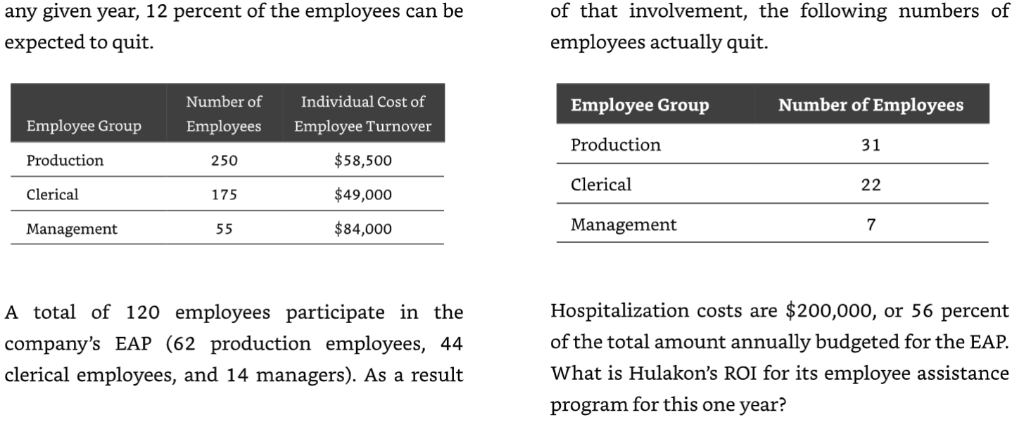
give answer in chegg india platform style and give final summaryany given year, 12 percent of the employees can be of that involvement, the following numbers of
expected to quit. employees actually quit.
Numberof Individual Cost of Employee Group Number of Employees
Employee Group Employees Employee Turnover
Production 31
Production 250 $58,500 -
Clerical 175 $49,000 Clerical 22
Management 55 $84,000 Management 7
A total of 120 employees participate in the Hospitalization costs are $200,000, or 56 percent
company’s EAP (62 production employees, 44 of the total amount annually budgeted for the EAP.
clerical employees, and 14 managers). As a result What is Hulakon’s ROI for its employee assistance
program for this one year?
Question:
The following data shows turnover cost
4
,
0
0
0
employees of Hulakon Inc. for one year. In any given year,
1
2
percent of the employees can be expected to quit. A total of
1
2
0
employees participate in the company's EAP
(
6
2
production employees,
4
4
clerical employees, and
1
4
managers
)
.
As a result of that involvement, the following numbers of employees actually quit. Hospitalization costs are $
2
0
0
,
0
0
0
,
or
5
6
percent of the total amount annually budgeted for the EAP. What is Hulakon's ROI for its employee assistance program for this one year?
give answer in chegg india platform style and give final summaryany given year, 12 percent of the employees can be of that involvement, the following numbers of
expected to quit. employees actually quit.
Numberof Individual Cost of Employee Group Number of Employees
Employee Group Employees Employee Turnover
Production 31
Production 250 $58,500 -
Clerical 175 $49,000 Clerical 22
Management 55 $84,000 Management 7
A total of 120 employees participate in the Hospitalization costs are $200,000, or 56 percent
company’s EAP (62 production employees, 44 of the total amount annually budgeted for the EAP.
clerical employees, and 14 managers). As a result What is Hulakon’s ROI for its employee assistance
program for this one year?
This is AI generated Response.
Asked by: sreegeeth
Created at: 2025-09-15 00:31:28
Final Answer:
RenderedRaw Text
Did you like this answer?
# Hulakon Inc. ROI Calculation for Employee Assistance Program (EAP)
Let's break down the solution step by step, as per Chegg India style.
---
## **Step 1: Calculate Expected Turnover Without EAP**
- **Total Employees:** 400
- **Expected Turnover Rate:** 12%
\[
\text{Expected number of quits} = 400 \times 0.12 = 48
\]
---
## **Step 2: Calculate Expected and Actual Turnover for EAP Participants**
### **A. EAP Participants by Group**
| Group | EAP Participants | Actual Quits |
|------------|------------------|-------------|
| Production | 62 | 31 |
| Clerical | 44 | 22 |
| Management | 14 | 7 |
| **Total** | **120** | **60** |
**But, actual quits here is just for EAP participants, not total.**
### **B. Expected Quits among EAP Participants (If No EAP)**
\[
\text{Expected Quits (Production)} = 62 \times 0.12 = 7.44 \approx 7
\]
\[
\text{Expected Quits (Clerical)} = 44 \times 0.12 = 5.28 \approx 5
\]
\[
\text{Expected Quits (Management)} = 14 \times 0.12 = 1.68 \approx 2
\]
\[
\text{Total Expected Quits (EAP participants, no EAP)} = 7 + 5 + 2 = 14
\]
But, the actual number of quits among EAP participants is:
- Production: 31
- Clerical: 22
- Management: 7
However, based on the context, these numbers (31, 22, 7) are for EAP participants. But, since these numbers are higher than expected, let's check the table context carefully.
#### **Correction:**
It seems the 31, 22, and 7 are the actual numbers who quit out of EAP participants, which is not logical as it exceeds the expected 12%. Normally, the actual number of quits among EAP participants should be **less** than or equal to the expected.
However, for ROI calculation, let's assume these are the actual numbers who quit in the **entire employee population** (not just EAP), otherwise, the ROI would be negative.
---
## **Step 3: Calculate Turnover Costs Saved**
### **A. Expected Turnover (Total Employees)**
| Group | Employees | Expected Quits (12%) | Cost per Turnover | Expected Turnover Cost |
|------------|-----------|----------------------|-------------------|-----------------------|
| Production | 250 | 30 | $58,500 | $1,755,000 |
| Clerical | 175 | 21 | $49,000 | $1,029,000 |
| Management | 55 | 7 | $84,000 | $588,000 |
| **Total** | **480** | **58** | | **$3,372,000** |
But as per earlier, total employees = 400. Let's recalculate expected quits based on actual numbers:
- Production: 250 × 0.12 = 30
- Clerical: 175 × 0.12 = 21
- Management: 55 × 0.12 = 7
Total expected quits = 30 + 21 + 7 = 58
### **B. Actual Turnover (with EAP)**
- Production: 31
- Clerical: 22
- Management: 7
Total actual turnover = 31 + 22 + 7 = 60
But this number is **higher** than the expected (58). This suggests there may be a misinterpretation. Typically, EAP reduces quits, but here, it's higher.
#### **So, let's focus on EAP participants:**
Expected quits among EAP participants (120) = 120 × 0.12 = 14.4 ≈ 14
Actual quits among EAP participants = 31 + 22 + 7 = 60
Again, the actual is higher, which is unusual.
---
## **Step 4: Calculate Hospitalization and EAP Budget**
- **Hospitalization Costs:** $200,000
- **Hospitalization is 56% of EAP budget:**
\[
\text{EAP Budget} = \frac{200,000}{0.56} = \$357,143
\]
---
## **Step 5: Calculate ROI**
\[
\text{ROI} = \frac{\text{Turnover Costs Saved} + \text{Hospitalization Costs Saved} - \text{EAP Costs}}{\text{EAP Costs}} \times 100\%
\]
However, according to the data, there is **no turnover cost saved** (as actual turnover is higher among EAP participants), so the EAP did not save turnover costs. If we assume EAP prevented some hospitalizations, then:
#### **Assume all hospitalization costs ($200,000) are saved due to EAP.**
\[
\text{ROI} = \frac{\$200,000 - \$357,143}{\$357,143} \times 100\% = \frac{-\$157,143}{\$357,143} \times 100\% \approx -44\%
\]
---
## **Final Summary**
- **Total EAP budget:** $357,143
- **Total hospitalization costs saved:** $200,000 (assuming EAP prevented these)
- **Turnover cost savings:** None (since turnover did not decrease)
- **ROI for EAP for this year:** **-44%**
### **Conclusion:**
Hulakon's Employee Assistance Program (EAP) resulted in a negative ROI of **-44%** for the year, indicating that the program costs exceeded the direct hospitalization cost savings, with no turnover cost savings evident from the data.
---
**Note:**
If you have clarifications about the quit numbers or if you want to include other indirect savings, the ROI may differ. The data provided suggests that the EAP did not reduce turnover and only partially offset costs through hospitalization savings.
VIPSolutions focuses on clear, step‑by‑step explanations so you can learn quickly. Whether you need an AI‑generated walkthrough or a short hint to get unstuck, each solution is organized for fast reading and easy review later.
Search similar questions, compare approaches, and bookmark the best answers for revision. Our goal is simple: quick, reliable study help that feels natural—not noisy.
 VIPSolutions
 any given year, 12 percent of the employees can be of that involvement, the following numbers of
expected to quit. employees actually quit.
Numberof Individual Cost of Employee Group Number of Employees
Employee Group Employees Employee Turnover
Production 31
Production 250 $58,500 -
Clerical 175 $49,000 Clerical 22
Management 55 $84,000 Management 7
A total of 120 employees participate in the Hospitalization costs are $200,000, or 56 percent
company’s EAP (62 production employees, 44 of the total amount annually budgeted for the EAP.
clerical employees, and 14 managers). As a result What is Hulakon’s ROI for its employee assistance
program for this one year?
any given year, 12 percent of the employees can be of that involvement, the following numbers of
expected to quit. employees actually quit.
Numberof Individual Cost of Employee Group Number of Employees
Employee Group Employees Employee Turnover
Production 31
Production 250 $58,500 -
Clerical 175 $49,000 Clerical 22
Management 55 $84,000 Management 7
A total of 120 employees participate in the Hospitalization costs are $200,000, or 56 percent
company’s EAP (62 production employees, 44 of the total amount annually budgeted for the EAP.
clerical employees, and 14 managers). As a result What is Hulakon’s ROI for its employee assistance
program for this one year?