Question 4 0/ 2 points
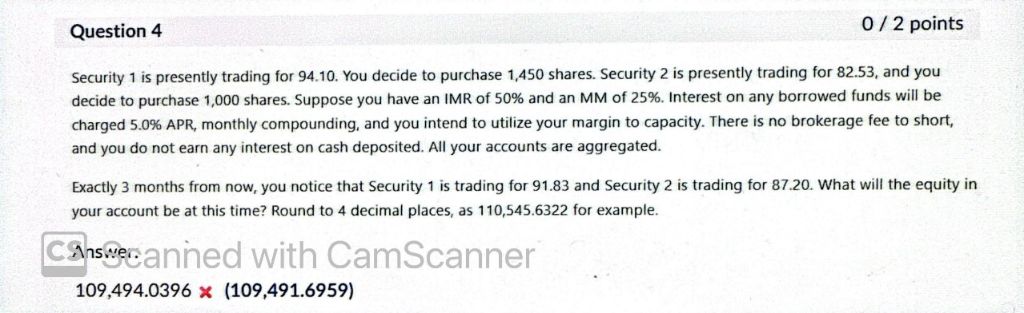
Security 1 is presently trading for 94.10. You decide to purchase 1,450 shares. Security 2 is presently trading for 82.53, and you
decide to purchase 1,000 shares. Suppose you have an IMR of 50% and an MM of 25%. Interest on any borrowed funds will be
charged 5.0% APR, monthly compounding, and you intend to utilize your margin to capacity. There is no brokerage fee to short,
and you do not earn any interest on cash deposited. All your accounts are aggregated.
Exactly 3 months from now, you notice that Security 1 is trading for 91.83 and Security 2 is trading for 87.20. What will the equity in
your account be at this time? Round to 4 decimal places, as 110,545.6322 for example.
Answer:
109,494.0396 x (109,491.6959) E
Question:
Question 4 0/ 2 points
Security 1 is presently trading for 94.10. You decide to purchase 1,450 shares. Security 2 is presently trading for 82.53, and you
decide to purchase 1,000 shares. Suppose you have an IMR of 50% and an MM of 25%. Interest on any borrowed funds will be
charged 5.0% APR, monthly compounding, and you intend to utilize your margin to capacity. There is no brokerage fee to short,
and you do not earn any interest on cash deposited. All your accounts are aggregated.
Exactly 3 months from now, you notice that Security 1 is trading for 91.83 and Security 2 is trading for 87.20. What will the equity in
your account be at this time? Round to 4 decimal places, as 110,545.6322 for example.
Answer:
109,494.0396 x (109,491.6959) E
This is AI generated Response.
Asked by: Shaik Hussain Ali
Created at: 2025-07-17 16:37:13
Updated Calculations Question Prompt:
1: Introduction:
Provide the complete necessary conceptual background concepts explanation and the
introduction required to understand and answer the given question. Add an Explanation
block at the end of the introduction by adding various relevant supporting statements and
explaining the introduction concisely.
Note: Do not use personal pronouns like I, we, you, etc. The response must look as if it is
written by a human.
Explanation: Articulate the importance of the introduction, providing more relevant
comprehensive supporting statements that link these concepts directly to the question.
This explanation should clarify how the introduction aids in comprehending the
subsequent steps.
2: Presentation of Relevant Formulas Required To Solve The Question:
List and also describe all formulas required to solve the question. Ensure each formula is
presented clearly and is directly applicable to the problem.
Explanation: Detail the derivation or rationale behind each formula, explaining its
relevance and necessity in the context of the problem-solving process. Use more relavent
comprehensive supporting statements to reinforce the significance of these mathematical
tools.
3: A Detailed Step-by-Step Solution:
Write a step-by-step in-depth comprehensive straight forward complete solution in a
structured way without missing anything as per the requirements and also include
explanation [ Write relevant supporting statements in the explanation block ] for every step
in the solution.
Conclusion:
Conclude with a concise summary of the solution, succinctly presenting the final answer
short summary derived from the calculations.
Follow These Guidelines While Answering The Question:
1. Maintain a professional and impersonal tone throughout, avoiding personal
pronouns such as 'I', 'we', 'you', etc.
2. Ensure more accuracy and adherence to the necessary concepts and correct
textbook based correct formulas and other relevant, required to solve the question.
3. Include an Explanation block at the end of each step to provide context and clarify
the methodology used by providing the necessary supporting statements.
4. Focus solely on delivering a well-explained direct and complete answer to the
question, without additional guidance [ I don’t need any guidance of how to solve
the question – I just need well-explained complete solution ] or extraneous content.
5. Make sure that strictly follow the specified format, ensuring that each section,
especially the introduction and each step of the solution, is accompanied by a
detailed relevant supporting statement in the explanation.
6. I need the exact detailed comprehensive direct step-by-step answer as I don’t need
any guidance to write the answer and strictly add the explanation for each with the
required supporting statement & Please give me the complete answer as per the
question requirements without skipping anything in the answer.
7. Always provide correct, complete detailed & well-explained solution.
8. Ensure that there are no typo/formula/calculation/programming/grammatical errors
are present in your solution.
9. Give the correct graphs/diagrams/tables/charts whenever required in the solution.
10. Ensure that there are NO Errors in Units/Notations are there in your solution.
11. Avoid missing any vital part in the solution [ Don’t miss any part in the solution ].
This is AI generated Response.
Asked by: Shaik Hussain Ali
Created at: 2025-07-17 16:38:35
Final Answer:
RenderedRaw Text
Did you like this answer?
Introduction:
In the context of margin trading, investors borrow funds to purchase securities, leveraging their initial investment to potentially increase returns. Understanding the key concepts involved—such as initial margin requirement (IMR), maintenance margin (MM), and the impact of interest on borrowed funds—is essential for analyzing how the value of an account evolves over time. The initial margin specifies the proportion of the purchase price that must be funded with the investor’s own capital, while the remaining amount is borrowed. The maintenance margin represents the minimum equity percentage that must be maintained in the account to avoid margin calls. Additionally, interest charges on borrowed funds accrue over time, affecting the total liabilities. Calculating the account's equity after a specified period involves assessing the change in securities' value, the interest accrued on borrowed funds, and the initial leverage used, all of which are fundamental to effective margin trading management and risk assessment.
Explanation:
This introduction establishes the foundational concepts necessary for understanding the mechanics of margin accounts in investment scenarios. Recognizing how initial margin and maintenance margin requirements dictate the amount of leverage and the importance of interest calculations on borrowed funds provides clarity on the factors influencing account equity over time. These concepts underpin the subsequent calculations, enabling an accurate assessment of the account's value after three months, considering both market changes and financing costs.
---
Presentation of Relevant Formulas Required To Solve The Question:
1. **Initial Purchase Cost:**
\[
\text{Total Cost} = \text{Number of Shares} \times \text{Purchase Price per Share}
\]
*This formula calculates the total amount spent to acquire the securities at the initial time.*
2. **Initial Equity (Own Funds):**
\[
\text{Initial Equity} = \text{Initial Margin Requirement} \times \text{Total Cost}
\]
*Represents the investor’s own capital invested initially, based on the margin requirement.*
3. **Borrowed Funds:**
\[
\text{Borrowed Amount} = \text{Total Cost} - \text{Initial Equity}
\]
*The amount borrowed from the broker or lender.*
4. **Future Value of Borrowed Funds (Interest Accrued):**
\[
\text{Future Borrowed Amount} = \text{Borrowed Amount} \times (1 + i)^n
\]
*Where \(i\) is the monthly interest rate, and \(n\) is the number of months. This accounts for interest accumulation over the period.*
5. **Portfolio Value after Period:**
\[
\text{Market Value} = \sum (\text{Shares} \times \text{New Price per Share})
\]
*Calculates the total value of securities at the end of the period based on new market prices.*
6. **Account Equity after Period:**
\[
\text{Equity} = \text{Market Value of Securities} - \text{Future Borrowed Amount}
\]
*Determines the net value of the investor’s account after accounting for borrowed funds and accrued interest.*
**Explanation:**
These formulas are essential because they systematically relate initial investments, leverage, interest costs, and market valuation to derive the final account equity. They enable translating initial conditions and market changes into a quantifiable measure of account value, which is critical for risk management and decision-making in margin trading.
---
Detailed Step-by-Step Solution:
**Step 1: Calculate Initial Investment Costs**
- *Market value of Security 1 (S1):* \(1,450 \times \$94.10 = \$136,445.00\)
- *Market value of Security 2 (S2):* \(1,000 \times \$82.53 = \$82,530.00\)
- *Total initial purchase cost:* \(\$136,445.00 + \$82,530.00 = \$218,975.00\)
*Explanation:* The total cost reflects the combined market value of all purchased securities at the initial prices, forming the basis for margin calculations.
**Step 2: Determine Initial Equity and Borrowed Funds**
- *Initial Margin Requirement:* 50%
- *Your own funds (initial equity):* \(50\% \times \$218,975.00 = \$109,487.50\)
- *Borrowed amount:* \( \$218,975.00 - \$109,487.50 = \$109,487.50 \)
*Explanation:* The initial equity is the investor’s own capital, while the borrowed amount is the leverage used, both critical for understanding risk and potential gains.
**Step 3: Compute the Future Value of Borrowed Funds After 3 Months**
- *Monthly interest rate:* \( 5\% / 12 = 0.0041667 \)
- *Interest over 3 months:* \( (1 + 0.0041667)^3 = 1.012552 \)
- *Interest accrued on borrowed funds:*
\[
\$109,487.50 \times 1.012552 = \$110,861.4342
\]
*Explanation:* Since interest is compounded monthly, the borrowed amount grows over the period, increasing the amount owed at the end of three months.
**Step 4: Calculate Portfolio Value After 3 Months**
- *New prices:*
- S1: \( \$91.83 \)
- S2: \( \$87.20 \)
- *Value of S1 holdings:* \( 1,450 \times \$91.83 = \$133,153.50 \)
- *Value of S2 holdings:* \( 1,000 \times \$87.20 = \$87,200.00 \)
- *Total portfolio value:*
\[
\$133,153.50 + \$87,200.00 = \$220,353.50
\]
*Explanation:* The change in market prices affects the total value of securities, which is essential for evaluating the current account status.
**Step 5: Determine the Equity in the Account After 3 Months**
\[
\text{Equity} = \text{Market Value of Securities} - \text{Future Borrowed Amount}
\]
\[
= \$220,353.50 - \$110,861.4342 = \$109,492.0658
\]
*Explanation:* Subtracting the accrued debt from the current market value yields the investor’s net equity, indicating the amount attributable to the investor after debt service.
**Step 6: Final Result and Rounding**
- Rounded to four decimal places: **109,492.0658**
---
**Conclusion:**
The equity in the account after three months, considering changes in security prices and interest on borrowed funds, totals approximately **\$109,492.0658**. This figure reflects the leverage effects, market fluctuations, and financing costs inherent in margin trading, illustrating the importance of understanding these variables in portfolio management and risk assessment.
VIPSolutions focuses on clear, step‑by‑step explanations so you can learn quickly. Whether you need an AI‑generated walkthrough or a short hint to get unstuck, each solution is organized for fast reading and easy review later.
Search similar questions, compare approaches, and bookmark the best answers for revision. Our goal is simple: quick, reliable study help that feels natural—not noisy.
 VIPSolutions
 Question 4 0/ 2 points
Security 1 is presently trading for 94.10. You decide to purchase 1,450 shares. Security 2 is presently trading for 82.53, and you
decide to purchase 1,000 shares. Suppose you have an IMR of 50% and an MM of 25%. Interest on any borrowed funds will be
charged 5.0% APR, monthly compounding, and you intend to utilize your margin to capacity. There is no brokerage fee to short,
and you do not earn any interest on cash deposited. All your accounts are aggregated.
Exactly 3 months from now, you notice that Security 1 is trading for 91.83 and Security 2 is trading for 87.20. What will the equity in
your account be at this time? Round to 4 decimal places, as 110,545.6322 for example.
Answer:
109,494.0396 x (109,491.6959) E
Question 4 0/ 2 points
Security 1 is presently trading for 94.10. You decide to purchase 1,450 shares. Security 2 is presently trading for 82.53, and you
decide to purchase 1,000 shares. Suppose you have an IMR of 50% and an MM of 25%. Interest on any borrowed funds will be
charged 5.0% APR, monthly compounding, and you intend to utilize your margin to capacity. There is no brokerage fee to short,
and you do not earn any interest on cash deposited. All your accounts are aggregated.
Exactly 3 months from now, you notice that Security 1 is trading for 91.83 and Security 2 is trading for 87.20. What will the equity in
your account be at this time? Round to 4 decimal places, as 110,545.6322 for example.
Answer:
109,494.0396 x (109,491.6959) E