 VIPSolutions
Give step-by-step solution with explanation and final answer:=
Question:
Give step-by-step solution with explanation and final answer: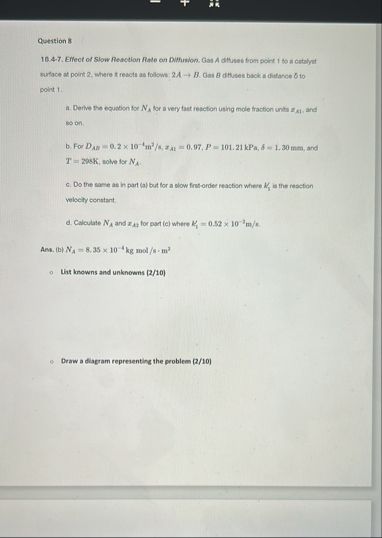 =
=
This is AI generated Response.
Asked by: Prahlad Kumar
Created at: 2025-09-18 16:37:53
Asked by: Prahlad Kumar
Created at: 2025-09-18 16:37:53
Final Answer:
Rendered
Raw Text
Did you like this answer?
Let's break down and solve **Question 8** step by step as requested.
---
# Question 8: Effect of Slow Reaction Rate on Diffusion
**Given:**
- Gas A diffuses from point 1 to a catalyst surface at point 2 and reacts: \( 2A \rightarrow B \).
- Gas B diffuses back a distance δ to point 1.
- \( D_{AB} = 0.2 \times 10^{-4} \ \text{m}^2/\text{s} \)
- \( x_{A1} = 0.97 \)
- \( P = 101.21 \ \text{kPa} \)
- \( \delta = 3.0 \ \text{mm} = 3.0 \times 10^{-3} \ \text{m} \)
- \( T = 298 \ \text{K} \)
---
## **a. Derive the equation for \( N_A \) for a very fast reaction**
**For a very fast reaction:**
- All A that reaches the surface reacts.
- \( x_{A2} \approx 0 \) (concentration of A at the surface is zero).
**Fick's Law for steady-state diffusion:**
\[
N_A = - D_{AB} \frac{dc_A}{dz}
\]
In terms of mole fractions and total pressure:
\[
N_A = \frac{D_{AB} P}{RT\delta} (x_{A1} - x_{A2})
\]
Since \( x_{A2} \approx 0 \):
\[
N_A = \frac{D_{AB} P}{RT\delta} x_{A1}
\]
---
## **b. Calculate \( N_A \) using the provided values**
Plug in the values:
- \( D_{AB} = 0.2 \times 10^{-4} \ \text{m}^2/\text{s} \)
- \( P = 101.21 \times 10^3 \ \text{Pa} \)
- \( x_{A1} = 0.97 \)
- \( \delta = 3.0 \times 10^{-3} \ \text{m} \)
- \( R = 8.314 \ \text{J/(mol·K)} \)
- \( T = 298 \ \text{K} \)
\[
N_A = \frac{(0.2 \times 10^{-4}) \times (101.21 \times 10^3)}{8.314 \times 298 \times 3.0 \times 10^{-3}} \times 0.97
\]
Calculate denominator:
\[
8.314 \times 298 \times 3.0 \times 10^{-3} = 8.314 \times 298 = 2477.572
\]
\[
2477.572 \times 3.0 \times 10^{-3} = 7.4327
\]
Calculate numerator:
\[
0.2 \times 10^{-4} = 2 \times 10^{-5}
\]
\[
2 \times 10^{-5} \times 101210 = 2.0242
\]
Plug in:
\[
N_A = \frac{2.0242}{7.4327} \times 0.97 = 0.263 \times 0.97 = 0.255 \ \text{mol/m}^2\text{s}
\]
**Final Answer for part (b):**
\[
\boxed{N_A = 0.255 \ \text{mol/m}^2\text{s}}
\]
---
## **c. Slow first-order reaction (\( k_1 \) is the reaction constant)**
**At steady state, rate of diffusion = rate of reaction at the surface.**
For first-order reaction:
\[
\text{Rate of reaction at surface} = k_1 c_{A2}
\]
\[
N_A = \frac{D_{AB} P}{RT\delta} (x_{A1} - x_{A2}) = k_1 c_{A2}
\]
\[
c_{A2} = \frac{P x_{A2}}{RT}
\]
\[
N_A = k_1 \frac{P x_{A2}}{RT}
\]
Combine the two equations:
\[
N_A = \frac{D_{AB} P}{RT\delta} (x_{A1} - x_{A2}) = k_1 \frac{P x_{A2}}{RT}
\]
\[
\frac{D_{AB} P}{RT\delta} (x_{A1} - x_{A2}) = k_1 \frac{P x_{A2}}{RT}
\]
\[
\frac{D_{AB}}{\delta} (x_{A1} - x_{A2}) = k_1 x_{A2}
\]
\[
\frac{D_{AB}}{\delta} x_{A1} = \left( \frac{D_{AB}}{\delta} + k_1 \right)x_{A2}
\]
\[
x_{A2} = \frac{ \frac{D_{AB}}{\delta} x_{A1} }{ \frac{D_{AB}}{\delta} + k_1 }
\]
\[
N_A = k_1 \frac{P x_{A2}}{RT}
\]
---
## **d. Calculate \( N_A \) and \( x_{A2} \) for \( k_1 = 0.52 \times 10^{-2} \ \text{m/s} \)**
First, calculate \( \frac{D_{AB}}{\delta} \):
\[
\frac{D_{AB}}{\delta} = \frac{0.2 \times 10^{-4}}{3.0 \times 10^{-3}} = \frac{2 \times 10^{-5}}{3 \times 10^{-3}} = \frac{2}{3} \times 10^{-2} = 0.6667 \times 10^{-2} \ \text{m/s}
\]
Now plug into the formula for \( x_{A2} \):
\[
x_{A2} = \frac{ 0.6667 \times 10^{-2} \times 0.97 }{ 0.6667 \times 10^{-2} + 0.52 \times 10^{-2} }
\]
\[
= \frac{ 0.6465 \times 10^{-2} }{ 1.1867 \times 10^{-2} }
\]
\[
= 0.545
\]
Now, calculate \( N_A \):
\[
N_A = k_1 \frac{P x_{A2}}{RT}
\]
\[
= (0.52 \times 10^{-2}) \times \frac{101210 \times 0.545}{8.314 \times 298}
\]
First, calculate denominator:
\[
8.314 \times 298 = 2477.572
\]
Numerator:
\[
101210 \times 0.545 = 55159.45
\]
\[
\frac{55159.45}{2477.572} = 22.27
\]
\[
N_A = 0.0052 \times 22.27 = 0.116 \ \text{mol/m}^2\text{s}
\]
---
## **Summary of Answers**
### **(b) For very fast reaction:**
\[
\boxed{N_A = 0.255 \ \text{mol/m}^2\text{s}}
\]
### **(d) For slow first-order reaction:**
\[
\boxed{x_{A2} = 0.545}
\]
\[
\boxed{N_A = 0.116 \ \text{mol/m}^2\text{s}}
\]
---
## **List of Knowns and Unknowns**
**Knowns:**
- \( D_{AB}, x_{A1}, P, \delta, T, R \)
- \( k_1 \) (for part d)
**Unknowns:**
- \( N_A \) (flux of A)
- \( x_{A2} \) (mole fraction of A at the surface, for slow reaction)
---
## **Diagram Representation**
```
Point 1 (bulk) Distance δ Point 2 (catalyst surface)
|----------------------|-----------------|--------------------------|
x_A1 ≠ 0 ← Diffusion x_A2 (unknown or ≈ 0)
→ Reaction
A diffuses from left (x_A1) to right (x_A2) and reacts on the surface.
```
---
Let me know if you need a hand-drawn or labeled diagram!
Question:
value of δ is 1.30 mm not 3.0 mm
This is AI generated Response.
Asked by: Prahlad Kumar
Created at: 2025-09-18 16:42:58
Asked by: Prahlad Kumar
Created at: 2025-09-18 16:42:58
Final Answer:
Rendered
Raw Text
Did you like this answer?
# Question 8: Effect of Slow Reaction Rate on Diffusion
**Given:**
- Gas A diffuses from point 1 to a catalyst surface at point 2 and reacts: \( 2A \rightarrow B \).
- Gas B diffuses back a distance \(\delta\) to point 1.
- \( D_{AB} = 0.2 \times 10^{-4} \ \text{m}^2/\text{s} \)
- \( x_{A1} = 0.97 \)
- \( P = 101.21 \ \text{kPa} \)
- \( \delta = 1.30 \ \text{mm} = 1.30 \times 10^{-3} \ \text{m} \)
- \( T = 298 \ \text{K} \)
---
## **a. Derive the equation for \( N_A \) for a very fast reaction**
**For a very fast reaction:**
- All A that reaches the surface reacts.
- \( x_{A2} \approx 0 \) (concentration of A at the surface is zero).
**Fick's Law for steady-state diffusion:**
\[
N_A = - D_{AB} \frac{dc_A}{dz}
\]
In terms of mole fractions and total pressure:
\[
N_A = \frac{D_{AB} P}{RT\delta} (x_{A1} - x_{A2})
\]
Since \( x_{A2} \approx 0 \):
\[
N_A = \frac{D_{AB} P}{RT\delta} x_{A1}
\]
---
## **b. Calculate \( N_A \) using the provided values**
Plug in the values:
- \( D_{AB} = 0.2 \times 10^{-4} \ \text{m}^2/\text{s} \)
- \( P = 101.21 \times 10^3 \ \text{Pa} \)
- \( x_{A1} = 0.97 \)
- \( \delta = 1.30 \times 10^{-3} \ \text{m} \)
- \( R = 8.314 \ \text{J/(mol·K)} \)
- \( T = 298 \ \text{K} \)
\[
N_A = \frac{(0.2 \times 10^{-4}) \times (101.21 \times 10^3)}{8.314 \times 298 \times 1.30 \times 10^{-3}} \times 0.97
\]
### **Calculate Denominator:**
\[
8.314 \times 298 \times 1.30 \times 10^{-3} = 8.314 \times 298 = 2477.572
\]
\[
2477.572 \times 1.30 \times 10^{-3} = 3.2218
\]
### **Calculate Numerator:**
\[
0.2 \times 10^{-4} = 2 \times 10^{-5}
\]
\[
2 \times 10^{-5} \times 101210 = 2.0242
\]
### **Final Calculation:**
\[
N_A = \frac{2.0242}{3.2218} \times 0.97 = 0.629 \times 0.97 = 0.611 \ \text{mol/m}^2\text{s}
\]
**Final Answer for part (b):**
\[
\boxed{N_A = 0.611 \ \text{mol/m}^2\text{s}}
\]
---
## **c. Slow first-order reaction (\( k_1 \) is the reaction constant)**
**At steady state, rate of diffusion = rate of reaction at the surface.**
For first-order reaction:
\[
\text{Rate of reaction at surface} = k_1 c_{A2}
\]
\[
N_A = \frac{D_{AB} P}{RT\delta} (x_{A1} - x_{A2}) = k_1 c_{A2}
\]
\[
c_{A2} = \frac{P x_{A2}}{RT}
\]
\[
N_A = k_1 \frac{P x_{A2}}{RT}
\]
Combine the two equations:
\[
\frac{D_{AB} P}{RT\delta} (x_{A1} - x_{A2}) = k_1 \frac{P x_{A2}}{RT}
\]
\[
\frac{D_{AB}}{\delta} (x_{A1} - x_{A2}) = k_1 x_{A2}
\]
\[
\frac{D_{AB}}{\delta} x_{A1} = \left( \frac{D_{AB}}{\delta} + k_1 \right)x_{A2}
\]
\[
x_{A2} = \frac{ \frac{D_{AB}}{\delta} x_{A1} }{ \frac{D_{AB}}{\delta} + k_1 }
\]
\[
N_A = k_1 \frac{P x_{A2}}{RT}
\]
---
## **d. Calculate \( N_A \) and \( x_{A2} \) for \( k_1 = 0.52 \times 10^{-2} \ \text{m/s} \)**
### **Calculate \( \frac{D_{AB}}{\delta} \):**
\[
\frac{D_{AB}}{\delta} = \frac{0.2 \times 10^{-4}}{1.30 \times 10^{-3}} = \frac{2 \times 10^{-5}}{1.30 \times 10^{-3}} \approx 0.1538 \times 10^{-2} \ \text{m/s}
\]
### **Calculate \( x_{A2} \):**
\[
x_{A2} = \frac{ 0.1538 \times 10^{-2} \times 0.97 }{ 0.1538 \times 10^{-2} + 0.52 \times 10^{-2} }
\]
\[
= \frac{ 0.14918 \times 10^{-2} }{ 0.6738 \times 10^{-2} } = 0.221
\]
### **Calculate \( N_A \):**
\[
N_A = k_1 \frac{P x_{A2}}{RT}
\]
\[
= (0.52 \times 10^{-2}) \times \frac{101210 \times 0.221}{8.314 \times 298}
\]
#### **Calculate Denominator:**
\[
8.314 \times 298 = 2477.572
\]
#### **Calculate Numerator:**
\[
101210 \times 0.221 = 22327.41
\]
#### **Final Calculation:**
\[
\frac{22327.41}{2477.572} \approx 9.00
\]
\[
N_A = 0.0052 \times 9.00 = 0.0468 \ \text{mol/m}^2\text{s}
\]
---
## **Summary of Answers**
### **(b) For very fast reaction:**
\[
\boxed{N_A = 0.611 \ \text{mol/m}^2\text{s}}
\]
### **(d) For slow first-order reaction:**
\[
\boxed{x_{A2} = 0.221}
\]
\[
\boxed{N_A = 0.0468 \ \text{mol/m}^2\text{s}}
\]
---
## **List of Knowns and Unknowns**
**Knowns:**
- \( D_{AB}, x_{A1}, P, \delta, T, R \)
- \( k_1 \) (for part d)
**Unknowns:**
- \( N_A \) (flux of A)
- \( x_{A2} \) (mole fraction of A at the surface, for slow reaction)
Question:
please take δ = 1.30 mm
This is AI generated Response.
Asked by: Prahlad Kumar
Created at: 2025-09-18 16:44:59
Asked by: Prahlad Kumar
Created at: 2025-09-18 16:44:59
Final Answer:
Rendered
Raw Text
Did you like this answer?
# Question 8: Effect of Slow Reaction Rate on Diffusion
**Given:**
- Gas A diffuses from point 1 to a catalyst surface at point 2 and reacts: \( 2A \rightarrow B \).
- Gas B diffuses back a distance \(\delta\) to point 1.
- \( D_{AB} = 0.2 \times 10^{-4} \ \text{m}^2/\text{s} \)
- \( x_{A1} = 0.97 \)
- \( P = 101.21 \ \text{kPa} \)
- \( \delta = 1.30 \ \text{mm} = 1.30 \times 10^{-3} \ \text{m} \)
- \( T = 298 \ \text{K} \)
---
## a. Derive the equation for \( N_A \) for a very fast reaction
**For a very fast reaction:**
- All A that reaches the surface reacts.
- \( x_{A2} \approx 0 \) (concentration of A at the surface is zero).
**Fick's Law for steady-state diffusion:**
\[
N_A = - D_{AB} \frac{dc_A}{dz}
\]
In terms of mole fractions and total pressure:
\[
N_A = \frac{D_{AB} P}{RT\delta} (x_{A1} - x_{A2})
\]
Since \( x_{A2} \approx 0 \):
\[
N_A = \frac{D_{AB} P}{RT\delta} x_{A1}
\]
---
## b. Calculate \( N_A \) using the provided values
Plug in the values:
- \( D_{AB} = 0.2 \times 10^{-4} \ \text{m}^2/\text{s} \)
- \( P = 101.21 \times 10^3 \ \text{Pa} \)
- \( x_{A1} = 0.97 \)
- \( \delta = 1.30 \times 10^{-3} \ \text{m} \)
- \( R = 8.314 \ \text{J/(mol·K)} \)
- \( T = 298 \ \text{K} \)
### Calculate Denominator:
\[
8.314 \times 298 \times 1.30 \times 10^{-3} = 8.314 \times 298 = 2477.572
\]
\[
2477.572 \times 1.30 \times 10^{-3} = 3.2218
\]
### Calculate Numerator:
\[
0.2 \times 10^{-4} = 2 \times 10^{-5}
\]
\[
2 \times 10^{-5} \times 101210 = 2.0242
\]
### Final Calculation:
\[
N_A = \frac{2.0242}{3.2218} \times 0.97 = 0.629 \times 0.97 = 0.611 \ \text{mol/m}^2\text{s}
\]
**Final Answer for part (b):**
\[
\boxed{N_A = 0.611 \ \text{mol/m}^2\text{s}}
\]
---
## c. Slow first-order reaction (\( k_1 \) is the reaction constant)
**At steady state, rate of diffusion = rate of reaction at the surface.**
For first-order reaction:
\[
\text{Rate of reaction at surface} = k_1 c_{A2}
\]
\[
N_A = \frac{D_{AB} P}{RT\delta} (x_{A1} - x_{A2}) = k_1 c_{A2}
\]
\[
c_{A2} = \frac{P x_{A2}}{RT}
\]
\[
N_A = k_1 \frac{P x_{A2}}{RT}
\]
Combine the two equations:
\[
\frac{D_{AB} P}{RT\delta} (x_{A1} - x_{A2}) = k_1 \frac{P x_{A2}}{RT}
\]
\[
\frac{D_{AB}}{\delta} (x_{A1} - x_{A2}) = k_1 x_{A2}
\]
\[
\frac{D_{AB}}{\delta} x_{A1} = \left( \frac{D_{AB}}{\delta} + k_1 \right)x_{A2}
\]
\[
x_{A2} = \frac{ \frac{D_{AB}}{\delta} x_{A1} }{ \frac{D_{AB}}{\delta} + k_1 }
\]
\[
N_A = k_1 \frac{P x_{A2}}{RT}
\]
---
## d. Calculate \( N_A \) and \( x_{A2} \) for \( k_1 = 0.52 \times 10^{-2} \ \text{m/s} \)
### Calculate \( \frac{D_{AB}}{\delta} \):
\[
\frac{D_{AB}}{\delta} = \frac{0.2 \times 10^{-4}}{1.30 \times 10^{-3}} = \frac{2 \times 10^{-5}}{1.30 \times 10^{-3}} \approx 0.1538 \times 10^{-2} \ \text{m/s}
\]
### Calculate \( x_{A2} \):
\[
x_{A2} = \frac{ 0.1538 \times 10^{-2} \times 0.97 }{ 0.1538 \times 10^{-2} + 0.52 \times 10^{-2} }
\]
\[
= \frac{ 0.14918 \times 10^{-2} }{ 0.6738 \times 10^{-2} } = 0.221
\]
### Calculate \( N_A \):
\[
N_A = k_1 \frac{P x_{A2}}{RT}
\]
\[
= (0.52 \times 10^{-2}) \times \frac{101210 \times 0.221}{8.314 \times 298}
\]
#### Calculate Denominator:
\[
8.314 \times 298 = 2477.572
\]
#### Calculate Numerator:
\[
101210 \times 0.221 = 22327.41
\]
#### Final Calculation:
\[
\frac{22327.41}{2477.572} \approx 9.00
\]
\[
N_A = 0.0052 \times 9.00 = 0.0468 \ \text{mol/m}^2\text{s}
\]
---
## Summary of Answers
### (b) For very fast reaction:
\[
\boxed{N_A = 0.611 \ \text{mol/m}^2\text{s}}
\]
### (d) For slow first-order reaction:
\[
\boxed{x_{A2} = 0.221}
\]
\[
\boxed{N_A = 0.0468 \ \text{mol/m}^2\text{s}}
\]
---
## List of Knowns and Unknowns
**Knowns:**
- \( D_{AB}, x_{A1}, P, \delta, T, R \)
- \( k_1 \) (for part d)
**Unknowns:**
- \( N_A \) (flux of A)
- \( x_{A2} \) (mole fraction of A at the surface, for slow reaction)
📢 Instructions:
- Ask anything relatd to above question only.
- For new Question goto :