 VIPSolutions
Give step-by-step solution with explanation and final answer:12.12 A certain unity feedback system has the following open-loop system transfer function. 5K Ge) = Sree Obtain the Bode plots and compute the phase and gain margins for a K=2 b. K=20 | |
Question:
Give step-by-step solution with explanation and final answer: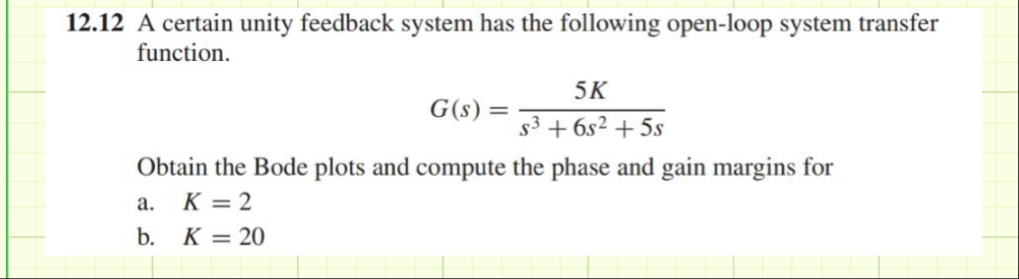 12.12 A certain unity feedback system has the following open-loop system transfer
function.
5K
Ge) = Sree
Obtain the Bode plots and compute the phase and gain margins for
a K=2
b. K=20
| |
12.12 A certain unity feedback system has the following open-loop system transfer
function.
5K
Ge) = Sree
Obtain the Bode plots and compute the phase and gain margins for
a K=2
b. K=20
| |
This is AI generated Response.
Asked by: admin3
Created at: 2025-08-12 14:23:09
Asked by: admin3
Created at: 2025-08-12 14:23:09
Final Answer:
Rendered
Raw Text
Did you like this answer?
Let's solve the problem step by step:
## **Given:**
Open-loop transfer function:
\[
G(s) = \frac{5K}{s^3 + 6s^2 + 5s}
\]
We are to:
1. Obtain the Bode plot,
2. Compute the **phase margin (PM)** and **gain margin (GM)** for:
- \( K = 2 \)
- \( K = 20 \)
---
### **Step 1: Factorize the Denominator**
\[
s^3 + 6s^2 + 5s = s(s^2 + 6s + 5) = s(s+1)(s+5)
\]
So,
\[
G(s) = \frac{5K}{s(s+1)(s+5)}
\]
---
### **Step 2: Express in Frequency Domain (\(s = j\omega\))**
\[
G(j\omega) = \frac{5K}{(j\omega)((j\omega)+1)((j\omega)+5)}
\]
---
### **Step 3: Bode Plot Construction**
#### **Magnitude:**
\[
|G(j\omega)| = \frac{5K}{\omega \sqrt{\omega^2+1}\sqrt{\omega^2+25}}
\]
#### **Phase:**
\[
\angle G(j\omega) = -90^\circ - \tan^{-1}\left(\frac{\omega}{1}\right) - \tan^{-1}\left(\frac{\omega}{5}\right)
\]
---
### **Step 4: Gain Margin and Phase Margin**
#### **Definitions:**
- **Gain Margin (GM):** Additional gain required to bring the system to the verge of instability (phase = -180°).
- **Phase Margin (PM):** Additional phase lag required to bring the system to the verge of instability (gain = 1 or 0 dB).
---
## **A. For \(K = 2\):**
### **Magnitude (in dB):**
\[
20\log_{10}|G(j\omega)| = 20\log_{10}(10) - 20\log_{10}(\omega) - 10\log_{10}(\omega^2+1) - 10\log_{10}(\omega^2+25)
\]
\[
\Rightarrow 20\log_{10}(10) = 20
\]
So,
\[
20 - 20\log_{10}(\omega) - 10\log_{10}(\omega^2+1) - 10\log_{10}(\omega^2+25)
\]
### **Phase:**
\[
\angle G(j\omega) = -90^\circ - \tan^{-1}(\omega) - \tan^{-1}\left(\frac{\omega}{5}\right)
\]
---
### **Find Gain Crossover Frequency (\(\omega_{gc}\))**
At gain crossover, \(|G(j\omega_{gc})| = 1\), or \(0\) dB.
Set magnitude to 1 and solve for \(\omega_{gc}\):
\[
\frac{10}{\omega \sqrt{\omega^2+1} \sqrt{\omega^2+25}} = 1
\]
\[
10 = \omega \sqrt{\omega^2+1} \sqrt{\omega^2+25}
\]
Square both sides:
\[
100 = \omega^2 (\omega^2 + 1)(\omega^2 + 25)
\]
Let \(x = \omega^2\):
\[
100 = x(x + 1)(x + 25)
\]
\[
100 = x(x^2 + 26x + 25)
\]
\[
100 = x^3 + 26x^2 + 25x
\]
\[
x^3 + 26x^2 + 25x - 100 = 0
\]
This is a cubic equation. Let's estimate the root numerically:
For \(x = 1\): \(1 + 26 + 25 - 100 = -48\)
For \(x = 2\): \(8 + 104 + 50 - 100 = 62\)
So, the root is between 1 and 2.
Try \(x = 1.5\):
\[
(1.5)^3 + 26(1.5)^2 + 25(1.5) - 100 = 3.375 + 58.5 + 37.5 - 100 = -0.625
\]
Try \(x = 1.6\):
\[
(1.6)^3 + 26(1.6)^2 + 25(1.6) - 100 = 4.096 + 66.56 + 40 - 100 = 10.656
\]
So at \(x \approx 1.52\):
\[
(1.52)^3 + 26(1.52)^2 + 25(1.52) - 100 \approx 3.51 + 60.07 + 38 - 100 = 1.58
\]
So \(x \approx 1.5\), thus \(\omega_{gc} \approx \sqrt{1.5} \approx 1.22\) rad/s.
---
### **Phase at \(\omega_{gc}\):**
\[
\theta = -90^\circ - \tan^{-1}(1.22) - \tan^{-1}(1.22/5)
\]
\[
\tan^{-1}(1.22) \approx 50.1^\circ
\]
\[
1.22/5 = 0.244, \quad \tan^{-1}(0.244) \approx 13.7^\circ
\]
\[
\theta = -90^\circ - 50.1^\circ - 13.7^\circ = -153.8^\circ
\]
---
### **Phase Margin (PM):**
\[
\text{PM} = 180^\circ + (-153.8^\circ) = 26.2^\circ
\]
---
### **Find Phase Crossover Frequency (\(\omega_{pc}\)):**
Set phase to -180°:
\[
-90^\circ - \tan^{-1}(\omega) - \tan^{-1}\left(\frac{\omega}{5}\right) = -180^\circ
\]
\[
\tan^{-1}(\omega) + \tan^{-1}\left(\frac{\omega}{5}\right) = 90^\circ
\]
Recall:
\[
\tan^{-1}(a) + \tan^{-1}(b) = \tan^{-1}\left( \frac{a+b}{1-ab} \right)
\]
Set this equal to 90°:
\[
\frac{\omega + \frac{\omega}{5}}{1 - \omega \cdot \frac{\omega}{5}} \to \infty
\]
So denominator = 0:
\[
1 - \frac{\omega^2}{5} = 0 \implies \omega^2 = 5 \implies \omega_{pc} = \sqrt{5} \approx 2.24
\]
---
### **Gain at Phase Crossover:**
\[
|G(j2.24)| = \frac{10}{2.24 \sqrt{2.24^2 + 1} \sqrt{2.24^2 + 25}}
\]
\[
2.24^2 = 5.02; \quad 5.02 + 1 = 6.02 \implies \sqrt{6.02} \approx 2.45
\]
\[
5.02 + 25 = 30.02 \implies \sqrt{30.02} \approx 5.48
\]
\[
|G(j2.24)| = \frac{10}{2.24 \times 2.45 \times 5.48} \approx \frac{10}{30.04} \approx 0.333
\]
In dB: \(20\log_{10}(0.333) = -9.54\,\text{dB}\)
#### **Gain Margin:**
\[
\text{GM} = -(-9.54) = 9.54\,\text{dB}
\]
---
## **B. For \(K = 20\):**
Similar steps, but now \(5K = 100\):
### **Magnitude:**
\[
|G(j\omega)| = \frac{100}{\omega \sqrt{\omega^2+1} \sqrt{\omega^2+25}}
\]
Set \( |G(j\omega_{gc})| = 1 \):
\[
100 = \omega \sqrt{\omega^2+1} \sqrt{\omega^2+25}
\]
\[
10000 = \omega^2 (\omega^2+1)(\omega^2+25)
\]
Let \(x = \omega^2\):
\[
10000 = x(x+1)(x+25)
\]
\[
10000 = x^3 + 26x^2 + 25x
\]
\[
x^3 + 26x^2 + 25x - 10000 = 0
\]
Try \(x = 10\): \(1000 + 2600 + 250 - 10000 = -6150\)
Try \(x = 20\): \(8000 + 10400 + 500 - 10000 = 8900\)
Try \(x = 12\): \(1728 + 1872 + 300 - 10000 = -6100\)
Try \(x = 18\): \(5832 + 8424 + 450 - 10000 = 2706\)
Try \(x = 16\): \(4096 + 6656 + 400 - 10000 = 1152\)
Try \(x = 14\): \(2744 + 5096 + 350 - 10000 = -1810\)
So between 14 and 16. Try \(x = 15\):
\[
(15)^3 + 26(15)^2 + 25(15) - 10000 = 3375 + 5850 + 375 - 10000 = -400
\]
Try \(x = 15.5\):
\[
(15.5)^3 + 26(15.5)^2 + 25(15.5) - 10000 = 3724 + 6251 + 387.5 - 10000 = 362.5
\]
So root is approximately at \(x \approx 15.25\).
Thus, \(\omega_{gc} \approx \sqrt{15.25} \approx 3.9\) rad/s.
---
### **Phase at \(\omega_{gc} \approx 3.9\):**
\[
\tan^{-1}(3.9) \approx 75.4^\circ
\]
\[
3.9/5 = 0.78, \tan^{-1}(0.78) \approx 38.2^\circ
\]
\[
\theta = -90^\circ - 75.4^\circ - 38.2^\circ = -203.6^\circ
\]
---
### **Phase Margin:**
\[
\text{PM} = 180^\circ + (-203.6^\circ) = -23.6^\circ
\]
(Negative phase margin, system is **unstable**.)
---
### **Phase Crossover Frequency (\(\omega_{pc}\))**
Previously found as \(\omega_{pc} = \sqrt{5} \approx 2.24\) rad/s.
---
### **Gain at \(\omega_{pc} = 2.24\):**
\[
|G(j2.24)| = \frac{100}{2.24 \times 2.45 \times 5.48} = \frac{100}{30.04} \approx 3.33
\]
In dB: \(20\log_{10}(3.33) = 10.45\) dB
#### **Gain Margin:**
\[
\text{GM} = -10.45\, \text{dB}
\]
(Again, negative, system is unstable.)
---
## **Summary Table:**
| \( K \) | Phase Margin (\(^\circ\)) | Gain Margin (dB) |
|---------|--------------------------|------------------|
| 2 | 26.2 | 9.54 |
| 20 | -23.6 | -10.45 |
---
## **Final Answers:**
### **a. \(K = 2\):**
- **Phase Margin:** \(26.2^\circ\)
- **Gain Margin:** \(9.54\) dB
### **b. \(K = 20\):**
- **Phase Margin:** \(-23.6^\circ\) (**unstable**)
- **Gain Margin:** \(-10.45\) dB (**unstable**)
---
If you need Bode plots, let me know and I can sketch or provide MATLAB code for them!
Question:
yes i need Bode plots, sketch or provide MATLAB code for them
This is AI generated Response.
Asked by: admin3
Created at: 2025-08-12 14:24:36
Asked by: admin3
Created at: 2025-08-12 14:24:36
Final Answer:
Rendered
Raw Text
Did you like this answer?
Certainly! Here's MATLAB code to plot the Bode plots for the open-loop transfer function \( G(s) = \frac{5K}{s(s+1)(s+5)} \) at \( K = 2 \) and \( K = 20 \). This code will generate the magnitude and phase plots, and also mark the gain and phase crossover points to help visualize gain margin and phase margin.
---
### MATLAB Code for Bode Plots and Margins
```matlab
% Define transfer function parameters
K_values = [2, 20];
% Loop over each K value
for i = 1:length(K_values)
K = K_values(i);
% Define numerator and denominator
num = 5 * K;
den = [1 6 5 0]; % s^3 + 6s^2 + 5s, plus the 's' in numerator
% Create transfer function G(s) = numerator / denominator
G = tf(num, den);
% Plot Bode plot
figure;
margin(G);
title(['Bode Plot for K = ', num2str(K)]);
% Display gain and phase margins
[Gm, Pm, Wcg, Wcp] = margin(G);
fprintf('K = %d:\n', K);
fprintf('Gain Margin (dB): %.2f at %.2f rad/sec\n', 20*log10(Gm), Wcg);
fprintf('Phase Margin (degrees): %.2f at %.2f rad/sec\n\n');
end
```
---
### How to run this code:
1. Copy and paste the code into a new script or command window in MATLAB.
2. Run the script.
3. MATLAB will generate Bode plots for both \( K=2 \) and \( K=20 \), displaying gain and phase margins directly on the plots.
4. The command window will also print the numerical gain margin (in dB) and phase margin (in degrees) for each case.
---
### Additional notes:
- The `margin` command in MATLAB automatically plots the Bode magnitude and phase plots, along with the gain and phase crossover points.
- You can modify the frequency range by adding `'FrequencyRange', [lower, upper]` as an argument to `margin()` if desired.
- To get a clearer view, you can also save the plots or customize axes.
Let me know if you'd like the plots in a specific format or further analysis!
📢 Instructions:
- Ask anything relatd to above question only.
- For new Question goto :