 VIPSolutions
your company assembles five different models of motor scooter that is sold in specialty stores in the United States. The company uses the same engine for all five models. You have been given the assignment of choosing a supplier for these engines for the coming year due to the size of your warehouse and other administrative restrictions, you must order the engines and lot sizes of 1 3 5 0 units because of the unique characteristics of the engine special towing is needed during the manufacturing process for which you agree to reimburse the supplier. Your assistant has obtained quotes from two reliable engine suppliers and you need to decide which to use the following data have been collected requirements 1 6 , 2 0 0 unit units weight per engine 2 5 pounds. auto processing cost $ 1 5 0 per order inventory carry cost 2 0 % of the average value of inventory per year Supplier 1 Supplier 2 give full answer and give final summaryeR a ER A ERE ER re el Osupplier1 Ey Ce Rips JB a Fr uncle 20 Th 1. f you could-move the lot size up to ship In truckload quantities, calculate the total cost for each supplier, Ree Note: Do not round Intermediate calculations. Round "Required lot size for truckload” and final answers to the nearest w grata ® Rs os HINT: Use (full) truckload cost rates and the lowest (feasible) unit cost for all calculations. For example, if there are 83 0rd ers per | ont spit the 8:3 orders into 8 full truckloads and 0.3 less-than-truckloads - use the fll truckload rate for all 83 ders. For annu i purchase cost, don't use two different unit costs for the 8 complete orders and the 0.3 partial orders ~ use the lowest | (feasible) unit Sa cost for all 8:3 purchase orders based on the lot size needed for a full truckload. pe” g fe & SR RR igehd o1 § fe Er BE @ Answer is complete but not entirely correct. Ee EE el ani SE : © b2.Would your supplier selection change? bo 2 < % ’ gt aa = Yes @ Hh 3 1 “No NY i RT Li Sh < i | & WN ee a, al ai 4 LLL cae dx 1 fy Gra TR UR 9 Al El Na Th 12 2B 2 TR A ES CT OI A =. CEE eR a THR LN PRA - 2-1. Calculate the total cost for each supplier. ~~ A HRA {RARE Note: Round your answers to the nearest whole number. ~~ As, his “i AAR EER a LAL NR J E © Answer is complete but not entirely correct. ‘ Phe: Na Er oa ir tw tna RENO CC seer [sen | NA [eews 5 amos wwe ne i N iy ba Le He Mpc ia Kyat fsa i Who, = iy Ny CR 5 2-2. Which supplier would you select? pow a Supplier 1 eS phos 2 ® Supplier 2@ ne | gio fare ph 1. Ifyou could move the lot size up to ship In truckload quantities, calculate the total cost for each supplier 25 pe Note: Do not round intermediate calculations. Round "Required lot size for truckload" and final re o the near 2 4 HINT: Use full) truckload cost rates and the lowest (feasible) unit cost for all calculations. For example, if there are 83 ~--ars per yes Z ‘don't split the 8.3 orders into 8 full truckloads and 0.3 less-than-truckloads - use the full truckload rate for all 8.3 or ~ ENS a ‘purchase cost, don't use two different unit costs for the 8 complete orders and the 0.3 partial orders — use the it cost for all 8.3 purchase orders based on the lot size needed for a full truckload. ps 3 aid SE Sal, E ‘@ Answer is complete but not entirely correct. | & " ey A _—
Question:
your company assembles five different models of motor scooter that is sold in specialty stores in the United States. The company uses the same engine for all five models. You have been given the assignment of choosing a supplier for these engines for the coming year due to the size of your warehouse and other administrative restrictions, you must order the engines and lot sizes of
1
3
5
0
units because of the unique characteristics of the engine special towing is needed during the manufacturing process for which you agree to reimburse the supplier. Your assistant has obtained quotes from two reliable engine suppliers and you need to decide which to use the following data have been collected requirements
1
6
,
2
0
0
unit units weight per engine
2
5
pounds. auto processing cost $
1
5
0
per order inventory carry cost
2
0
%
of the average value of inventory per year Supplier
1
Supplier
2
give full answer and give final summary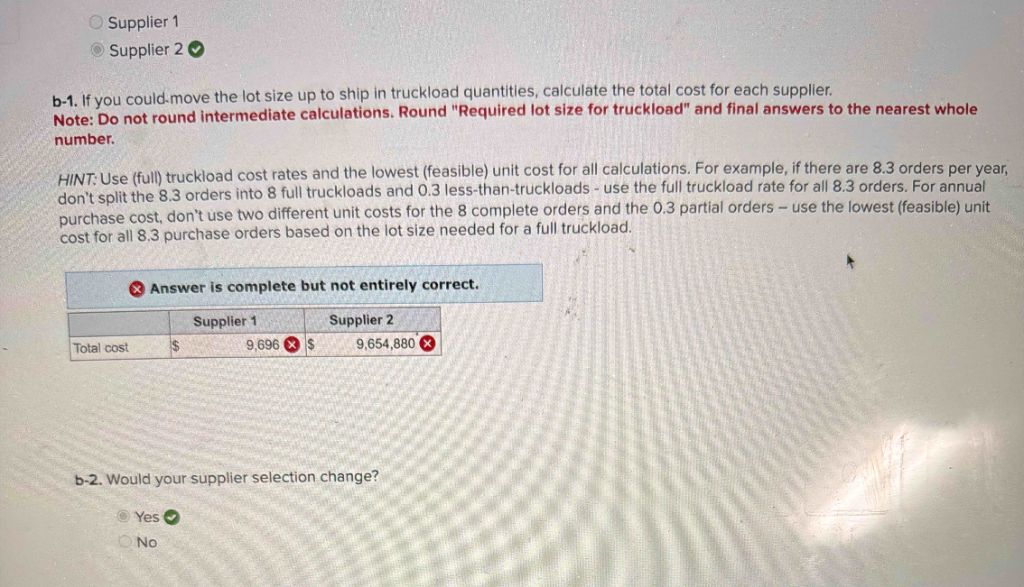
 eR a ER A ERE ER re el
Osupplier1 Ey Ce
Rips JB a
Fr uncle 20 Th
1. f you could-move the lot size up to ship In truckload quantities, calculate the total cost for each supplier, Ree
Note: Do not round Intermediate calculations. Round "Required lot size for truckload” and final answers to the nearest w
grata ® Rs
os HINT: Use (full) truckload cost rates and the lowest (feasible) unit cost for all calculations. For example, if there are 83 0rd ers per
| ont spit the 8:3 orders into 8 full truckloads and 0.3 less-than-truckloads - use the fll truckload rate for all 83 ders. For annu
i purchase cost, don't use two different unit costs for the 8 complete orders and the 0.3 partial orders ~ use the lowest | (feasible) unit
Sa cost for all 8:3 purchase orders based on the lot size needed for a full truckload. pe” g
fe & SR RR igehd o1 § fe
Er BE @ Answer is complete but not entirely correct. Ee
EE el
ani SE
: © b2.Would your supplier selection change? bo 2
< % ’ gt aa
= Yes @ Hh 3
1 “No NY i
RT Li
Sh < i | & WN ee a, al
ai 4 LLL cae
dx 1 fy Gra TR UR
9 Al El Na Th 12 2B 2 TR A ES CT OI
A =. CEE eR a THR LN PRA
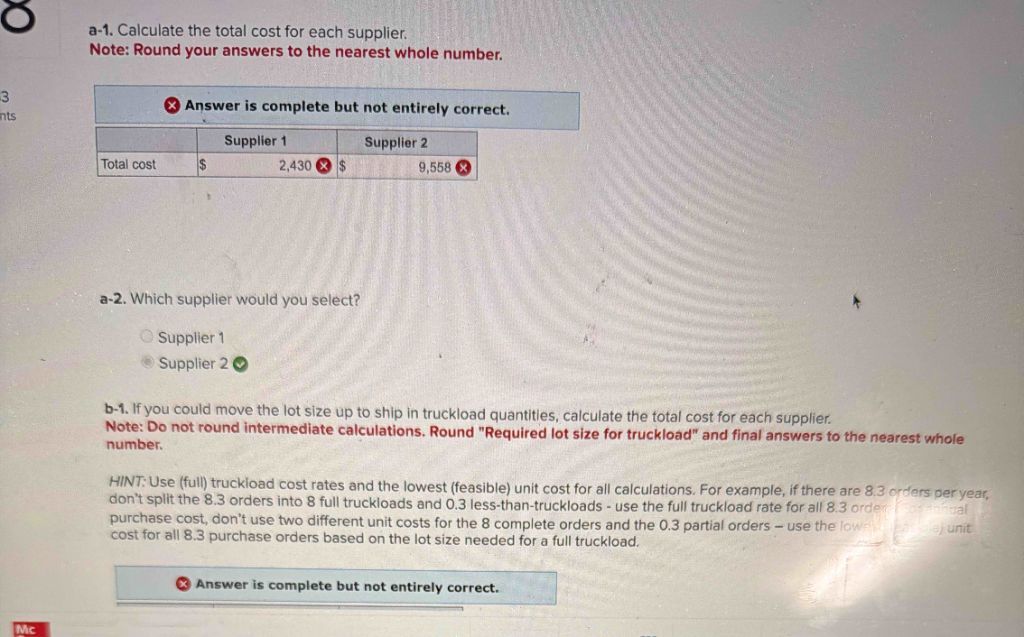
- 2-1. Calculate the total cost for each supplier. ~~ A HRA {RARE
Note: Round your answers to the nearest whole number. ~~ As, his
“i AAR EER
a LAL NR
J E © Answer is complete but not entirely correct. ‘ Phe: Na
Er oa ir tw tna RENO
CC seer [sen | NA
[eews 5 amos wwe ne
i N iy ba
Le He Mpc
ia Kyat
fsa i Who,
= iy Ny CR
5 2-2. Which supplier would you select? pow
a Supplier 1 eS
phos
2 ® Supplier 2@ ne |
gio fare
ph 1. Ifyou could move the lot size up to ship In truckload quantities, calculate the total cost for each supplier 25
pe Note: Do not round intermediate calculations. Round "Required lot size for truckload" and final re o the near 2
4 HINT: Use full) truckload cost rates and the lowest (feasible) unit cost for all calculations. For example, if there are 83 ~--ars per yes
Z ‘don't split the 8.3 orders into 8 full truckloads and 0.3 less-than-truckloads - use the full truckload rate for all 8.3 or ~ ENS
a ‘purchase cost, don't use two different unit costs for the 8 complete orders and the 0.3 partial orders — use the it
cost for all 8.3 purchase orders based on the lot size needed for a full truckload. ps
3 aid SE Sal,
E ‘@ Answer is complete but not entirely correct. | &
" ey A _—
eR a ER A ERE ER re el
Osupplier1 Ey Ce
Rips JB a
Fr uncle 20 Th
1. f you could-move the lot size up to ship In truckload quantities, calculate the total cost for each supplier, Ree
Note: Do not round Intermediate calculations. Round "Required lot size for truckload” and final answers to the nearest w
grata ® Rs
os HINT: Use (full) truckload cost rates and the lowest (feasible) unit cost for all calculations. For example, if there are 83 0rd ers per
| ont spit the 8:3 orders into 8 full truckloads and 0.3 less-than-truckloads - use the fll truckload rate for all 83 ders. For annu
i purchase cost, don't use two different unit costs for the 8 complete orders and the 0.3 partial orders ~ use the lowest | (feasible) unit
Sa cost for all 8:3 purchase orders based on the lot size needed for a full truckload. pe” g
fe & SR RR igehd o1 § fe
Er BE @ Answer is complete but not entirely correct. Ee
EE el
ani SE
: © b2.Would your supplier selection change? bo 2
< % ’ gt aa
= Yes @ Hh 3
1 “No NY i
RT Li
Sh < i | & WN ee a, al
ai 4 LLL cae
dx 1 fy Gra TR UR
9 Al El Na Th 12 2B 2 TR A ES CT OI
A =. CEE eR a THR LN PRA
- 2-1. Calculate the total cost for each supplier. ~~ A HRA {RARE
Note: Round your answers to the nearest whole number. ~~ As, his
“i AAR EER
a LAL NR
J E © Answer is complete but not entirely correct. ‘ Phe: Na
Er oa ir tw tna RENO
CC seer [sen | NA
[eews 5 amos wwe ne
i N iy ba
Le He Mpc
ia Kyat
fsa i Who,
= iy Ny CR
5 2-2. Which supplier would you select? pow
a Supplier 1 eS
phos
2 ® Supplier 2@ ne |
gio fare
ph 1. Ifyou could move the lot size up to ship In truckload quantities, calculate the total cost for each supplier 25
pe Note: Do not round intermediate calculations. Round "Required lot size for truckload" and final re o the near 2
4 HINT: Use full) truckload cost rates and the lowest (feasible) unit cost for all calculations. For example, if there are 83 ~--ars per yes
Z ‘don't split the 8.3 orders into 8 full truckloads and 0.3 less-than-truckloads - use the full truckload rate for all 8.3 or ~ ENS
a ‘purchase cost, don't use two different unit costs for the 8 complete orders and the 0.3 partial orders — use the it
cost for all 8.3 purchase orders based on the lot size needed for a full truckload. ps
3 aid SE Sal,
E ‘@ Answer is complete but not entirely correct. | &
" ey A _—
Asked by: praseetha
Created at: 2025-12-02 11:03:55
Final Answer:
Question:
give a1,a2 and b1,b2 question answer and calculation and a1 and b1 are wrong answer give correct answer and give final summary
Asked by: praseetha
Created at: 2025-12-02 11:07:32
Final Answer:
📢 Instructions:
- Ask anything relatd to above question only.
- For new Question goto :